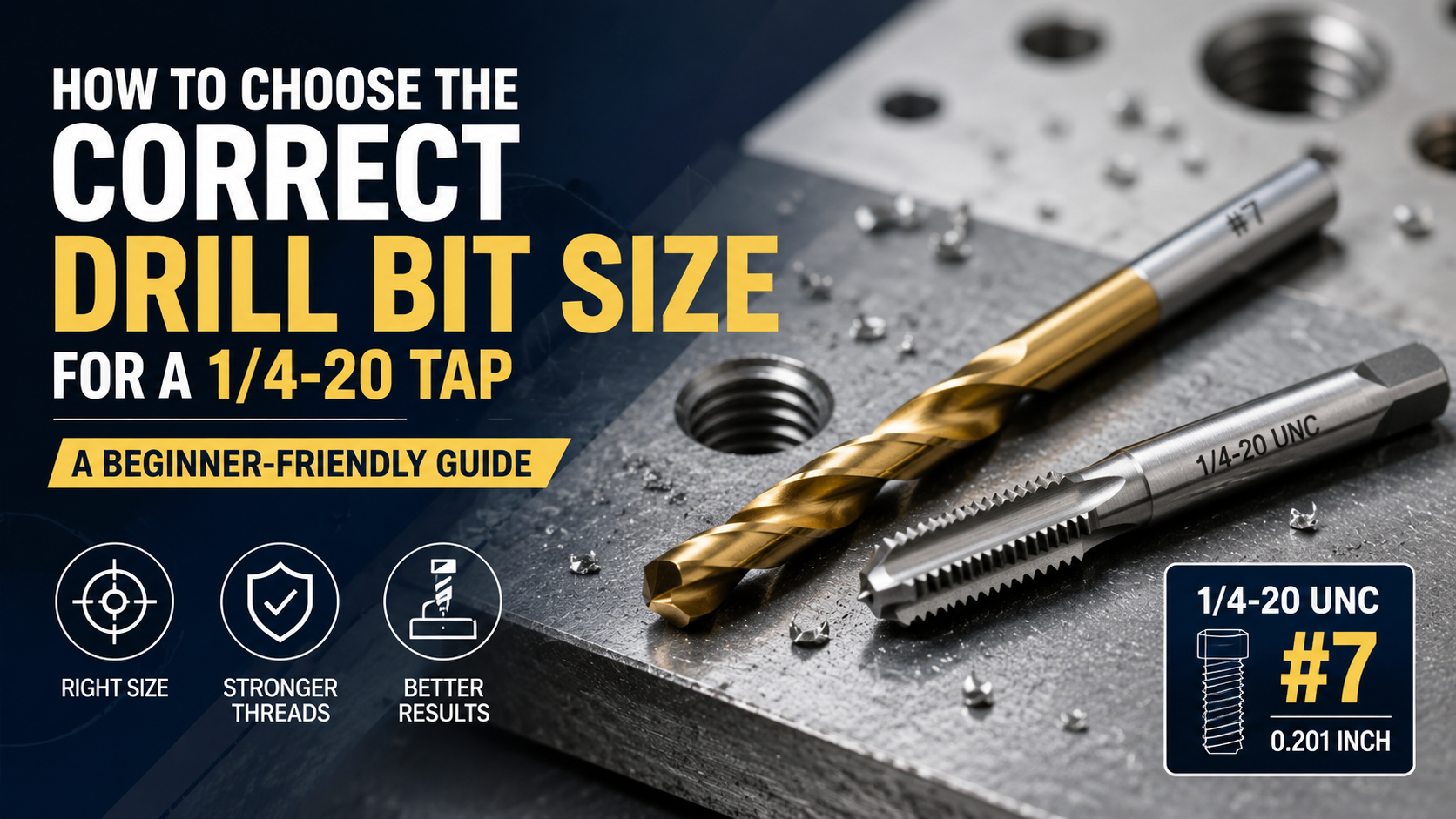
I. Introduction
Choosing a drill bit for a #10 screw is not as simple as choosing a standard diameter. The proper size varies with the screw type, hole function, workpiece material and needed holding power. A poor choice can break the material, strip the threads, increase the torque needed to install, or even loosen the joint. This article will take you through the practical inspections and reference sizes you need to make a solid choice.
II. Common Types of #10 Screws and Their Hole Requirements
Before you choose a drill bit, make sure you read the entire screw description, not just the #10 marking. varied #10 screws have varied thread shapes and installation procedures, so they don’t all require the same hole.
1. #10 Wood Screws
Wood screws commonly have deep threads, a sharp tip, and a tapered or partly threaded body. They are designed to cut into softwood, hardwood and wood based panels without the need for a tapped thread to be produced first. A pilot hole is often drilled to guide the screw, cut down resistance to driving, prevent splitting while leaving enough material for the threads to bite.
2. #10 Machine Screws
Machine screws are threaded uniformly along a straight body. They are generally inserted in a tapped hole, threaded insert or nut, making them ideal for metal parts and regulated mechanical assemblies. When the thread must be in the material itself, the drill size is to be the machine screw pitch; when the screw passes just through the part, a larger clearance hole is necessary.
3. #10 Self-Tapping Screws
Self tapping screws develop or cut their mating threads into metal or plastic when they are driven in. They eliminate the need for a separate tapping procedure, but most still need an appropriately sized pilot hole. The pilot must be sufficiently small so as to allow the screw to form a complete thread and sufficiently large so as not to cause excessive installation torque or screw breakage.
4. #10 Sheet-Metal Screws
Sheet-metal screws have coarse threads and a pointed tip that helps them bite into panels, enclosures, and other thin parts. They vary pilot-hole needs with point style, thread design, sheet thickness and material strength. A hole for thin aluminium should not be automatically utilised for the same screw in thicker mild steel.
5. #10 Self-Drilling Screws
Self-drilling screws have a drill point that drills into the work piece before the threads engage. If the screw’s drill capacity is suitable for the material type and total thickness, it will produce its own hole and will not need an additional pre-drilling step. If the material is tougher, then a different drill-point specification or fastening method is needed.
6. #10-24 and #10-32 Thread Standards
The two most prevalent machine screw standards are #10-24 UNC and #10-32 UNF. Both have a nominal main diameter of something like .190 inches or 4.83 mm. But #10-24 has 24 threads per inch and #10-32 has 32. Their exterior diameters are practically the same, but the various pitches mean that they need different tapping-hole sizes.
III. Determine What the Hole Must Do
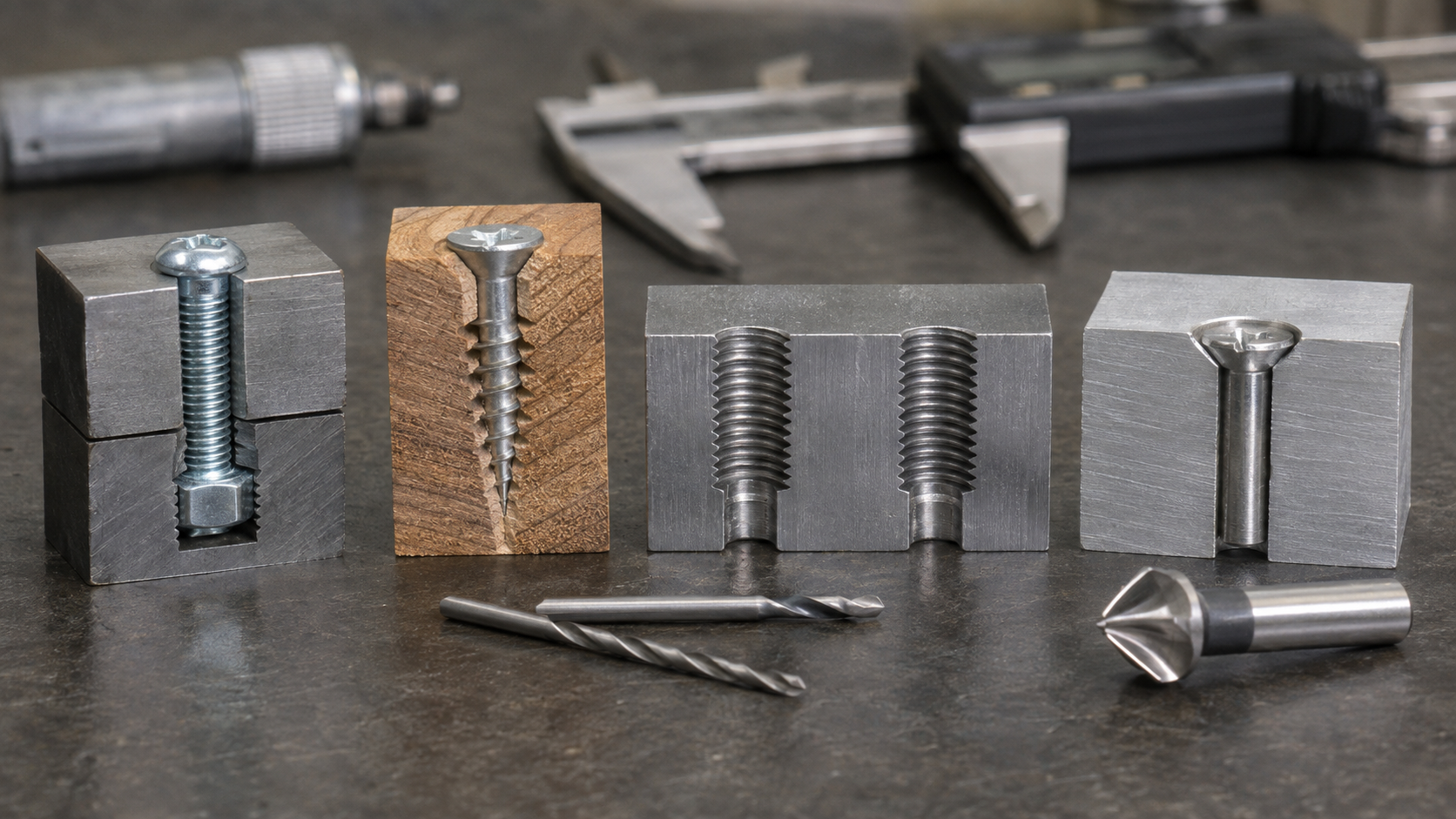
Then the diameter is selected. But the hole function has to be validated. Different installation needs use a clearance hole , pilot hole , tapping hole and countersunk hole .
1. Clearance Hole
The upper part has a clearance hole for a # 10 screw so that the threads only engage the lower part , insert , or nut . Most #10 screws will fit with near to normal clearance with a diameter of about 0.196 to 0.201 inches (4.98 to 5.11 mm). The smaller number allows for tighter positioning, the bigger value makes assembly easier when the holes has a tiny variance of the alignment.
2. Pilot Hole
A pilot hole is used to guide a wood screw, a sheet-metal screw, or a self-tapping screw and to save material for the threads to engage. A smaller pilot enhances the contact with the thread but increases the driving torque, while a larger pilot reduces the resistance but reduces the quantity of material supporting the thread. Softer materials will generally need the lower end of the recommended range, whereas tougher materials will require a somewhat bigger hole.
3. Tapping Hole
First a hole is drilled and then cut with a tap to make an internal machine thread . For the standard #10 thread, a #10-24 tapping hole generally uses a #25 drill (0.1495 inches), while a #10-32 tapping hole normally uses a #21 drill (0.1590 inches). The whole thread identification allows to select the drill and thus not confuse the two pitches.
4. Countersunk Hole
A countersunk hole is utilised when a flat head screw needs to be flush or below the surface of the work piece. First choose the main pilot, clearance or tapping hole, then fit the upper recess to the screw-head diameter and included angle. Pan head, round head, hex head and washer head screws employ different conical recesses.
IV. Choose a Drill Bit That Can Produce the Required Hole
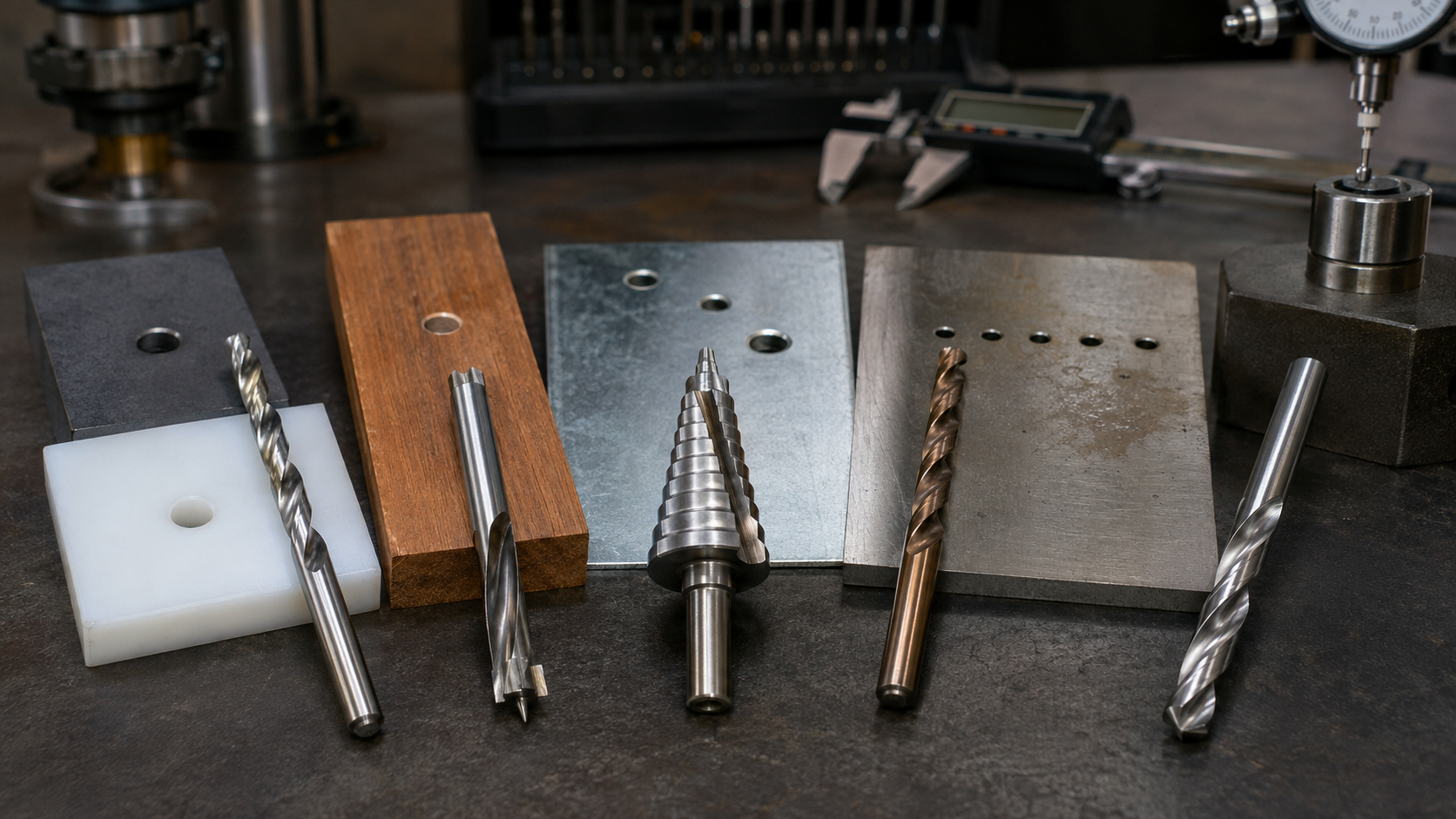
Once you determine the size of the hole, pick a drill style that suits the workpiece. The drill type should assist in maintaining the desired diameter and position of the hole, but should not be utilised to substitute the proper nominal size with a different value.
1. Standard Twist Drills
For metal, plastic and most workshop use the standard twist drill is the conventional choice. They come in fractional and numerical and metric sizes, including the #25 and #21 drills used for #10 machine screw tapping holes. Wear or side movement might increase the completed hole, therefore a sharp drill, limited runout, and tight workholding are essential.
2. Brad-Point Drills
The brad-point drill is handy for wood since the point in the middle finds the hole and the exterior cutting edges make a neater entry. They decrease wandering on visible surfaces and assist maintain pilot hole consistency in furniture, cabinets and other woodworking operations. Select the bit by the needed pilot diameter and not the woodworking design.
3. Step Drills
The brad-point drill is handy for wood since the point in the middle finds the hole and the exterior cutting edges make a neater entry. They decrease wandering on visible surfaces and assist maintain pilot hole consistency in furniture, cabinets and other woodworking operations. Select the bit by the needed pilot diameter and not the woodworking design.
4. Cobalt Drills
Cobalt drills are good in stainless steel, high-strength alloys and where regular HSS drills lose their edge too rapidly. The improved heat resistance helps to ensure cutting performance and hole consistency, especially when drilling metal repeatedly. You can use the same theoretical hole size and then measure and test fit in the actual material.
5. Precision Jobber Drills
Cheap general purpose drills will not be as consistent from diameter to diameter or be as concentric as a precision jobber drill. They are useful for tapping holes and for repetitive assembly where minor changes in the finished diameter effect torque or thread engagement. The drill still has to be held and replaced properly before wear starts to alter the hole.
V. Choose the Drill Bit Size for the Workpiece Material
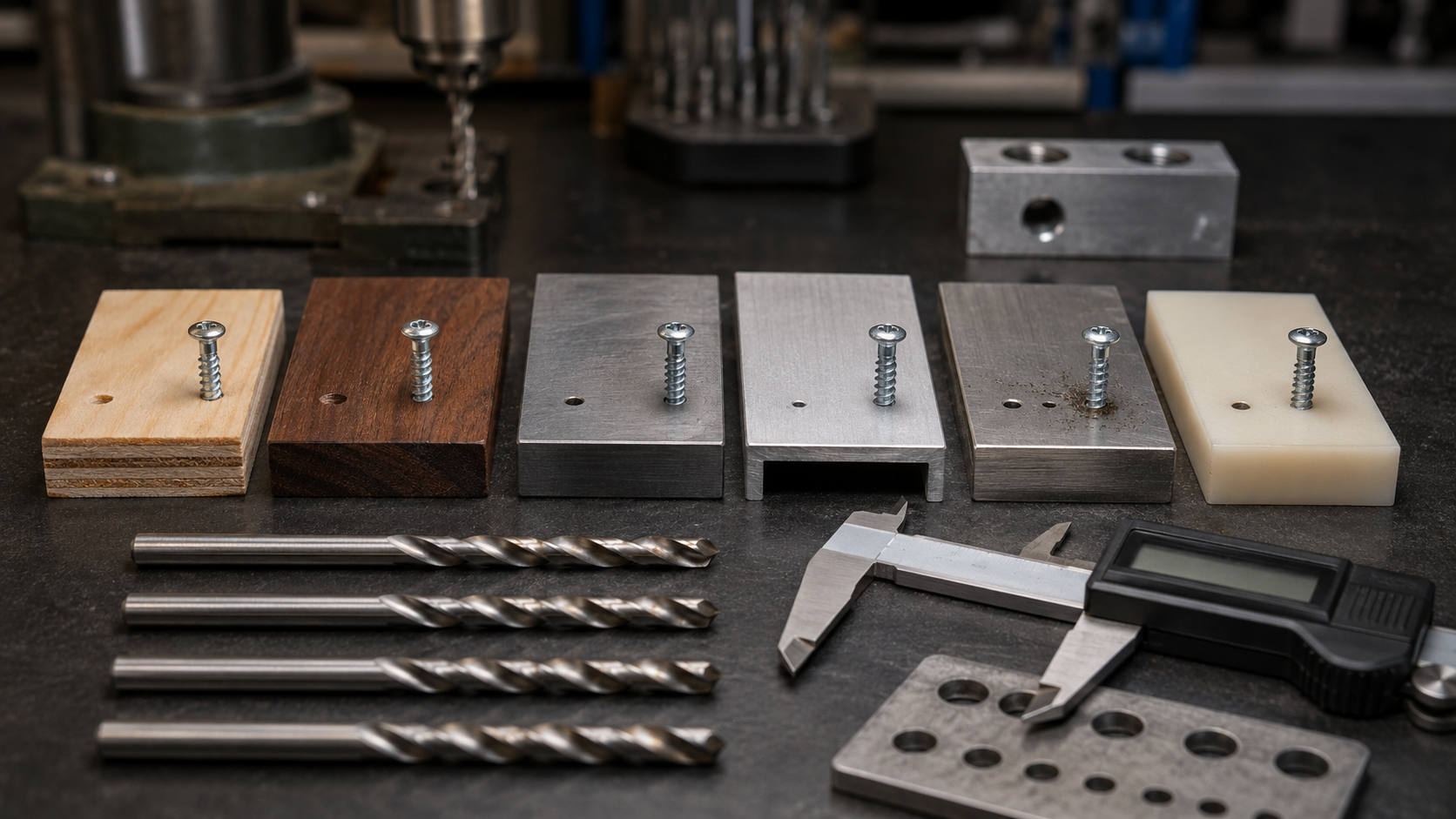
The material behaviour directly leads to the ultimate choice. The values below are useful starting points for typical #10 screw applications and should be verified on the actual screw and material before batch manufacturing.
| Workpiece material | Recommended starting size | Metric equivalent | Practical use |
| Softwood and plywood | 3/32 in | Approximately 2.4 mm | Pilot hole for strong thread grip with lower splitting risk |
| Hardwood | 1/8 in | Approximately 3.2 mm | Pilot hole with lower driving resistance |
| Mild steel and common aluminum alloys | 1/8 in | Approximately 3.2 mm | Starting reference for suitable self-tapping screws |
| Soft aluminum and thin sheet metal | 7/64 in | Approximately 2.8 mm | Preserves thread engagement in thin or soft material |
| Stainless steel and higher-strength alloys | 1/8 to 9/64 in | Approximately 3.2 to 3.6 mm | Reduces installation torque in harder material |
| Plastics and composites | Approximately 7/64 in | Approximately 2.8 to 3.0 mm | Limits cracking and material deformation |
1. Softwood and Plywood
A pilot hole of 3/32 inch or 2.4 mm is a good starting point for many #10 screws in softwood and plywood. These materials are more easily compressed, thus the smaller opening leaves sufficient material for the threads to cut and retain. If the screw is too hard to screw in , the wood splits , or the screw has a clearly thick core , increase the pilot to the next appropriate size and try again .
2. Hardwood
Hardwood offers more resistance around the screw core, so a pilot near 1/8 inch, or 3.2 mm, is a good place to start. If the material is dense, the length of the engagement is long, the installation is end grain, or the screw is close to an edge, you may need a slightly larger hole to prevent splitting or screw damage. The chosen size should allow for complete seating without losing the wood needed for the threads.
3. Mild Steel and Common Aluminum Alloys
As a starting point, a suitable #10 self-tapping screw of around 1/8 inch can be utilised for mild steel and the usual aluminium alloys. The design of the self-tapping point and the threads are different, therefore the final value must be according to the screw specification and the thickness of the sheet. The hole you should accept should allow the screw to produce a complete thread without stalling, breaking or spinning out after seated.
4. Soft Aluminum and Thin Sheet Metal
A pilot near 7/64 inch, or 2.8 mm, can hold more thread contact in soft aluminium and thin sheet. If the hole is too big, there is not enough material for the screw to grasp, and if the hole is too small, the installation torque can increase dramatically. Test the real sheet. Increase the size only when the screw can not make the thread smoothly.
5. Stainless Steel and Higher-Strength Alloys
Harder materials resist thread formation and may increase heat and installation torque. You can take a beginning range of say 1/8 to 9/64 inch or 3.2 to 3.6 mm for a good #10 self tapping design. If the smaller hole is creating considerable resistance, utilise the bigger end of the allowed range and stable workholding with a sharp cobalt drill.
6. Plastics and Composites
Pilot holes of 2.8 to 3.0 mm are good initial guides for many #10 screws for plastics and composites. Soft polymers can take a smaller pilot . Brittle materials often require a bit bigger hole and a controlled speed of drilling to prevent breakage . The last test should make sure that the screw fits tightly without fracturing the boss, deforming the panel or removing the produced thread.
7. Tapped and Clearance Holes
Pilot sizes depending on material are not a substitute for normal machine thread and clearance hole sizes. For a # 10-24 tapping hole use # 25, for a # 10-32 tapping hole use # 21, and for close to typical clearance use 0.196 to 0.201 inches. Material qualities may justify a slight allowance, but the full thread and fit criteria are the starting point.
VI. Balance Thread Engagement and Holding Strength
The size of the drill determines how much material contacts the screw thread. The hole too large decreases the holding strength, the hole too tiny increases the installation or tapping torque. The aim is to get sufficient engagement in the joint without stressing the screw, tap or workpiece too much.
1. Practical Engagement Targets
For common tapped metal holes, about 65% to 75% threads engagement is a practical compromise between strength and tapping effort. About 60% might be enough for a lightly loaded assembly. 70% to 75% is a common design figure for many conventional mechanical joints. Higher engagement can be specified for structural or vibration-loaded joints, however raising engagement to 80% will also increase tapping torque and should be validated for the material and tap.
2. Adjusting the Hole for Holding Strength
For soft materials if additional contact with the thread is needed and the installation torque is allowed you can use a slightly smaller permitted hole. Use a slightly bigger permitted hole if the hard material provides too much resistance or threatens the screw or tap. Such changes should be minor and should be verified by holding performance rather than by the ease of the screw during installation alone.
VII. Verify the Selection by Test Fitting
Take a piece of the same material, thickness and finished state as the final product and drill a trial hole. Install the exact #10 screw. It should go in easily . It should cut or use full threads . It should get to its seated position and stay there without stripping . If the installation is too tight, enlarge the hole by 0.02 to 0.05 mm, if too loose, decrease the hole by a comparable amount and try again. If the fit and holding result are satisfactory, record the permitted drill size.
VIII. Common Size Selection Errors and Their Consequences
1. Undersized Holes
A small hole increases the driving effort to drive the screw and this can lead to excess torque, damaged drive recesses, cracking of the material, screw breakage or tap failure. If the actual hole is under size, increase the hole in a controlled increment of around 0.02 to 0.05 mm and repeat the test instead of increasing the power-tool torque.
2. Oversized Holes
An oversized hole decreases thread contact and may result in a loose connection, poor pull-out resistance, or a screw that spins before fastening the parts. A damaged hole may require an acceptable thread insert, a larger fastener, or replacement of the damaged component. Increasing the installation torque cannot replace the material removed by an oversized drill.
3. Oval or Misaligned Holes
Even if the advertised drill size is correct, worn cutting edges, excessive drill runout, bad fixturing and tilted entrance can make an oval or mis-aligned hole. This reduces constant contact with the threads and may cause the screw to be at an angle. . Replace the nominal diameter . Replace the worn drill . Restrict the movements of the tools . Secure the workpiece .
4. Ignoring Surface Treatment
Galvanising, plating, paint, powder coat can decrease the useable diameter of a hole or add material within a thread . A fit that will go on before finishing can be excessively tight after finishing. When the hole is affected by the coating process, check the finished assembly after surface treatment and add a controlled allowance.
IX. Final Recommendation
Begin with the full #10 screw type, thread standard, and the needed hole function. For common references, use #25 for #10-24 tapping and #21 for #10-32 tapping, 0.196 to 0.201 inches for clearance, and pilot sizes from about 3/32 to 9/64 inch, as appropriate to the material. Choose a drill that is appropriate for the workpiece. Test in the real material. Only if the installation torque and the holding performance are satisfactory, approve the size.
X. FAQs About Drill Bit Sizes for #10 Screws
1. Why Does a #10 Screw Feel Tight with the Recommended Drill Size?
Drill wear, burrs, debris, spindle runout or coating build-up might cause effective hole size to be smaller or less consistent than planned. Measure the finished hole and clean it. Then enlarge the diameter of the finished hole by 0.02 to 0.05 mm.
2. Why Can a Tapped Hole Fail after Surface Treatment?
Galvanising, plating and powder coating might build up in the hole and restrict the amount of useful thread clearance. When finished, check fit and apply controlled allowance, masking or an approved thread cleaning method if applicable.
3. How Does Drill Wear Affect a #10 Screw Hole?
A worn drill might result in heat, burrs, taper, ovality or uneven finishing diameter. Check the hole and replace the drill if dimensional changes will compromise installation torque or thread engagement.
4. Why Does a #10 Screw Repeatedly Strip in a Metal Part?
Common causes are too large of a pilot hole, not enough thickness of material, too much torque on the installation, or the screw thread is not appropriate. Always check the exact hole diameter, sheet thickness and available engagement before placing another screw.
5. Is a #10 Screw Exactly 3/16 Inch in Diameter?
Nope. A # 10 screw is roughly 0.190 ” nominal main diameter, while 3/16 inch is 0.1875 inches . When picking a clearance or tapping hole, the difference is minor yet crucial.
6. What Drill Bit Is Commonly Used for a #10-24 Tapping Hole?
A #25 drill measuring 0.1495 inches (about 3.80 mm) is a common beginning size. Make sure you have a #10-24 not a #10-32 before drilling.
7. What Drill Bit Is Commonly Used for a #10-32 Tapping Hole?
A good starting point is a # 21 drill , which is 0.1590 inches ( 4.04 mm ) . The #10-32 has a finer thread pitch and a bigger hole .
8. What Clearance-Hole Size Should Be Used for a #10 Screw?
Close clearance is around 0.196 inches, with more general assembly clearance of about 0.201 inches. Then select one of them according to the required tolerance of placement and alignment.
9. What Pilot Hole Should Be Used for a #10 Screw in Softwood?
For many #10 wood screws in softwood, a good starting point is about 3/32 inch, or 2.4 mm. If the screw needs too much torque, or the wood starts splitting, make the hole a bit bigger.
10. What Pilot Hole Should Be Used for a #10 Screw in Hardwood?
A good beginning point in hardwood is around 1/8 inch, or 3.2 mm. For dense material, end grain and edge installation, a slightly bigger authorised hole may be needed.
11. Can the Same Pilot Hole Be Used in Mild Steel and Stainless Steel?
Not always. Stainless steel generally has more resistance to drilling and installation and hence may require a somewhat larger authorised hole than mild steel for the same self-tapping screw.
12. Does a #10 Self-Drilling Screw Need a Pilot Hole?
If the drill point is rated for the material type and gross thickness then a separate pilot is not usually required. Use an appropriate drill point specification or a separate permitted operation if the workpiece capacity is exceeded.
13. How Should the Hole Size Be Adjusted for Brittle Plastic?
Use the bigger end of the suggested pilot range and reduce the drilling speed to limit surface damage and cracking. Test the actual plastic, as different grades can react extremely differently to the same screw.
14. Does Screw Length Change the Pilot-Hole Diameter?
The length of the screw will mostly affect the depth of the hole you need, not the diameter. A longer engagement will increase resistance, therefore the pilot should go through the entire length of the screw into the receiving material.
15. How Can a #10 Screw Hole Be Checked before Production?
Drill and tap the same screw in a sample of the same material, thickness and finish as the final product. Approve the size only if the screw seats smoothly, retains securely and does not break, peel, or deform the workpiece.