I. Introduction
A drill that operates in ordinary steel may skate, overheat, or turn dull as soon as it encounters hardened steel. Choosing the correct bit depends on more than whether it contains cobalt or carbide. You need to match its material, coating, geometry, and construction to the real HRC, machine stability, hole circumstances, and production amount. This article lets you make that option without overpaying for underused tool capacity.
II. Why Does Hardened Steel Require a Different Drill Bit?
Hardened steel can be anything from pre-hardened material (30–40 HRC) to completely hardened tool, bearing or die steel (55–65 HRC). The great resistance to wear causes normal cutting edges grow dull very rapidly. The heat and cutting load might make an inappropriate carbide drill chip. Case-hardened parts are a different problem because the drill must punch through a hard outer skin before reaching the softer core, whereas the through-hardened steel continues to wear the cutting edges all the way down the hole. This is why the present HRC and heat-treatment state should be checked before drill selection.
III. Which Type of Drill Bit Is Suitable for Hardened Steel?
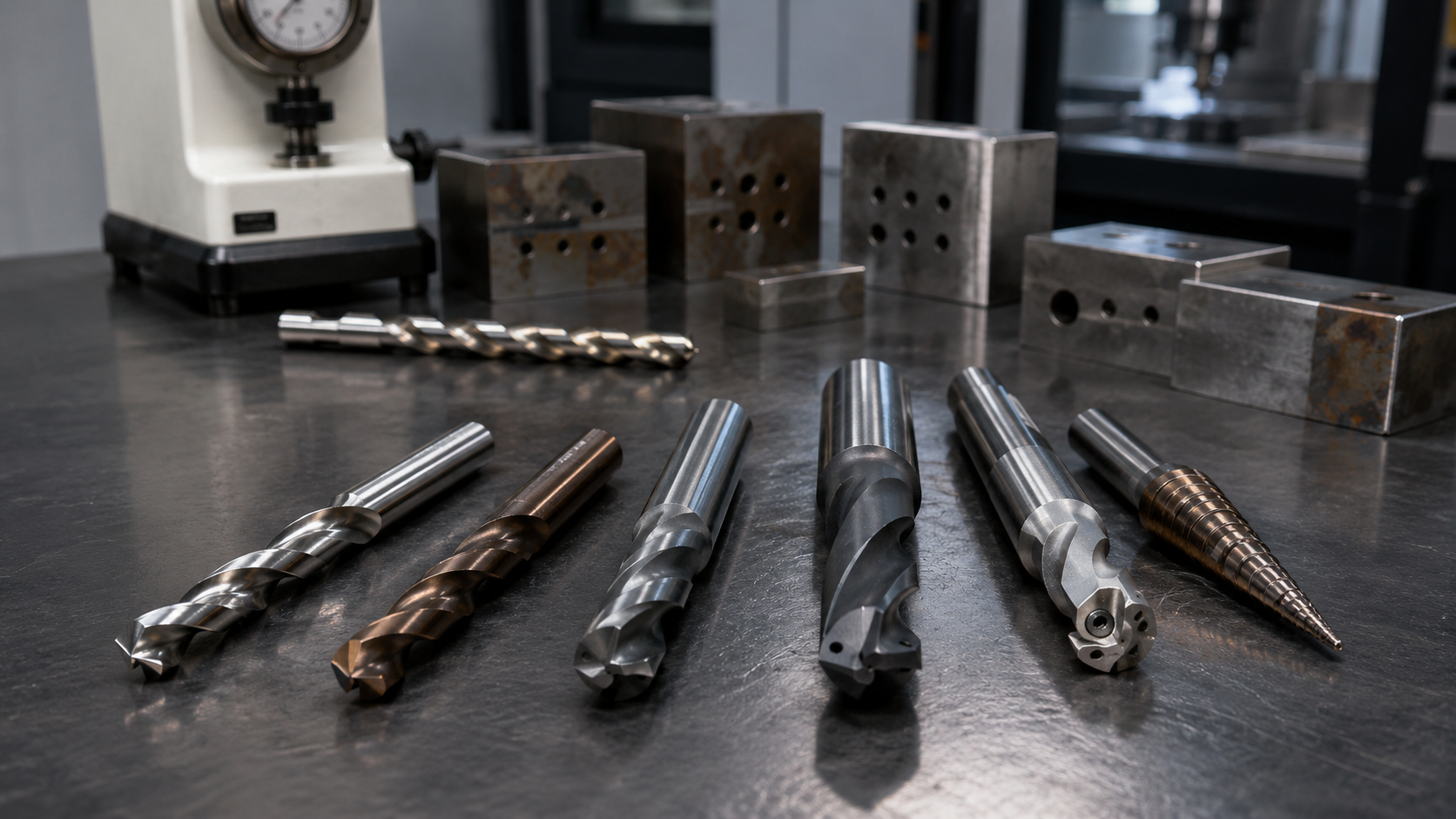
1. M35 Cobalt Drill Bits
M35 usually has about 5% cobalt, which gives it superior hot hardness and wear resistance than standard HSS. It is good for occasional holes in moderately hardened steel, usually from about 30 HRC up to the mid 30 HRC range. Because it is HSS based, it is better than solid carbide at dealing with little misalignment and vibration, hence it is helpful on regular drill presses and in repair work. M35, however, can soon lose its cutting edge when hardness nears the high end of the hardened steel spectrum.
2. M42 Cobalt Drill Bits
M42 contains around 8% cobalt, and holds its cutting hardness at higher temperatures than M35. Depending on the design of the drill, the depth of the hole, the coating and the condition of the machine, selected M42 drills can be used as a first choice for low-to-medium volumes in steel about 35-50 HRC. M42 is a good choice when you need higher wear resistance than M35 but can’t deliver the low runout and strong clamping necessary for solid carbide. The “M42” designation alone does not ensure 50 HRC capability, thus the actual drill series must still specify that it covers this range.
3. Solid-Carbide Drill Bits
For repetitive drilling in hardened steel of approx. 40 – 55 HRC, solid carbide is generally recommended. Its exceptional wear resistance means that the cutting edge, hole diameter and hole position are maintained for a longer manufacturing run. It works best on solid drill presses and CNC machines with accurate holders, short tool extension and secure workholding. Its downside is brittleness. If the drill hits an inclined surface, runs off centre or vibrates it may chip before its wear resistance offers any production benefit.
4. Hard-Machining Carbide Drill Bits
If you are looking at a steel hardness range of about 55 to 65 HRC you should use a carbide drill that is built for hard machining, not a general purpose solid-carbide drill. These drills are made out of a proper grade of carbide with reinforced cutting blades, controlled honing, a heavy drill core, a point usually around 140°–145° and a high temperature coating. The series chosen must indicate the range of HRC and the depth of drilling it is meant for. A drill intended for 3D holes cannot be used automatically for drilling 8D.
5. Carbide-Tipped Drill Bits
Drills with carbide tips have carbide cutting blades on a steel body, and can be less expensive to acquire than solid carbide, especially with bigger diameters. The steel body may give additional toughness but the real performance depends on the support of the carbide tip and whether the grade of the tip is suitable for the hardness of the steel. These drills are worth considering for infrequent or medium-volume larger holes, but should not be mistaken with masonry drills, the carbide tips of which are shaped to crush concrete instead of to cut steel.
6. Replaceable-Head Drill Bits
Replaceable-head drills enable the cutting head to be changed while the drill body continues in service. They can reduce carbide consumption, shorten tool-change time and provide a cheaper cost per hole in repetitive medium and large diameter drilling. Suitability depends on the availability of a hard material head for the requisite HRC, hole depth and coolant condition. One cannot assume that an ordinary alloy-steel head will function in fully hardened steel.
7. Step Drill Bits
A step drill can also be used to expand existing holes or to create numerous diameters in thin hardened sheet if the cutting material and coating are rated for the actual hardness. It helps where a regular twist drill would snag the thin sheet on the way out. However, a step drill is not ideal for deep holes or for thick solid hardened components and a general purpose HSS step drill should not be represented as being suitable for fully hardened steel.
8. Ordinary HSS Drill Bits
Standard HSS is fine for mild steel, routine workshop drilling, but is generally the least reliable choice for hardened steel. It may start by scoring the surface and then start to polish when the cutting edges get dull. Applying extra pressure to a dull HSS drill will just increase friction and heat and not enhance the wear resistance of the drill.
IV. Which Coating Is Best for Hardened-Steel Drill Bits?
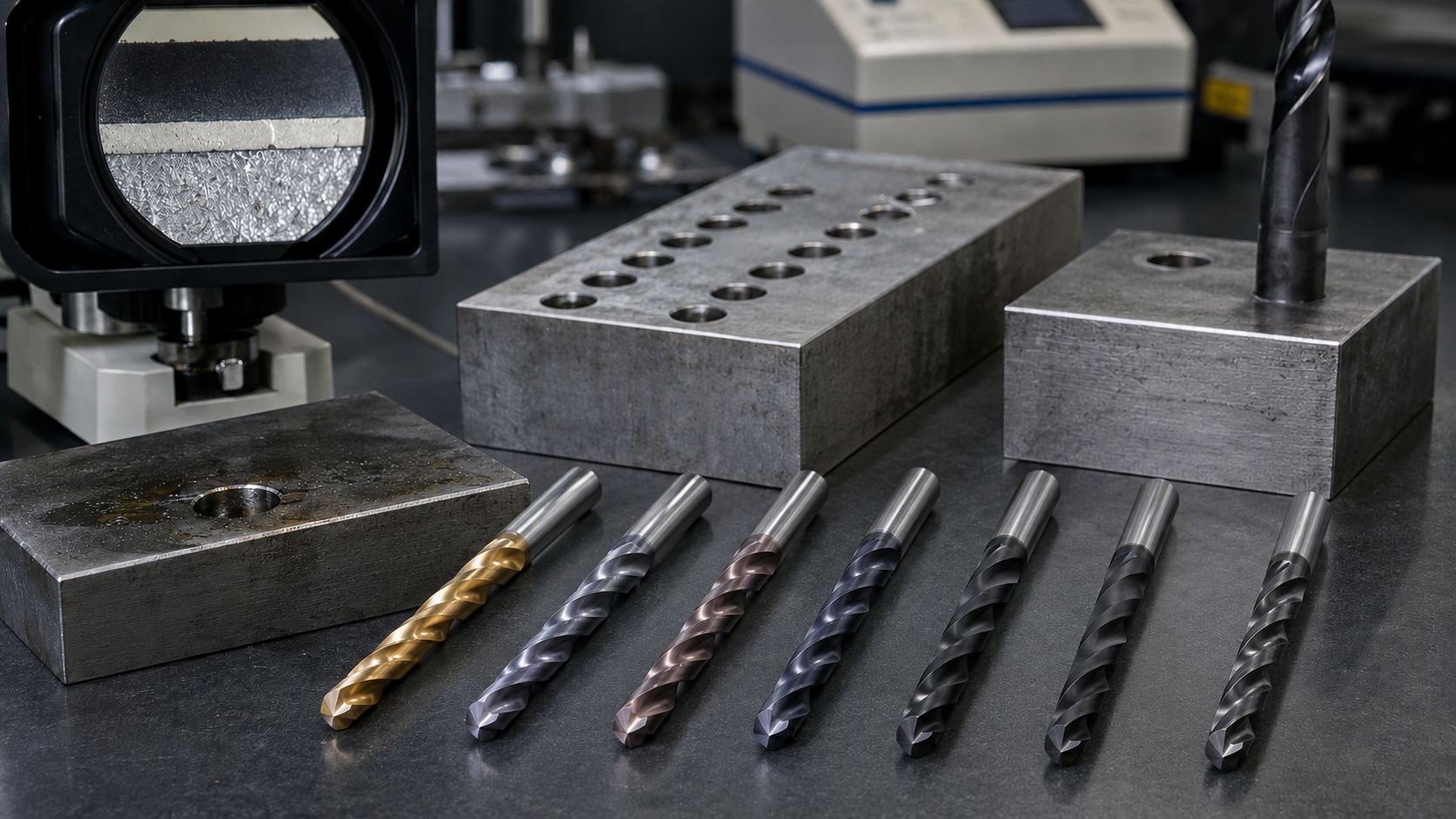
1. TiN Coating
TiN is a general-purpose coating, usually identified by its gold colour. It gives lower friction and better wear resistance than an uncoated HSS drill. It is suitable for mild cutting conditions and lower hardness steels. It is cheap and common, but offers limited performance at high temperatures compared to TiAlN or AlTiN. TiN may hold an M35 or M42 drill in moderately hardened steel, but is not generally the first choice for carbide drilling at 50-65 HRC.
2. TiCN Coating
TiCN provides greater hardness and resistance to abrasive wear than TiN and can be effective on cobalt or carbide drills cutting medium-hard steels. It is appropriate if the primary problem is flank wear and the cutting temperatures are within the operating range of the coating. TiCN, however, is not as heat resistant as the other aluminum-containing coatings, and therefore is less suitable for the hardest HRC materials or drilling settings that generate continuously high cutting temperatures.
3. TiAlN Coating
TiAlN is a tougher choice for carbide drilling in hardened steel, because it has superior high temperature and oxidation resistance than TiN and TiCN. Aluminium presence assists in forming a protective oxide layer on the cutting surface as the cutting temperature increases. Drills with a TiAlN coating are usually used for steel hardness 40 to 55 HRC and for production environments where a general-purpose coating wears out too fast. It is still dependent on the carbide substrate and edge preparation for performance, therefore the coating should not be assessed apart from the full drill.
4. AlTiN Coating
AlTiN normally has a higher amount of aluminium than TiAlN and is commonly used for high temperature machining of toughened materials. It is very resistant to oxidation and abrasive wear and is therefore often used for hard-machining carbide drills over about 50 HRC. AlTiN works especially well when the drill is used with little or no coolant and when the heat is concentrated at the cutting blades. For steel at 60–65 HRC and above, AlTiN coating should be a part of a specialist hard-machining drill not a coating on a standard carbide geometry.
5. Black Oxide
Black oxide is used largely on HSS and cobalt HSS drills to enhance oil retention, corrosion resistance and lubricity. It can support low-speed drilling with cutting oil, but it lacks the high-temperature wear protection of TiAlN or AlTiN. A black-oxide M35 or M42 drill may be practical for occasional work in moderately hardened steel, but black oxide should not be the primary reason to select a drill for high-HRC material.
6. DLC Coating
DLC provides a low friction surface and is effective in many applications with aluminium, copper, graphite, composites and other non-ferrous materials. It is not a typical first choice for hardened ferrous steel due to its performance limitations at high cutting temperatures and its interaction with iron. TiAlN and AlTiN are more significant coating families for the drilling of toughened steel.
7. Coating Selection by Hardness
Depending on the quantity and cooling conditions, a good quality cobalt drill uncoated or TiN, TiCN, black oxide for steel around 30-40 HRC may be suitable. In the range of 40–55 HRC, carbide drills with TiAlN- or AlTiN-coatings typically offer a better combination of heat and wear resistance. From approx. 55-65 HRC utilise the coating stated as part of a dedicated hard-machining carbide drill. These are useful starting points for practical use, but are not a guaranty that every drill with the same coating will achieve the same outcome.
V. What Other Drill Features Matter?
Often point angles of roughly 135°–145° and split-point designs are utilised to optimise entrance and prevent inclination to walk, while regulated edge honing or a slight corner chamfer protects the cutting lips from microchipping. The flutes still need to have room to clear the chips, but a thicker core makes the drill stronger. Select the appropriate 3×D, 5×D or deeper model instead of utilising excessive flute length and use the smallest drill that will reach the desired depth. As the hole depth grows, the internal coolant becomes increasingly critical to cool the cutting edges and force the chips back up the flutes. One point angle or flute type should not be regarded as suitable for all hardened-steel applications. These features should be verified jointly.
VI. How to Choose the Best Drill Bit for Your Application
1. Choose by HRC
M35 is a cost-effective entry point for occasional work on steel in the 30-35 HRC range. If you are around 35–50HRC, then look at M42 for lesser volumes or solid carbide if you have a solid setup. At 50–55 HRC, solid carbide is usually the more reliable choice. Use a carbide drill for hard machining, with a hardness of 55–65 HRC.
2. Choose by Machine Stability
Cobalt HSS is more forgiving of bending, and hence generally safer on handled tools, standard drill presses, and machines with slight unavoidable vibration. Solid Carbide is more suited for CNC machines and steady drill presses where low runout, short overhang and controlled feed may be utilised to the greatest use of its wear resistance. If the setup is not rigid, choosing a harder, more expensive drill will probably increase the chance of unexpected edge chipping rather than prolong tool life.
3. Choose by Production Quantity
For some holes, repair work or changeover projects, M35 or M42 is often more convenient, because the tool cost is initially lower and the drill can be resharpened. If you are drilling the same hole over and over, and you can use the entire life of the cutting edge, then solid carbide is cheaper. Replaceable-head drills can reduce cost even more in repeated larger diameter production since just the cutting head is replaced.
4. Choose by Hole Diameter and Depth
For tiny and medium holes, you can choose between cobalt or solid carbide twist drills, depending on hardness and machine stability. For greater diameters you may need carbide tipped or interchangeable head drills. For deep holes you will need a drill of the correct length, flute capacity and preferably internal coolant. A longer general purpose drill increases the risk of chips clogging and the tool deflecting.
5. Choose by Entry Condition
A flat, continuous surface is the most balanced entry. Uneven loading of the cutting edges and a greater risk of chipping of the carbide corners result from curved, sloping, case-hardened or interrupted surfaces. For these conditions select a drill with stronger cutting edges and look for advise of a spot drilling or pilot operation. If the setup can’t take the hit, cobalt drill is safer than conventional solid carbide.
6. Compare Cost per Hole
The lowest price of purchase does not always mean the lowest price of drilling. Compare the number of permissible holes, the cost of regrinding, the time for tool change, the machining time and the risk of trashing the component. With a rigid set-up, a carbide drill may drill many times the holes possible with a cobalt drill. In an unstable set-up, the same carbide drill may chip before normal wear and show no cost advantage.
VII. Top Drill Bit Choices for Hardened Steel
1. Best All-Round Choice
An M42 cobalt drill with an AlTiN or TiAlN coating and a 135° split point is a practical compromise of toughness, heat resistance and machine compatibility. Suitable for mixed, low to medium volume operations in moderately hardened steel, limited to the rated HRC of the selected series.
2. Best Budget Choice
Cheap option for occasional shallow holes in steel at 30-35 HRC is the M35 cobalt drill. It is cheaper than M42 or carbide and can be re-sharpened but is not intended for drilling fully hardened steel repeatedly.
3. Best Solid-Carbide Choice
For steels over around 55 HRC for example, an AlTiN coated carbide drill for severe machining is the perfect choice. Do not use a standard general-purpose carbide drill bit. Use a short length reinforced drill for the appropriate hardness and depth of hole.
4. Best Cobalt Drill Set
The M42 cobalt with 135 degree split points provide sufficient size coverage for maintenance work, Standard drill presses and when hole needs adjustment. It is a good choice if you want higher edge retention than M35, but more vibration tolerance than solid carbide.
5. Best Choice for Industrial Production
For constant, repeating output, drills with solid carbide or replaceable heads are more inexpensive per hole. For small and medium sizes and where hole quality is crucial, solid carbide is preferred; the replaceable head becomes more cheap for large holes that are drilled frequently.
6. Best Choice for CNC Machines
A through-coolant solid-carbide drill is the preferred CNC solution for the desired hole depth range of 3×D, 5×D or deeper. It provides uniform hole quality and chip removal when the holder, workpiece and cutting cycle are fixed.
VIII. What Happens If You Choose the Wrong Drill Bit?
1. The Drill Skates on the Surface
In case of a polished round mark or if the drill goes away from the intended place, the surface hardness may not correspond to the drill tip geometry, cutting-edge condition or wear resistance. A split point can aid with centre punching, but it cannot change a dull drill or an under-specified drill into a fully hardened steel.
2. The Drill Produces Powder Instead of Chips
Fine powder suggests cutting blades are rubbing or grinding rather than properly chipping. This is often the case when the drill is dull, the feed rate is too slow or the drill material cannot keep an edge at the actual HRC.
3. Penetration Becomes Progressively Slower
Drills that begin to cut but then need more pressure are usually losing their edge sharpness or are not eliminating heat and chips from the hole. If the pressure is too high, the entrance to the hole can be damaged and the drill can suddenly break.
4. One Carbide Corner Chips
If you see damage at a single outside corner, it is frequently caused by runout, a crooked entrance, uneven pilot, too much drill extension or improper clamping of the workpiece. If your set-up is uneven then a harder grade of carbide will not help.
5. Both Cutting Edges Wear Rapidly
They are both worn in the same way. This shows that the drill is not wear resistant enough for the HRC, the coating is not suitable for the temperature or the cutting speed is too high. This is different from single-corner chipping where the load is more probable to be balanced but the drill specification or cutting condition is not suitable.
6. Chips Block the Flutes
This is when the hole gets deeper than the drill’s flute or coolant system can handle, resulting in chip blockage. The drill force grows, the wall of the hole is scraped, the drill can jam or fracture under stress.
7. The Hole Becomes Oversized or Misaligned
Drill deflection, unequal cutting lips, excessive runout, improper spotting, or broken cutting edges can cause holes to be oversized or slanted. Replacing the drill with another of the same diameter will not fix the problem, if the reason is not rectified.
8. The Drill Breaks before Normal Wear Develops
The most frequent cause for a drill breaking before any cutting edge wears out is bending, chip blockage, unstable entry or unsuitable clamping. Maybe it’s not the drill material if the same issue continues recurring.
IX. Final Recommendation
Use M35 for intermittent holes in medium hard steels, and M42 when you need more hot hardness without going to a brittle solid-carbide tool. Solid carbide generally offers greater hole uniformity and cost per hole for stable repetitive drilling about 40-55 HRC. For steel around 55-65 HRC, you need a hard-machining carbide drill that is made for the job, usually with a high-temperature coating like AlTiN or TiAlN. Larger holes may require carbide-tipped or replaceable-head drills, and the use of step drills should be primarily limited to rated thin-sheet applications. Tell us your steel grade, HRC, hole diameter, depth, machine type and production quantity and we can help you confirm drill material, coating and geometry.
X. FAQs About Drill Bits for Hardened Steel
1. Can an M42 Drill Bit Cut 50 HRC Steel?
Some selected M42 drills can be used for machining steel about 50 HRC in shallow low-volume applications. Please check the rated hardness of the actual drill series since M42 material alone does not ensure this capacity.
2. Can a Solid-Carbide Drill Cut 65 HRC Steel?
You may utilise a hard-machining carbide drill particularly rated for 65 HRC. You cannot assume that a general purpose carbide drill will be suitable for the same hardness.
3. Is AlTiN Better than TiN for Hardened Steel?
AlTiN generally has superior high temperature and oxidation resistance, therefore it is better for carbide drilling in high-HRC steel. TiN is still suitable for general-purpose and mild cutting circumstances when the cutting temperature is lower.
4. Is TiAlN or AlTiN Better for Hardened Steel?
Both are frequently used for machining of hardened steel. Their performances rely on the coating composition, the carbide substrate and the drilling circumstances. AlTiN is typically chosen for harsh machining at elevated temperatures and TiAlN can offer a useful compromise between wear resistance and coating toughness.
5. Can Black-Oxide Drill Bits Cut Hardened Steel?
A black-oxide M35 or M42 drill will cut moderately hardened steel at low speeds and low volume. Black oxide improves oil retention but lacks the high-temperature wear protection needed for the toughest steels.
6. Can You Drill Hardened Steel with a Hand Drill?
Selected holes in moderately hardened steel will be hand drilled using a short cobalt drill. Not recommended for carbide drills of small size or for steel of high HRC. The lateral movement can chip or shatter the cutting blades.
7. Can Solid-Carbide Drills Be Resharpened?
Many solid-carbide drills can be properly re-sharpened if the body and coolant passages are undamaged. Accurate restoration of the original point geometry, edge preparation and diameter tolerance is required.
8. Can a Hole Saw Cut Hardened Steel?
A carbide hole saw is capable of cutting hardened steel within the HRC and material thickness range specified. The teeth of a normal bi-metal hole saw can be quickly worn out on fully hardened material.
9. Can Hardened Steel Be Drilled without Coolant?
Some carbide drills for hard machining are suitable for dry or air-cooled cutting under controlled circumstances. This method should be used only if the drill series gives the proper recommendations for the HRC, diameter and hole depth.
10. When Should EDM Be Used Instead of Drilling?
Use EDM for very high hardness, small or deep holes, odd shaped holes or when there is a high danger of tool breakage and traditional drilling is not reliable. EDM is also capable of removing a broken drill from a valuable hard part.