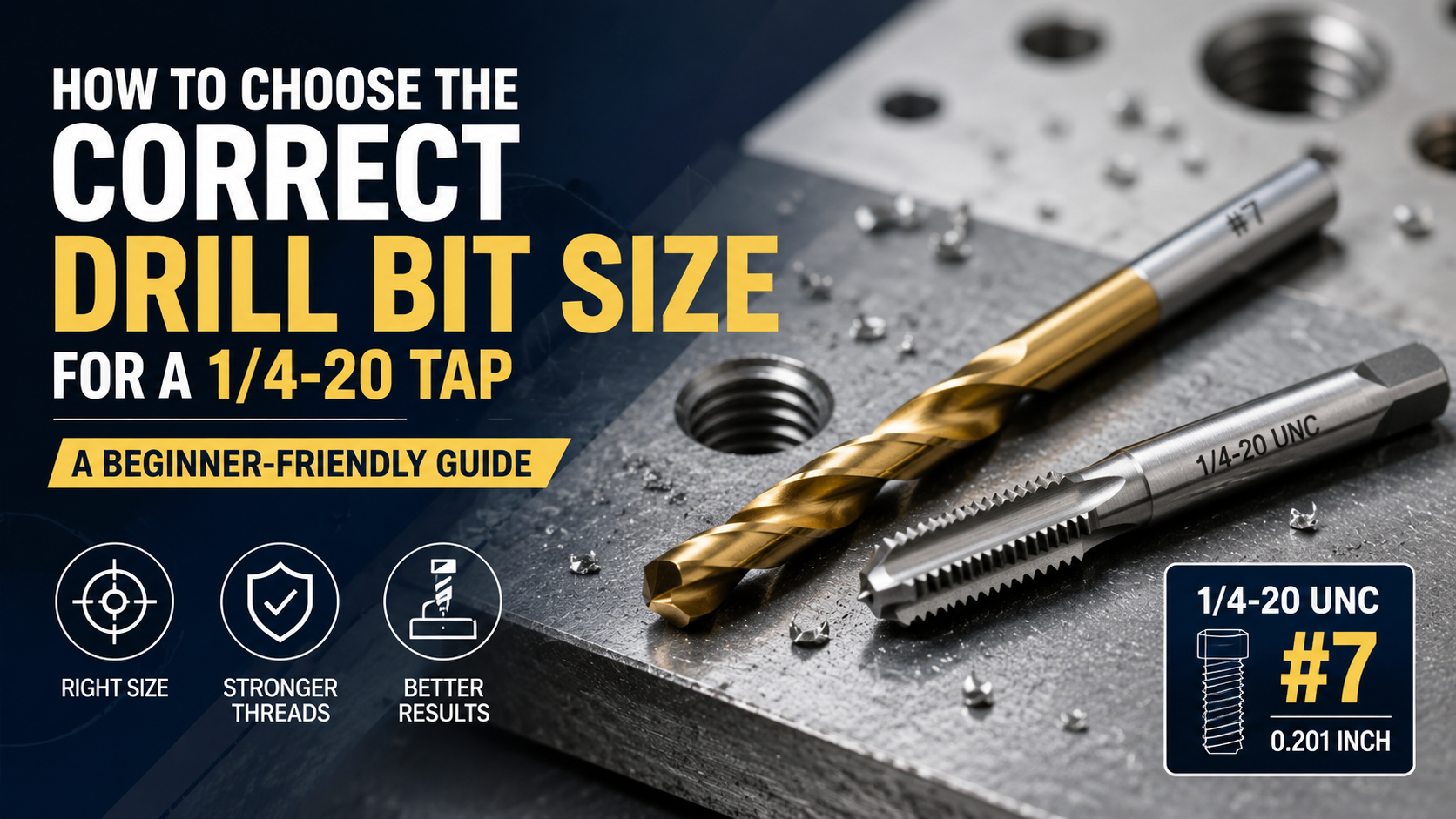
I. Introduction
When picking between titanium and carbide drill bits, it’s not just about price. If you make the wrong choice, it could cause broken parts, oversized holes, and production to stop without warning. Check the bit’s structure, the material of the workpiece, the steadiness of the machine, the number of holes that need to be drilled, and the drilling volume. The differences between them are explained in this guide. This will help you get stable performance without spending a lot of money on tools you don’t need.
II. Quick Answer: Titanium or Carbide Drill Bits?
Titanium-coated drill bits are better for general drilling, small amounts, and tools that aren’t very rigid.
CBN drill bits work better when drilling into hard materials, using high-speed CNC tools, or doing production that never stops. Your final choice can be made according to the material, machine, hole accuracy, and product you need.
III. What Are Titanium Drill Bits?
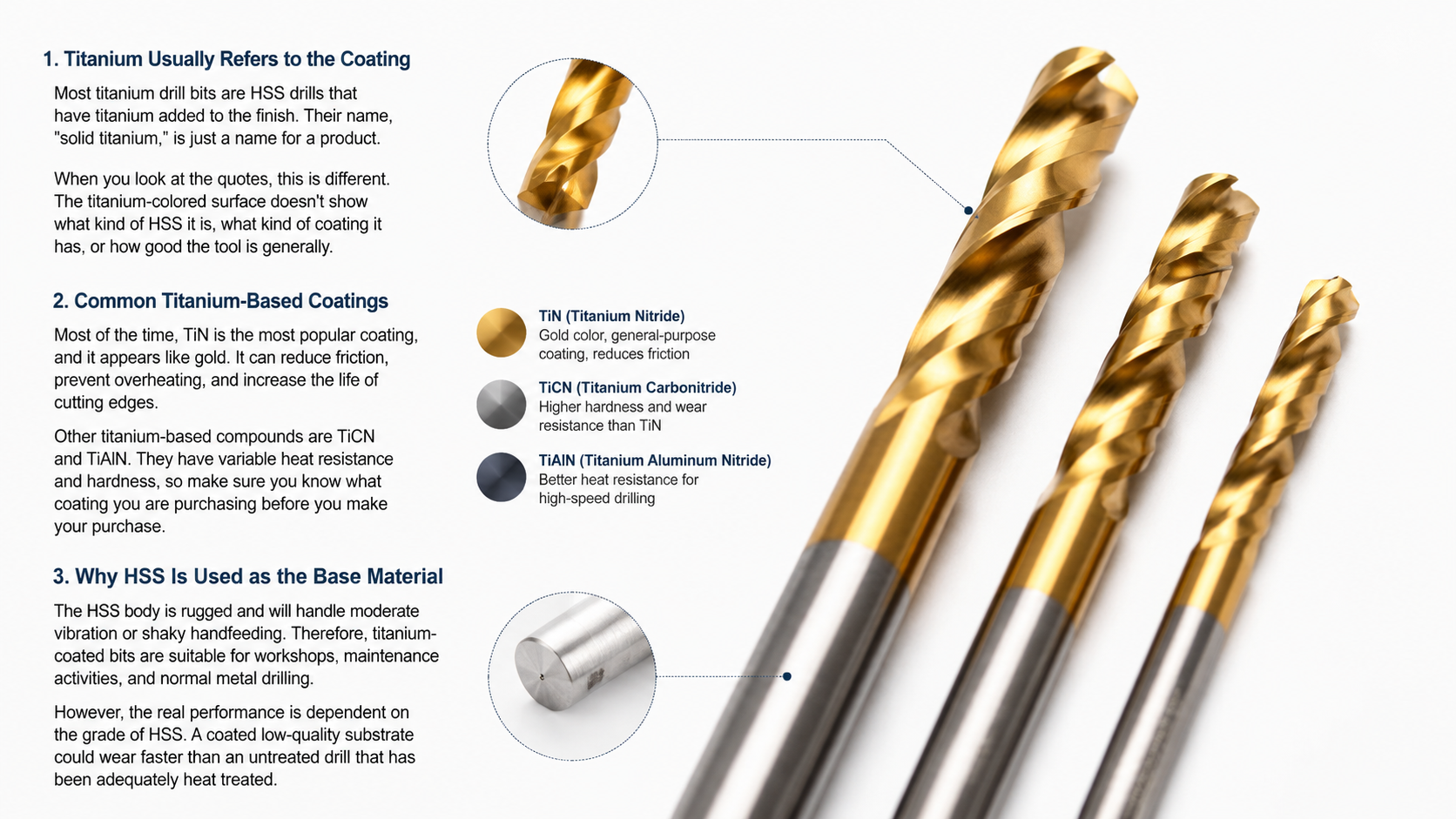
1. Titanium Usually Refers to the Coating
Most titanium drill bits are HSS drills that have titanium added to the finish. Their name, “solid titanium,” is just a name for a product.
When you look at the quotes, this is different. The titanium-colored surface doesn’t show what kind of HSS it is, what kind of coating it has, or how good the tool is generally.
2. Common Titanium-Based Coatings
Most of the time, TiN is the most popular coating, and it appears like gold. It can reduce friction, prevent overheating, and increase the life of cutting edges.
Other titanium-based compounds are TiCN and TiAlN. They have variable heat resistance and hardness, so make sure you know what coating you are purchasing before you make your purchase.
3. Why HSS Is Used as the Base Material
The HSS body is rugged and will handle moderate vibration or shaky handfeeding. Therefore, titanium-coated bits are suitable for workshops, maintenance activities, and normal metal drilling.
However, the real performance is dependent on the grade of HSS. A coated low-quality substrate could wear faster than an untreated drill that has been adequately heat treated.
IV. What Are Carbide Drill Bits?
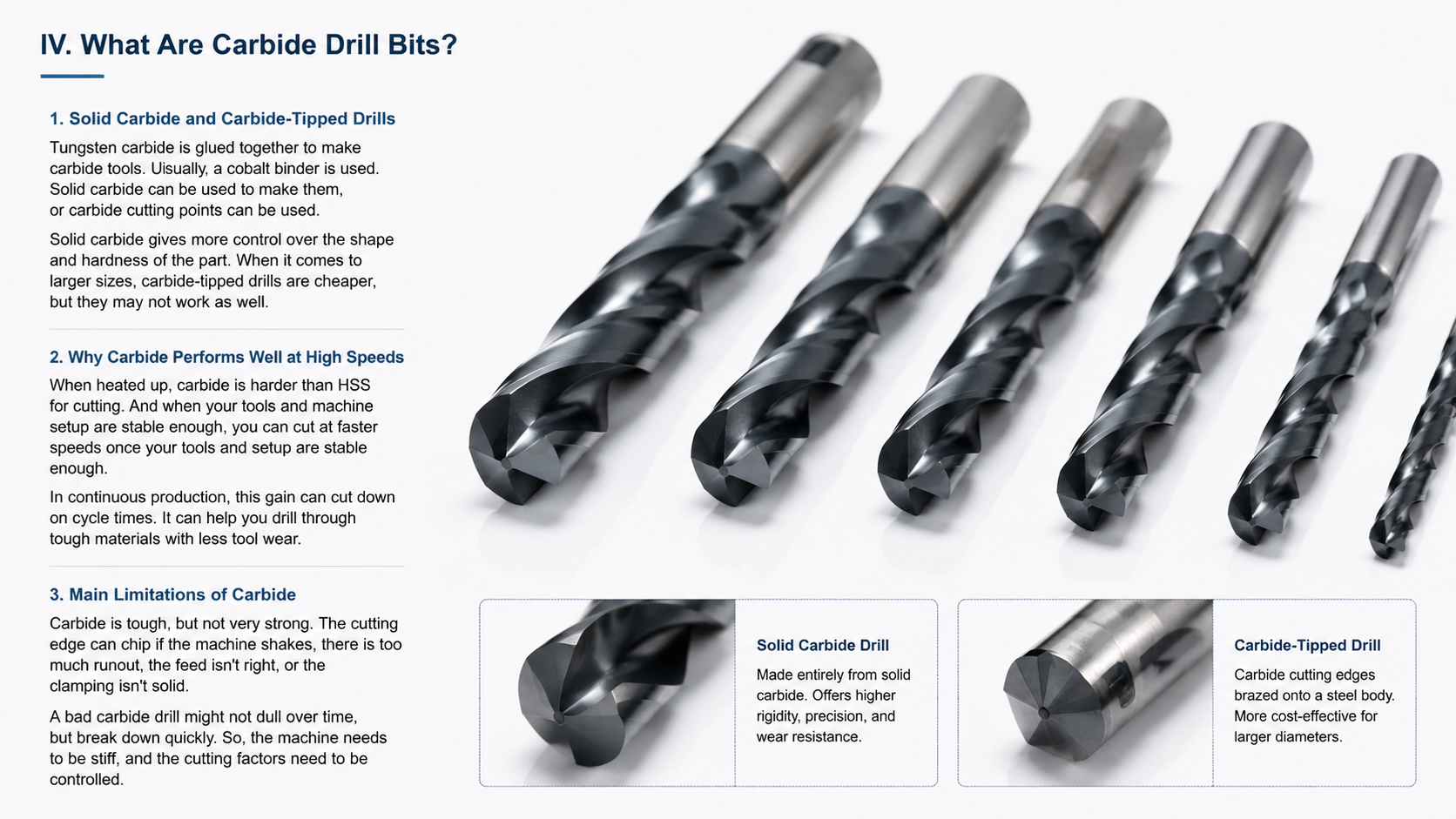
1. Solid Carbide and Carbide-Tipped Drills
Tungsten carbide is glued together to make carbide tools. Usually, a cobalt binder is used. Solid carbide can be used to make them, or carbide cutting points can be used.
Solid carbide gives more control over the shape and hardness of the part. When it comes to larger sizes, carbide-tipped drills are cheaper, but they may not work as well.
2. Why Carbide Performs Well at High Speeds
When heated up, carbide is harder than HSS for cutting. And when your tools and machine setup are stable enough, you can cut at faster speeds once your tools and setup are stable enough.
In continuous production, this gain can cut down on cycle times. It can help you drill through tough materials with less tool wear.
3. Main Limitations of Carbide
Carbide is tough, but not very strong. The cutting edge can chip if the machine shakes, there is too much runout, the feed isn’t right, or the clamping isn’t solid.
A bad carbide drill might not dull over time, but break down quickly. So, the machine needs to be stiff, and the cutting factors need to be controlled.
V. Titanium vs. Carbide Drill Bits: Main Differences
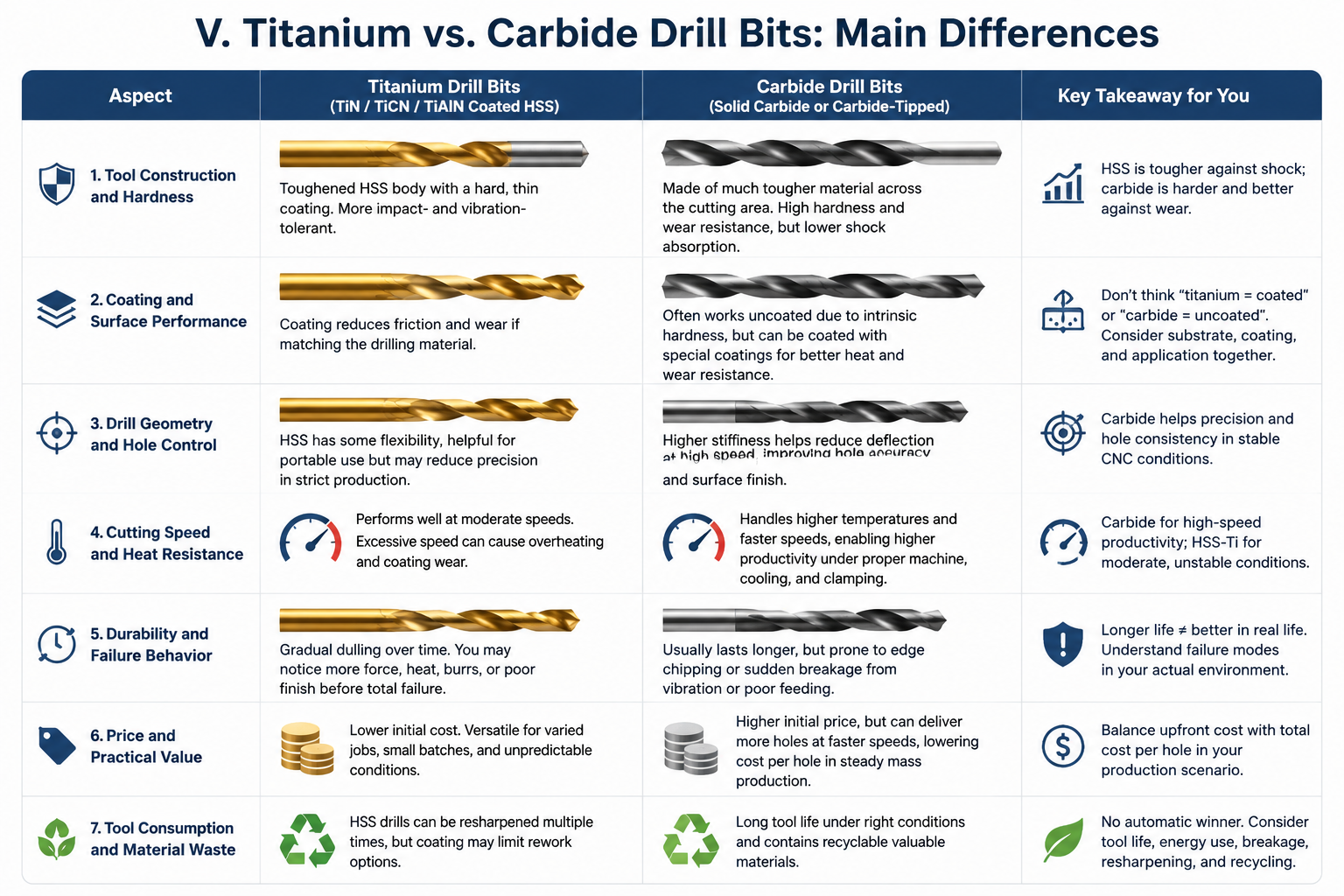
1. Tool Construction and Hardness
Titanium drill bits have a toughened HSS body with a hard, thin covering. Carbide drill bits are made of a much tougher substance across the cutting region. The HSS body is more impact- and vibration-tolerant. Carbide is resistant to deformation and abrasive wear but does not have the same shock absorption.
2. Coating and Surface Performance
The titanium coating reduces the direct contact between the HSS body and the workpiece. If the coating is compatible with the drilling material, it can reduce friction and delay wear. In many cases, carbide is already hard enough to work without a covering. But industrial carbide drills can also be coated with specific coatings to help with heat and wear resistance. So don’t think of titanium as “coated” and carbide as “uncoated.” Substrate, coating, and application should be considered in combination.
3. Drill Geometry and Hole Control
Carbide is stiff, which helps keep drills from deflecting when they’re cutting quickly. This can help make the surface finish, hole position, and diameter more consistent in a stable CNC setting. HSS can bend a little without breaking right away. This adaptability is helpful for portable tools, but it could hurt precision in production that needs to be precise. Material by itself doesn’t tell you how good a drill is. For both types, the form of the flutes, the thickness of the web, how the edges are prepared, and the consistency of the grinding are still important.
4. Cutting Speed and Heat Resistance
At modest cutting speeds, titanium-coated HSS works well. Too much speed can make the cutting edge too hot and shorten the life of the coating. When cutting, carbide can handle higher temperatures and faster speeds. This lets you get more done when the machine, cooling system, and clamping system for the part all allow for faster drilling. If you use carbide in conditions that are too low or unstable, it might not work as well as it could. If you use titanium-coated HSS too roughly, it can wear out quickly and make holes that aren’t straight.
5. Durability and Failure Behavior
Titanium-coated HSS generally gets dull over time. Before it fails completely, you may notice more cutting force, heat, burrs, or a bad surface. When things are fixed, carbides usually last longer. But edge chipping and rapid breakage can be caused by vibration or bad feeding. A longer theoretical tool life does not always mean that the tool will work better in real life. You need to think about how each material fails in the real world where you work.
6. Price and Practical Value
In general, titanium-coated drill bits cost less to buy. They are useful for a variety of tasks, small amounts, and drilling conditions that are hard to predict. At first, carbide drills are more expensive, but they may be able to make more holes at faster speeds. When you’re making a lot of holes steadily, this can lower your cost per hole.
7. Tool Consumption and Material Waste
There is no one type of drill that is automatically better for the environment. It depends on how long tools last, how much energy they use, how many broken pieces they make, how they are sharpened, and how they are recycled. Most of the time, HSS drills can be sharpened more than once, but the titanium covering may need to be fixed. When kept in the right conditions, carbide lasts longer and contains useful materials that can be recycled.
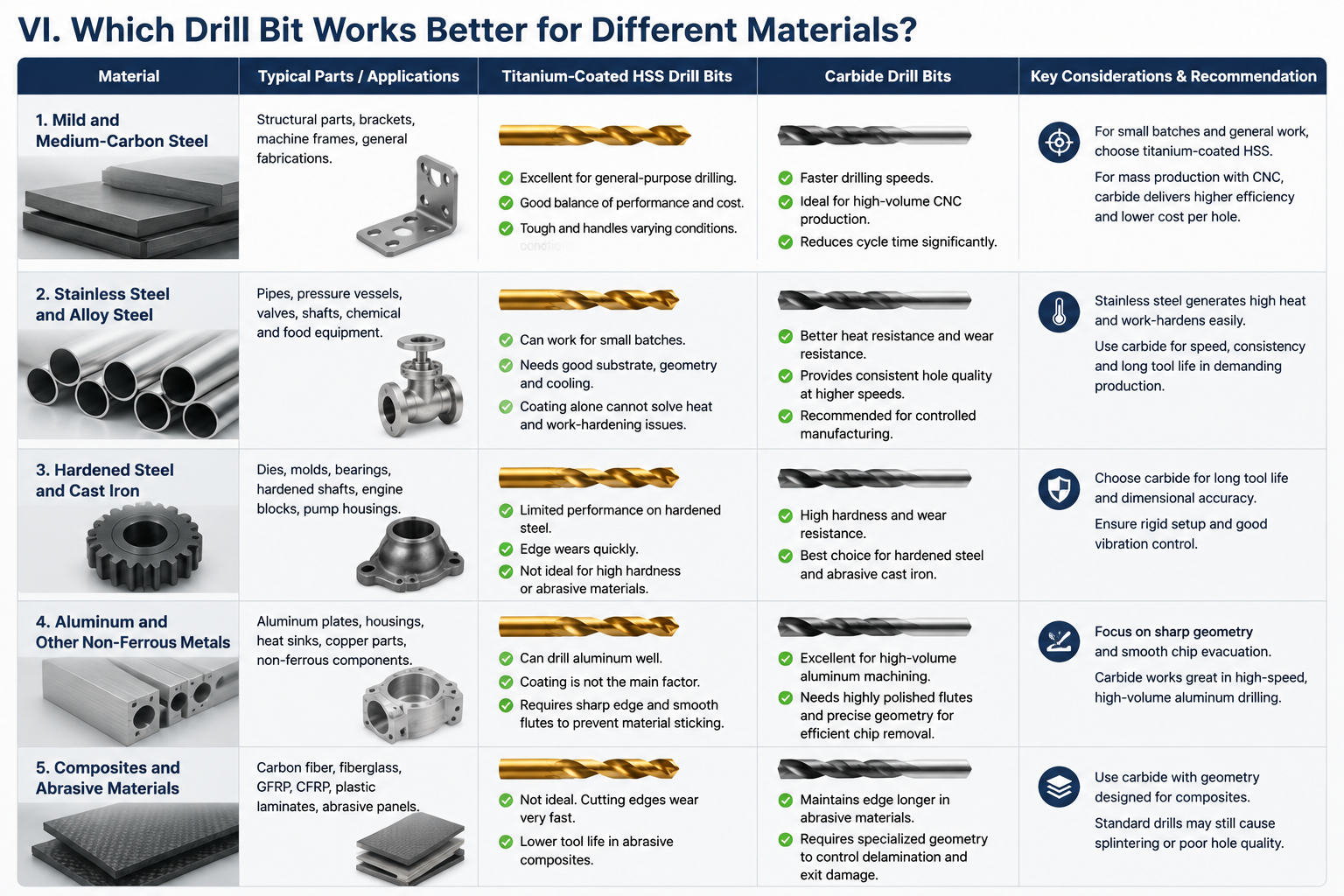
VI. Which Drill Bit Works Better for Different Materials?
1. Mild and Medium-Carbon Steel
Titanium-coated HSS is excellent for general-purpose drilling in mild and medium carbon steels. It offers a great compromise between tough, cut performance and cheap.
Carbide is worth it if you are going to drill hundreds of holes consistently using CNC equipment. Its faster speed reduces cycle time on big production batches.
2. Stainless Steel and Alloy Steel
Stainless steel heats up quickly, and you can work-harden it when you drill it. Poor geometry, weak HSS, or wrong cutting parameters cannot be compensated with a titanium coating alone.
Titanium-coated HSS can handle lesser quantities where substrate and cooling are sufficient. Carbide is better in regulated manufacturing with the need for speed and consistent hole quality.
3. Hardened Steel and Cast Iron
Because of its great hardness and wear resistance, carbide is generally the superior choice for hardened steel. HSS coated with Titanium can lose its edge rapidly or may not cut well.
Cast iron is abrasive and will affect the life of ordinary HSS drills. If you can keep the dust and vibration under control, carbide has greater wear resistance.
4. Aluminum and Other Non-Ferrous Metals
Titanium-coated HSS can drill aluminum, but the coating should not be the main selection factor. A smooth flute and proper cutting edge will avoid material sticking.
Carbide can provide great results in the high-volume manufacturing of aluminum. High-speed chip removal requires extremely well-polished flutes and precise shapes.
5. Composites and Abrasive Materials
Fiberglass, carbon fiber, and other composites can wear cutting edges rapidly. Carbide normally maintains its edge longer when drilling these abrasive materials.
The geometry must also control delamination, splintering, and exit damage. A general-purpose carbide drill may still perform poorly without the correct point design.
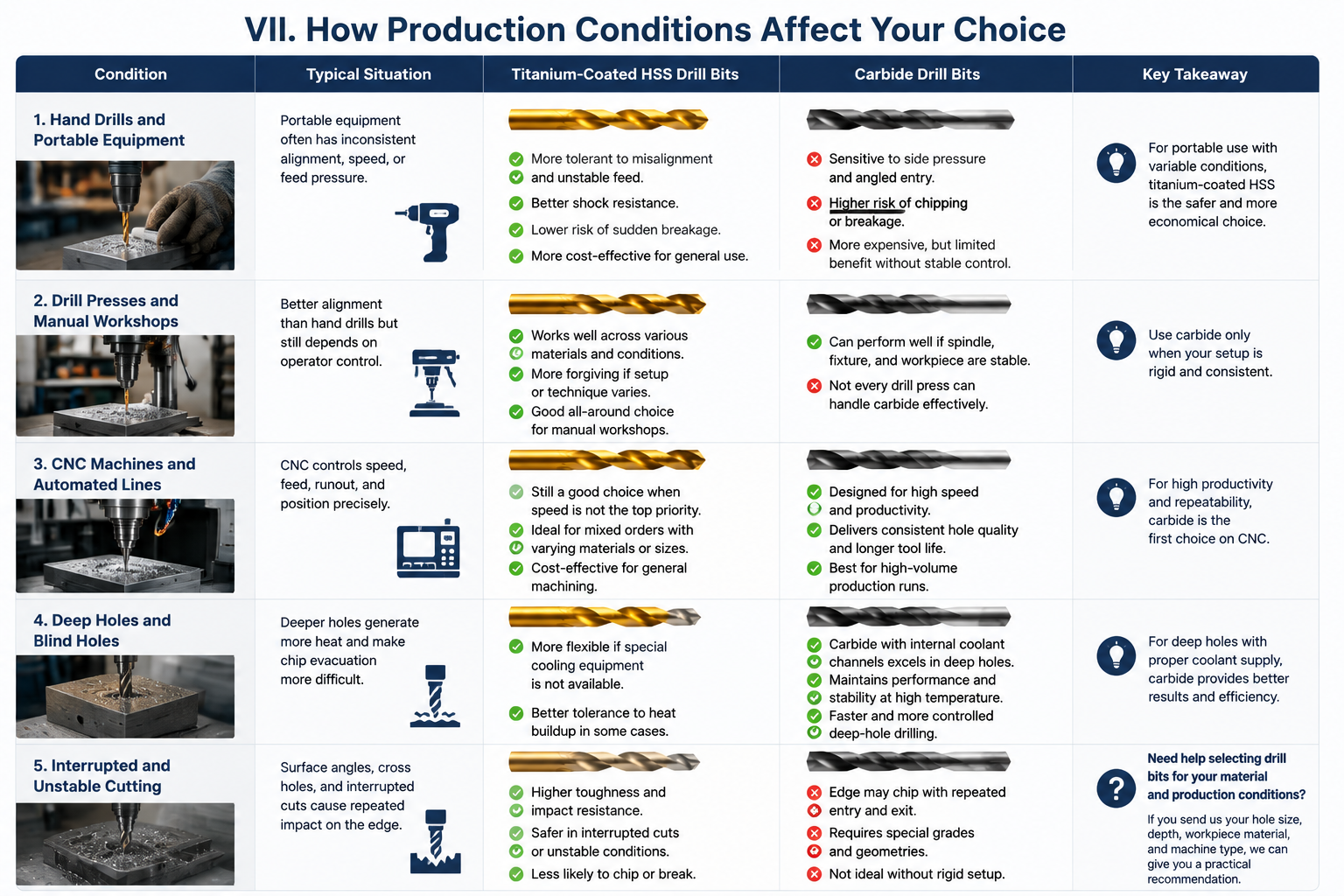
VII. How Production Conditions Affect Your Choice
1. Hand Drills and Portable Equipment
Portable equipment is not always consistent in alignment, speed, or feed pressure. Titanium-coated HSS can better deal with these fluctuations than brittle carbide.
The carbide can be broken if the drill tries to travel sideways or if it enters the workpiece at an angle. It’s more expensive, but it doesn’t add much without stable control.
2. Drill Presses and Manual Workshops
A drill press delivers greater alignment than a hand drill but is still dependent on operator control. Titanium-coated HSS is still suited for a variety of materials and production processes that vary.
If the spindle, fixture, and workpiece are stable, carbide may operate. But you can’t assume that every manual drill press will handle carbide satisfactorily.
3. CNC Machines and Automated Lines
The speed, feed, runout, and location are all controlled by CNC machines. Conditions for carbide drills for increased productivity and consistent hole quality.
Titanium-coated HSS is still a possible choice if production speed is not the most important consideration. It can also be applicable to mixed orders where changes in material or size are common.
4. Deep Holes and Blind Holes
Deeper holes emit more heat and also make chip removal more difficult. The importance of fundamental tool material may diminish relative to drill geometry and coolant delivery.
Carbide drills with internal coolant channels may produce deep holes quickly and in a regulated manner. Titanium-coated HSS provides more flexibility if special cooling equipment is not available.
5. Interrupted and Unstable Cutting
The angles on the surface, the cross holes, and the interrupted cuts cause the cutting edge to strike repeatedly. These conditions are far safer with hard titanium-coated HSS. Repeatedly, the cutting edge enters and departs the substance, which may chip the carbide. Such demanding applications require special carbide grades and geometries. Need help selecting drill bits for your material and production conditions? If you send us your hole size, depth, workpiece material, and machine type, we can give you a practical recommendation.
VIII. Conclusion
Your drill bit should match the complete drilling system, not just the highest specification on the product label. Even an expensive bit cannot perform reliably with unsuitable equipment, clamping, or cutting parameters. Before placing a bulk order, share your material, hole size, depth, machine type, and production volume, so we can recommend a practical configuration without adding unnecessary tooling costs.
IX. FAQs About Titanium and Carbide Drill Bits
1. Is a titanium-coated drill bit the same as a cobalt drill bit?
Not at all. Most of the time, cobalt is used to talk about an HSS alloy, while titanium is a surface coating. Titanium can also be used to cover a cobalt drill.
2. Is tungsten carbide the same as carbide?
Most of the time, cobalt is used as a metal binder to hold tungsten carbide pieces together when they are used in cutting tools. How well something works changes based on the binders and grain sizes used.
3. How can you verify a genuine titanium coating?
The way a coating looks doesn’t tell you anything about it. For large orders, get the name of the coating, a range of thicknesses, proof from the seller, adhesion data, or independent composition testing.
4. Why do similar titanium drill bits have different tool lives?
The HSS grade, heat treatment, edge grinding, coating adhesion, geometry, and batch consistency are some of the other things that can change how long a tool lasts. None of these can be seen in the colour of the surface.
5. Can titanium coating compensate for low-quality HSS?
Not at all. A hard coating can’t fix HSS that is too soft, the wrong form, or cutting edges that aren’t strong enough. The coating needs to stick to the thing it’s on.
6. What point angle should titanium or carbide drill bits use?
There isn’t just one good view. For many general tasks, a point at 118 degrees works well. On the other hand, a point at 135 degrees makes it easier to center hard metals.
7. Do carbide drill bits require a pilot hole?
Not very often, no. A lot of carbide drills are self-centering and are made to go right into anything solid. The cutting edges on the outside can get too heavy if you don’t match the starter hole.
8. Should you use a spot drill before carbide drilling?
It’s not always necessary to spot in hard CNC setups. At times, the spot angle should match the drill’s shape, and the carbide corners shouldn’t be used first.
9. Which tool holder is suitable for carbide drill bits?
An accurate collet, a hydraulic holder, or a shrink-fit holder can stop runout. When drill chucks are old, they can load unevenly, make bad holes, and damage the edges before they should.
10. How does spindle runout affect carbide drill bits?
Because of runout, one cutting lip has to hold more weight than the other. This causes wear that isn’t even, holes that are too big, shaking, and carbide chips that appear too soon.
11. Should you use peck drilling with carbide drill bits?
Peck drilling isn’t always better for carbide. A lot of entry can chip the edges, but limited feeds and coolant inside the machine might make it safer for chips to get out.
12. What chip shape indicates stable drilling performance?
If chips always come from both cutting edges, it means that the cutting is balanced. If the chips are tangled, burnt, powdery, or not all the same size, it could mean that the shape, settings, or way the chips are sent out are off.
13. How can you tell when a titanium drill bit is dull?
When titanium-coated drills get dull, they may squeal, make more noise, get too hot, get bigger burrs, change the colour of the surface, and make holes that aren’t as good.
14. How can you identify a chipped carbide cutting edge?
Cutting marks that aren’t even, holes with rough walls, or sudden changes in noise can all be signs of carbide chipping. Do not drill until the tool breaks.
15. Why does a drill bit produce oversized holes?
Uneven cutting lips, handle wear, drill deflection, the wrong feed, bad entry, or a broken cutting edge can all make the holes too big.
16. Why does titanium coating peel from a drill bit?
The coating may peel if the surface isn’t properly prepared. This could be because it doesn’t stick well, there is too much heat, the substrate changes shape, or the cutting conditions aren’t right. Wear and tear should happen over time.
17. Can titanium drill bits be recoated after sharpening?
Yes, it is possible to re-coat after sharpening, but for most normal HSS drills, it is not worth the extra cost. For bigger or more specialised tools, you might need a professional to recoat them.
18. Can carbide drill bits be reground and recoated?
CBN tools can often be reground and recoated if there is enough material left over. The service has to fix the shape of the points, how the edges are prepared, the width, and the quality of the coating.
19. How should you compare titanium and carbide drill samples?
Make sure both of them are cut with the same coolant, machine, hole depth, and stiffness of the material. Write down the holes that can be used, the cycle time, the wear, the breaking, and the ability to regrind.
20. What specifications should a drill bit supplier provide?
It’s helpful to have a specification that lists the grade of the substrate, the type of coating, the diameter tolerance, the point geometry, the recommended parameters, the coolant needs, the regrinding limits, and the way to keep track of each batch.