I. Introduction
Picking drill bits based on color or price can lead to more costs in the long run. A drill bit that looks like it will work might wear out quickly, make holes that are too big, or stop production. You need to look at how they are made, how well they handle heat, how well they work with different pieces of work, how sharp they are, and how well they work in real drilling situations.
II. Quick Selection Guide
1. When Cobalt Drill Bits Are the Better Choice
When you need to drill stainless steel, alloy steel, or other metals that keep getting hot, choose cobalt drill bits. Its alloy structure keeps its cutting sharpness even after the surface has been worn down. It is also still useful after being properly resharpened.
2. When Titanium-Coated Drill Bits Are More Practical
A titanium-coated HSS drill bit is most suitable for general steel drilling, maintenance work, and small to medium production amounts. Its coating can cut down on wear and friction. The lower price also makes it good for uses that don’t need high-end tools.
3. Why the Product Label Is Not Enough
Neither label guarantees stable drilling. HSS grade, heat treatment, point geometry, coating quality, runout, feed, and coolant can change results. A well-made standard drill can outperform a poorly manufactured premium drill.
III. What Are You Actually Comparing?
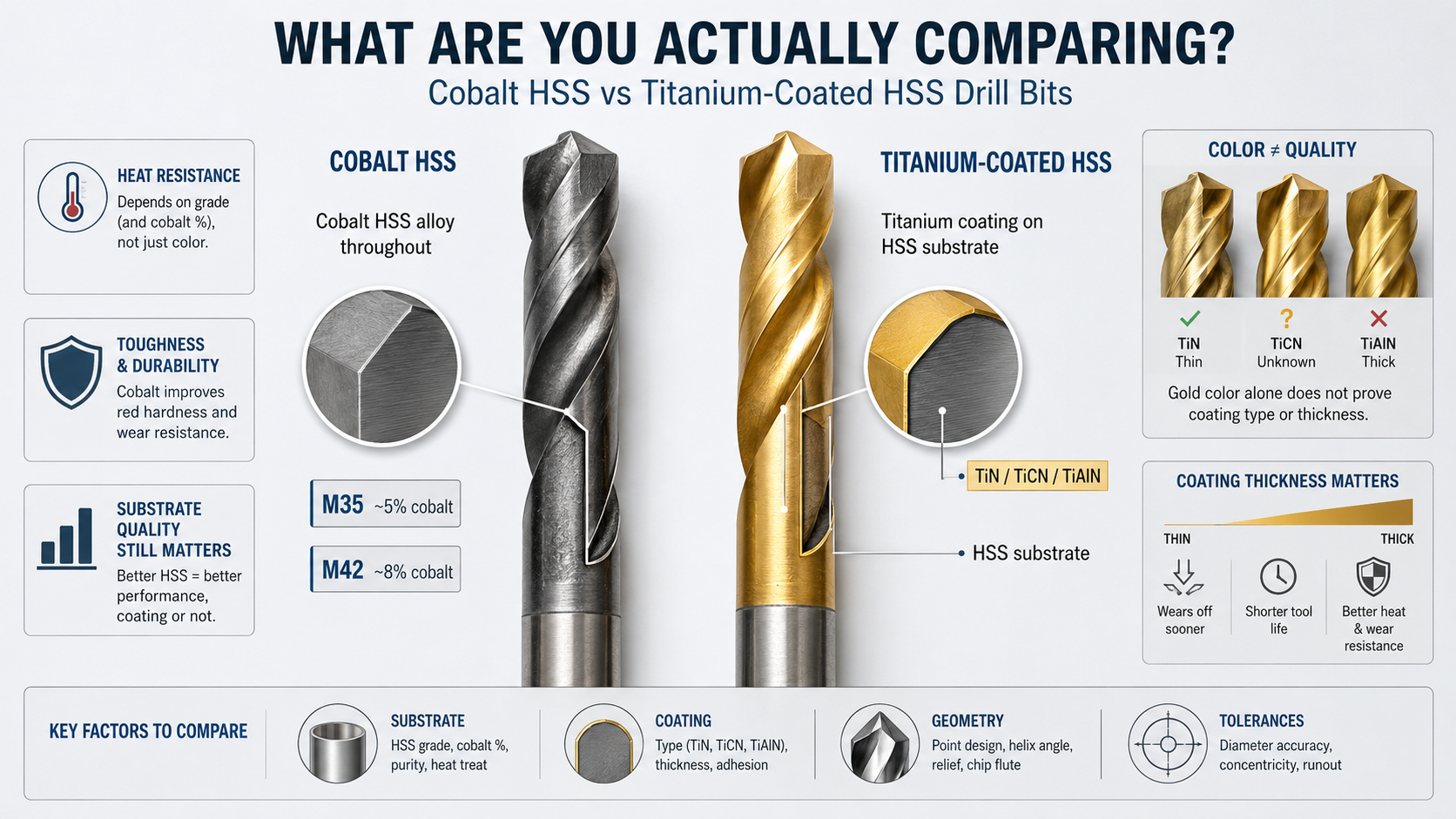
1. Cobalt Is Part of the HSS Alloy
Cobalt drill bits are made from high-speed steel that has cobalt added all the way through the cutting part. When the temperature of the drill rises, the cobalt helps the steel keep its strength. Since cobalt is a part of the material, its basic ability to resist heat stays the same even after the surface wears off. When you sharpen something correctly, you can see new cutting material that has the same metal properties.
2. M35 and M42 Are Not the Same
M35 HSS usually has about 5% cobalt in it and is a good balance between being tough and resistant to heat. It is often used to drill through stainless steel and speciality steel. M42 usually has about 8% cobalt in it, and it gets harder at higher temperatures. But it can be more fragile when fed unevenly or loaded from the side. It’s not always better to have a higher cobalt percentage. The grade should be right for the drill, the material, the hole size, and the security of the drilling.
3. Titanium Usually Refers to a Surface Coating
Most titanium drill bits have an HSS body with a thin covering made of titanium. TiN, TiCN, and TiAlN are all common choices. The hardness, friction, and temperature properties of these compounds are not the same. Because of this, the word “titanium” doesn’t give us enough information to make a good comparison.
4. Why the HSS Substrate Still Matters
A coating can keep the surface safe, but it can’t fix weak material that’s below the surface. Even if it has a nice covering, bad HSS may soften, bend, or lose its cutting edge. Hardness and toughness are also changed by heat treatment. If these qualities aren’t consistent, the drill might work well at first but break down quickly after being used a lot.
5. What Color and Product Names Cannot Prove
A gold surface usually means TiN, but the coating’s makeup or thickness can’t be told just by looking at it. Functional coats and decorative finishes can look the same. Also, the words “M35” or “M42” need to be properly controlled. Before you compare prices, make sure you know the grade of the substrate, the type of coating, the shape, the tolerances, and the best ways to cut it.
IV. How Their Performance Changes During Drilling
1. Performance Under Continuous Heat
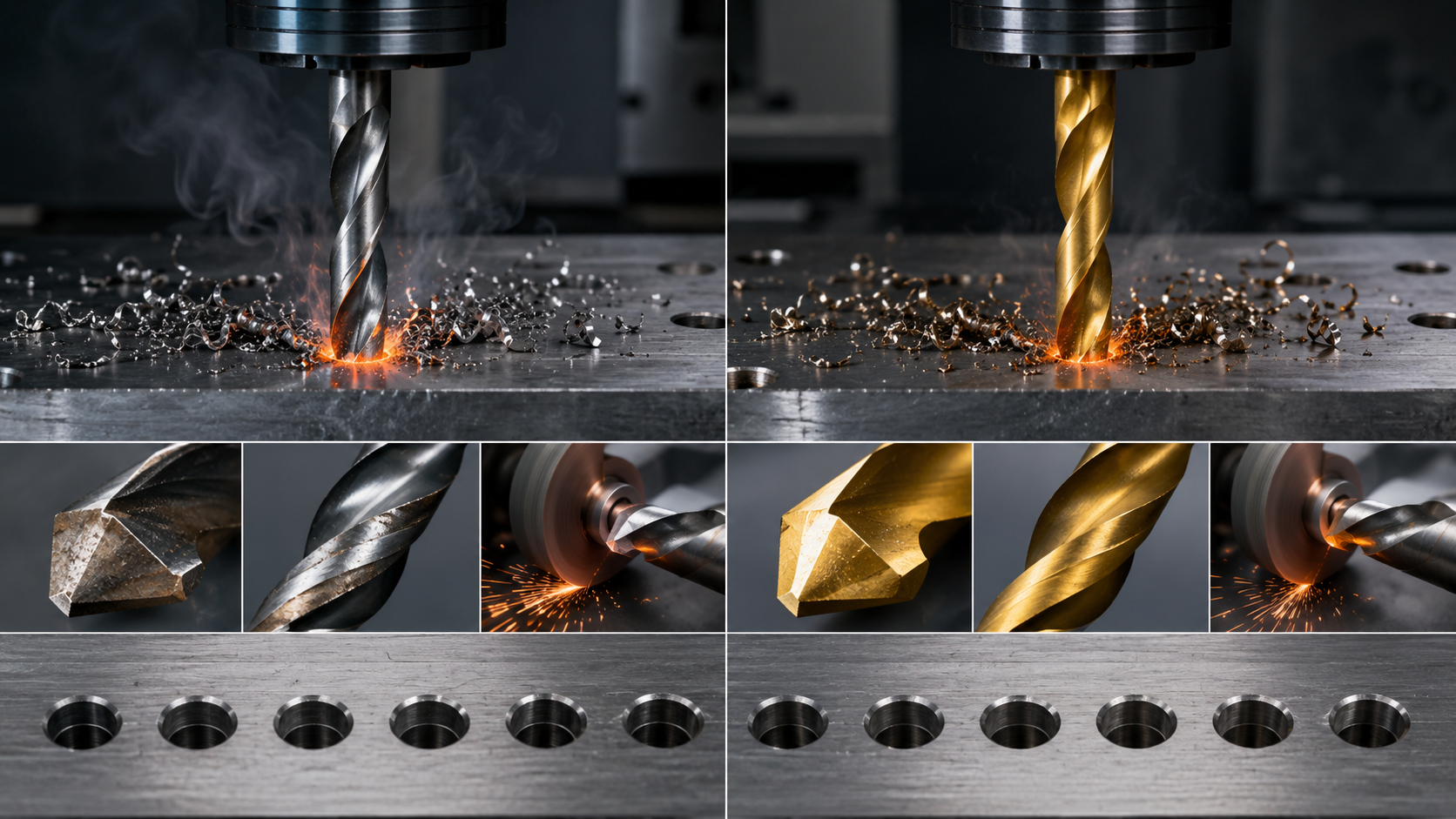
When you drill through stainless steel and alloy steel, the cutting edge gets very hot. When this heat keeps up, cobalt HSS keeps its toughness better than regular HSS.
Titanium coatings can make surfaces less rough and wear out more slowly. The coating can’t fully protect the HSS body, though, when the temperature goes above what the substrate can handle. So, cobalt gives you a bigger edge when you drill metal over and over again. Titanium-coated HSS can still be used when the amount of heat and production is moderate.
2. Friction and Chip Movement
If the titanium coating is proper, it can keep the drill from touching the subject. There’s a chance that this will make cutting easier and help chips move through the blades. But the performance of the coating varies on the material of the workpiece. When drilling aluminium and other soft metals, some treatments may make the material stick better.
There is no need for a surface layer for cobalt to be resistant to heat. Moving the chip still rests on the shape of the flutes, how sharp the edges are, how well they are oiled, and the right feed rate.
3. Cutting Edge Wear
Most of the time, cobalt drill bits lose their sharpness over time as the cutting edge wears down. Rising force, heat, burrs, and drilling noise are all signs that the blade needs to be sharpened.
Titanium-coated drills may work well as long as the coating is still there. When the standard HSS around the cutting lips and outer corners is worn down, performance goes down. There is no set way for either type to fail. Wear that happens slowly, quickly, or chips and cracks can be caused by things like material hardness, machine runout, cooling, and operator control.
4. Sharpening and Performance Recovery
You can sharpen cobalt drill bits without changing the way they work as an alloy. But the point angle, lip balance, and space must be returned to how they were originally.
Titanium-coated HSS can also be sharpened, but the coating is worn off when the new cutting edge is ground. The drill can still be used, but it no longer has some of the original surface protection. This difference is important if you often fix up bigger or more expensive drill bits. When you replace small standard sizes after wear, it doesn’t matter as much.
5. Hole Consistency Across a Production Batch
During its entire useful life, a drill bit must make holes that are good enough. The cutting speed at the start doesn’t tell you anything about how well it works after multiple drillings. You should keep an eye on the cycle time, hole diameter, burr formation, surface condition, cutting force, and burr formation. These measures show when wear starts to lower the quality of the production. Cobalt might make metals that make heat more consistent. Titanium-coated HSS can stay the same if the coating can handle the material and the load of production.
V. Choosing by Workpiece Material
1. Stainless Steel
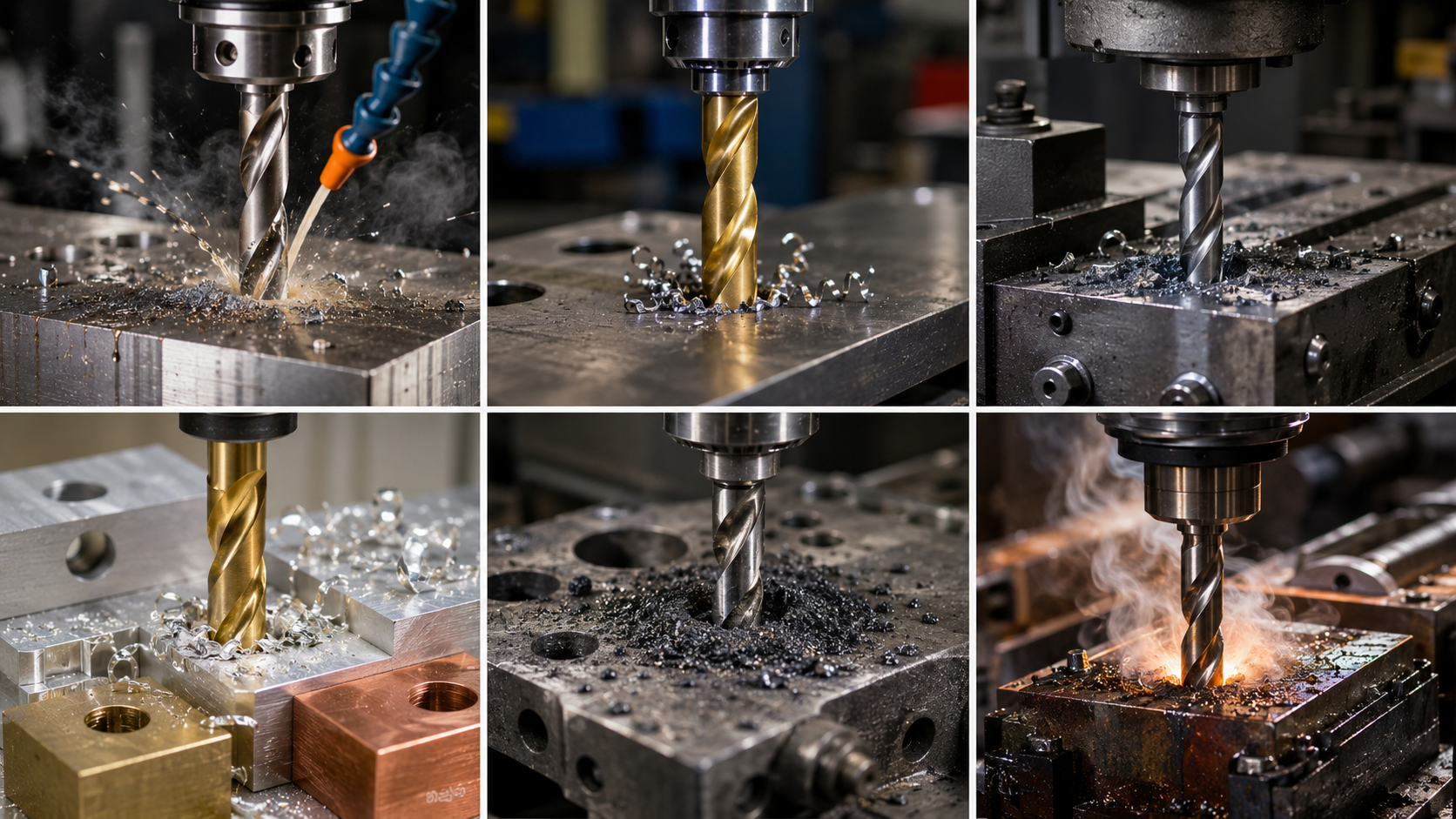
While drilling, if you rub the steel instead of cutting it, it can get harder. The next part of the hole gets harder because of the extra heat. Most of the time, a cobalt HSS drill bit is the better choice because it stays hard at high temperatures. You still need strong feeding, the right speed, and good lubrication. A titanium-coated drill bit can’t make up for light feeds or rubbing over and over again. When the cutting edge stops being sharp, the stainless steel could quickly hurt the HSS that is out in the open.
2. Mild and Medium-Carbon Steel
Titanium-coated HSS performs well in mild steel under moderate speeds and drilling volumes. Because it has less friction, it can cut smoothly and keep tool costs low. When you drill for a long time or work with stronger medium-carbon steels, a cobalt drill bit becomes more important. Because it doesn’t melt in hot conditions, it can last longer during longer production runs. For occasional holes, the extra cost of cobalt might not be worth it. Fewer tool changes can make up for the higher starting price when the product is made over and over again.
3. Alloy Steel and Tool Steel
Alloy steel performance depends on its hardness, heat treatment, and chemical composition. The name of the material is not enough to tell you which drill bit to use. A cobalt HSS drill bit can work with a lot of alloy steels that have been annealed and some tool steels. You need a cutting fluid that works well, a speed that can be adjusted, and stable feeding. Fully hardened material might be too far outside of the useful range of cobalt HSS. In this case, a tungsten drill might be a better way to get the job done.
4. Aluminum, Brass, and Copper
Melting metals can get stuck on the cutting edges and stop the flutes from moving. It is very important to have sharp geometry and good chip removal. These things can be drilled with HSS that is covered in titanium, but TiN isn’t always the best surface for aluminium. Polished flutes or another coating might be a better way to stop materials from sticking. Most of the time, cobalt is not needed for general non-ferrous drills. It can still be used if the current tools, hole design, or production conditions allow it.
5. Cast Iron and Abrasive Materials
Cast iron breaks down into small chips that can wear away quickly. In small amounts, cobalt HSS may last longer than normal titanium-coated HSS. However, cobalt isn’t always the best choice for industry. If the machine is stable enough and there is enough room to drill, carbide may be more productive. Edge shape and dust control are also things you should think about. These things affect the quality of the surface, the wear on tools, and how clean the equipment is.
6. Heat-Resistant Alloys
Nickel-based alloys have strong cutting forces and keep heat in the area where the metal is being cut. These conditions can quickly damage standard titanium-coated HSS. When drilling at controlled speeds, cobalt is better at withstanding heat. But hard metals might still need carbide tools, rigid machines, and special cooling methods. Do not just choose the drill based on the name of the metal. First, make sure you know the hardness, hole depth, diameter, tolerance, and amount of production you need.
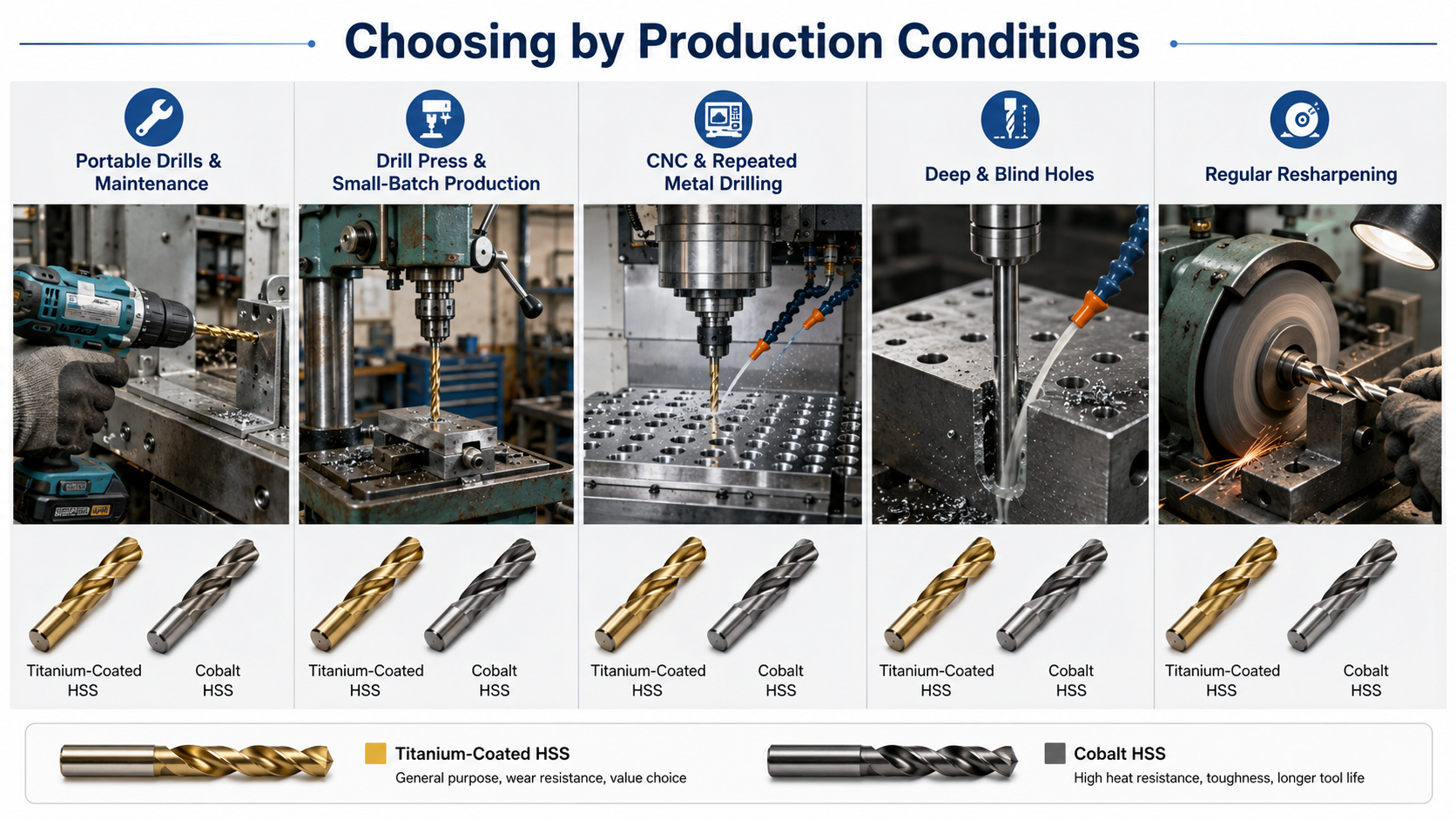
VI. Choosing by Production Conditions
1. Portable Drills and Maintenance Work
Portable drills can cause problems with alignment, feed pressure, and side loading. These conditions can hurt any drill bit, no matter what kind of material it is made of. Titanium-coated HSS is useful for general upkeep because it is not too expensive and is tough like HSS. Cobalt is useful for fixing metals that are harder to work with. Hold the drill straight and put steady forward pressure on it. Too much movement can damage the titanium layer or chip the cobalt edges.
2. Drill Presses and Small-Batch Production
A drill press is better than a handheld drill for controlling speed and alignment. This makes it easier for both types to work together. Titanium-coated HSS is good for a wide range of tasks that use common steels in moderate amounts. When harder metals are used a lot in production, cobalt is worth more. You should also think about how sharpening works when making your choice. Cobalt drill bits may be worth more in a workshop with the right cutting tools.
3. CNC and Repeated Metal Drilling
CNC machines let you control the speed, feed, placement, and holding of the tool. If these things are true, you can get a more accurate reading on tool life and hole regularity. Cobalt HSS can handle drilling over and over in materials that generate a lot of heat. Titanium-coated HSS may still be a good deal for metals that are easy to work with and for short production runs. If you need to make a lot of CNC parts, you might need coated carbide instead of either choice. The tool material should be chosen based on the production goal, not just the type of product.
4. Deep and Blind Holes
Deep holes keep heat in and make it harder to remove chips. Also, blind holes make it more likely that chips will get packed down near the bottom. Cobalt is better at dealing with long-term heat, but it can’t fix bad chip evacuation. You still need the right pecking cycles, blades, lubrication, and controlled feed. Ti-coated HSS can handle modest depths as long as chips can easily exit the hole. Too much heat could ruin the coating, revealing the HSS below.
5. Businesses That Regularly Resharpen Tools
Sharpening tools on a regular basis can lower the cost of making bigger sizes and more of them. It’s clear that cobalt is better because its alloy characteristics last below the surface. Titanium-coated drills lose their coating where the cutting edge is honed. Recoating is possible, but for most drill sizes, it might not be worth the money. You should also measure the web’s width and diameter. Grinding over and over again can change how the material cuts, even if the material is still good for drilling.
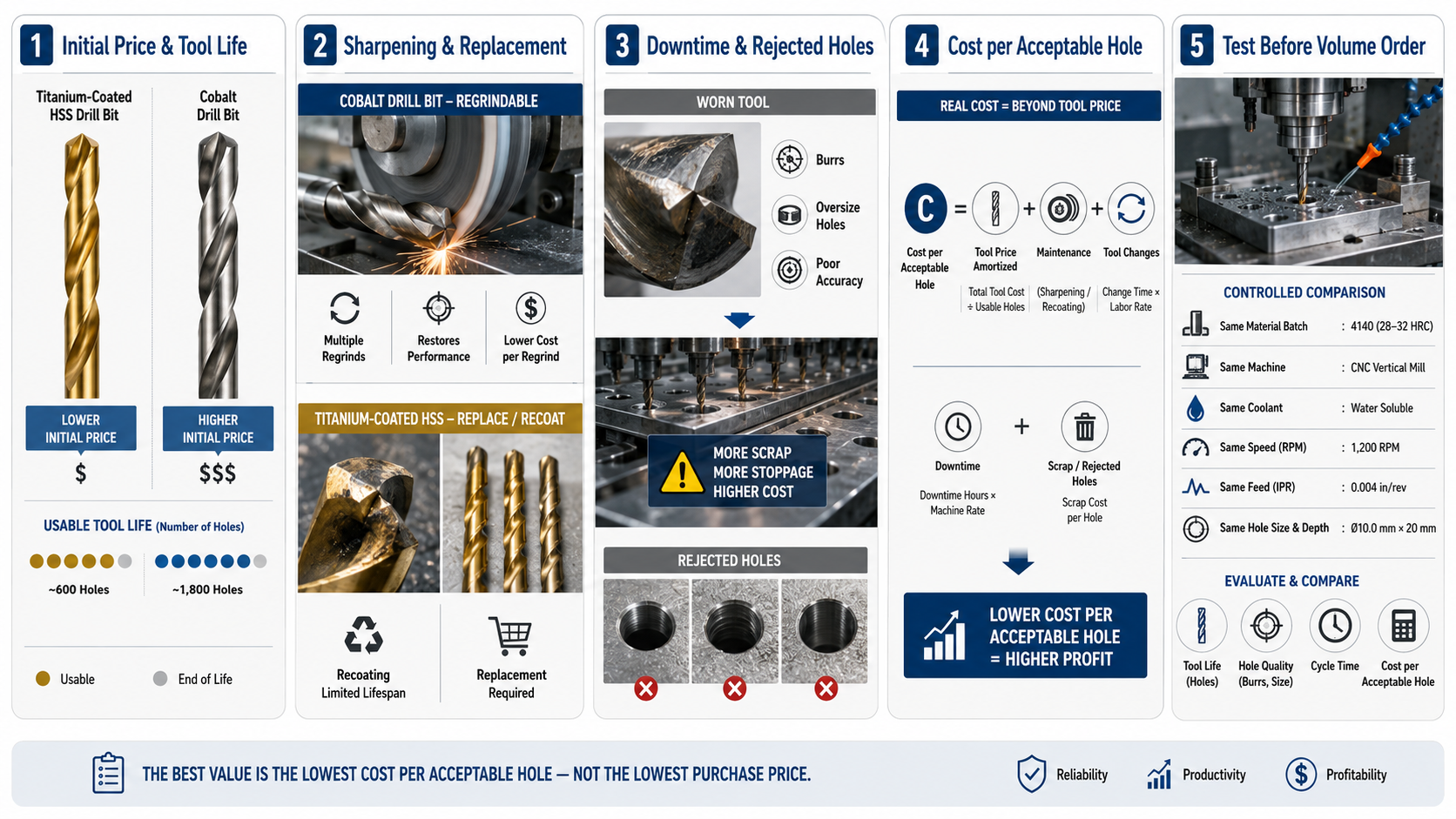
VII. Comparing the Real Value of Both Drill Bits
1. Initial Price and Usable Tool Life
The price of a titanium-coated HSS drill bit is usually lower. This makes it appealing when there isn’t a lot of work to be done, and the piece isn’t too hard. Cobalt costs more because of the alloys it is made of and the steps needed to make it. When longer life makes up for having to replace things more often, the higher price makes sense. It’s not always true that the cheapest drill is the best deal. The most expensive drill is also useless if it can’t be used for what it was made for.
2. Sharpening and Replacement Costs
When they are sharpened correctly, cobalt drill bits can be used many times. This could lower the number of times that common production sizes need to be replaced. Most of the time, titanium-coated drills work best before they are sharpened for the first time. The uncovered cutting edge acts more like an HSS that hasn’t been coated after grinding. You should figure in the cost of sharpening, shipping, inspection, and possibly recoating. These prices show whether reconditioning is worth it or not.
3. Production Downtime and Rejected Holes
A worn drill takes longer to cut with and may need to be replaced without warning. It can also make burrs, holes that are too big, and broken workpieces. These issues might cost more than the drill itself. Because of this, consistent performance is important when one bad hole can mean that a finished part has to be thrown away. The tool should be used until the quality of the holes is no longer acceptable. Waiting until the piece is completely broken puts production and safety at risk for no reason.
4. Cost per Acceptable Hole
Divide the total cost of tools and upkeep by the number of holes that can be used to get the cost. Do not count holes that need to be fixed or that make parts that can’t be used. Add up the cost of the drill, as well as the cost of grinding, coating, tool changes, downtime, and scrap. This gives a more accurate picture than just looking at the unit price. Cobalt may be the cheaper way to drill hard metals over and over again. Titanium-coated HSS may still be cheaper for work that is done less often and with less force.
5. Testing Before a Volume Order
Use the same batch of material, hole depth, machine, stand, coolant, speed, and feed for both drill types. If you change one condition, the comparison might not be valid anymore. Make a note of the accepted holes, cycle time, edge wear, burr size, and the ability to sharpen. The results show which choice best fits the way you actually make things. A useful sample test should be based on real-world production, not on perfect lab circumstances. So, you don’t have to choose tools based on what they say in the catalogue.
VIII. Conclusion
The right drill bit for your needs depends on how well its shape, material, and finish work in real-world production settings. Check the grade of the workpiece, its hardness, hole size, depth, machine type, number of holes to be drilled, and plan for sharpening before placing an order. We can help you compare suitable cobalt- and titanium-coated drill configurations without adding extra costs for tools that aren’t needed if you give us this information.
IX. FAQs
1. Can a cobalt drill bit also have a titanium coating?
Yes. A TiN, TiCN, or TiAlN layer can be put on an M35 or M42 cobalt-HSS drill to make it more resistant to heat and protect the surface even more.
2. How can you verify the cobalt content of a drill bit?
Use a material certificate that is tied to the production batch and is backed up by XRF or chemical analysis in the lab. Not enough is shown by colour, weight, sparks, and magnetism.
3. Can a magnet distinguish cobalt from titanium-coated HSS?
Not at all. Steel is used to make both cobalt HSS and standard coated HSS, and they are both usually magnetic. A magnet can’t tell you how much cobalt is in something or what the layer is made of.
4. How can you verify a titanium coating on drill bits?
Ask for the exact coating name, the supplier’s process record, and the thickness requirement. XRF or calibrated coating research can help make sure that important production orders are correct.
5. Does uneven coating color mean the drill bit is defective?
Not all the time. The thickness, viewing angle, cleaning, and geometry of a PVD coating can change its colour. Reject bits when the difference goes beyond what is expected or comes with physical flaws.
6. Which titanium coating defects should you reject?
Problems like peeling, blistering, bare cutting edges, heavy particles, burnt surfaces, and not sticking well are all flaws that matter. Small changes in shade might not affect how well drilling works.
7. How should you inspect drill bit diameter?
Use calibrated tools and the agreed-upon checking method to measure the drill across its edges. Check the outcomes against the drawing, the tolerance class, and the sample that was kept.
8. How can you inspect drill point geometry?
To check the point angle, lip length, clearance, web position, and alignment, use an optical comparator or toolmaker microscope. Small mistakes are missed by visual review alone.
9. Why is cutting-lip symmetry important?
Cutting lips that aren’t the same size split the load unevenly, which leads to drill walking, holes that are too big, vibration, and faster wear. For creation to be repeated, there must be symmetry.
10. Should the drill point angle appear in the quotation?
Yes. The point angle and split-point design should be written in the quote. Even though the drill diameters are the same, different materials and machines may need different geometries.
11. What does a split point do on a drill bit?
A split point makes the chisel edge smaller, the starting push smaller, and the centring better. Its usefulness depends on how well the grinding is done and how well the machine is aligned.
12. How does drill bit length affect performance?
Drills that are longer can reach more, but they are less rigid and bend more. Based on the hole depth and access needs, pick counterbore, jobber, or long-series lengths.
13. What is the purpose of a reduced-shank drill bit?
Larger drill sizes can fit into smaller chucks when the shank is shortened. The shank design, power transfer, and machine capacity must all be able to handle the cutting load, though.
14. Can cobalt and titanium drill bits use the same cutting parameters?
Not all the time. The right speeds and feeds for each drill bit depend on the type of substrate, coating, diameter, hardness of the material, coolant, and stiffness of the machine.
15. Why does a new drill bit walk across the workpiece?
Drill walking usually happens because the starting point is wrong, there is too much runout, the surface entry is bad, the clamping is weak, or there isn’t enough starting pressure. The type of material alone is not enough to blame.
16. Why does a cobalt or titanium drill bit squeal?
Most of the time, squealing means rubbing instead of cutting. Before you replace it, make sure the feed pressure, spindle speed, greasing, work hardening, and chip blockage are all correct.
17. Which quality documents should a drill bit supplier provide?
You should ask for a batch-linked material certificate, a hardness report, a check of the dimensions, a record of the coating, and the production lot number. When performance changes, these documents help with tracking.
18. Should you keep an approved drill bit sample?
Yes. Keep a reference piece that is sealed and write down what it is made of. Then, the shape, finish, markings, measurements, and packaging of later batches can be compared.
19. How should you inspect a bulk drill bit order?
Use risk-based or agreed-upon AQL sampling to check the packaging, markings, sizes, cutting edges, coating, and sizes. More checks should be done after changes to materials or processes.
20. How should drill bits be packed for ocean shipping?
For ocean shipping, protect against rust with desiccants, sealed inner packaging, and strong boxes. To keep drills from rusting and damaging the edges, keep them dry and separate.