I. Introduction
Picking the wrong drill bit can make it more expensive to repair tools, damage valuable workpieces, and make drilling less effective. When drilling into metals, ceramics, glass, stone, and alloys, carbide and diamond drill bits work very differently. This guide compares their materials, how well they cut, how long the tools last, what other tools you’ll need, how much they cost, and what kinds of jobs they’re good for. This will help you make an informed buying choice.
II. Quick Comparison of Carbide vs Diamond Drill Bits
| Comparison | Carbide drill bits | Diamond drill bits |
| Cutting method | Cuts material with defined edges | Removes material through grinding |
| Main materials | Steel, cast iron, aluminium and plastics | Glass, ceramic, porcelain, stone and composites |
| Drilling speed | Faster in suitable metals | More stable in hard and abrasive materials |
| Hole quality | Accurate metal holes under stable machining | Cleaner edges in brittle materials |
| Wear resistance | Good in metal machining | Higher in abrasive non-ferrous materials |
| Initial price | Usually lower | Usually higher |
| Resharpening | Often possible | Depends on the diamond construction |
| Cooling | Coolant recommended for metal and deep-hole drilling | Water commonly used for glass, ceramic and stone |
| Machine requirements | Stable equipment needed for solid carbide | Low runout and controlled feed are important |
| Best value | General and high-speed metal drilling | Repeated drilling of abrasive or brittle materials |
Most of the time, carbide drill bits are better when the product breaks into chips during drilling. Diamond drill bits are better when the material to be removed is hard, brittle, or very abrasive and needs to be ground down carefully.
III. What Is a Carbide Drill Bit?
1. Carbide Material and Construction
Carbide drill bits are typically made from tungsten carbide grains mixed with a metallic binder of around 6% to 12% cobalt. Lower cobalt percentage often increases hardness and wear resistance, whereas higher cobalt content can enhance toughness.
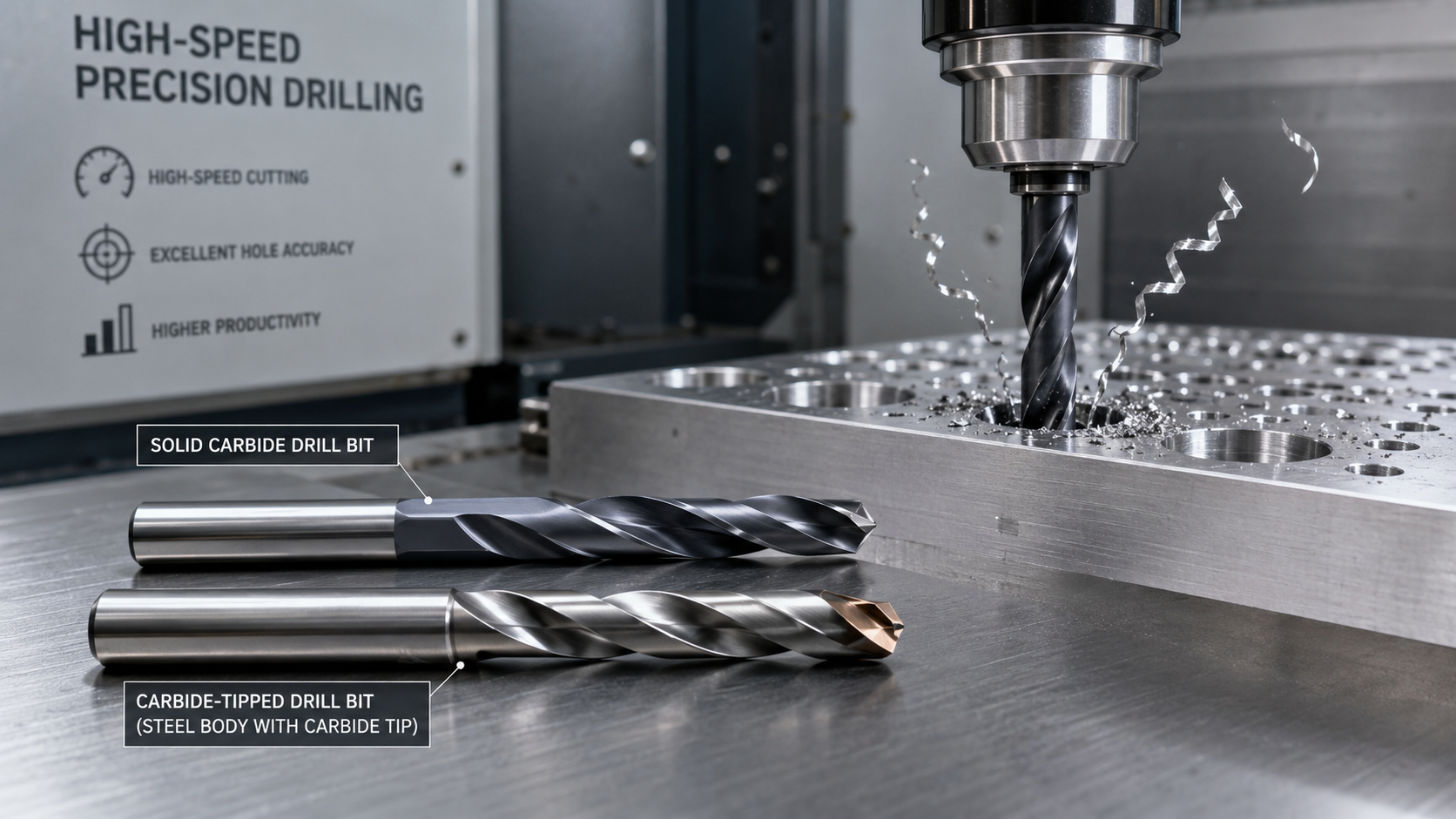
A carbide drill is all carbide in its cutting portion. The rigidity of the cutting edge location is great, so it is loadable, and faster cutting rates are possible. It is excellent for accurate CNC drilling.
Carbide-tipped drill: It has a steel body with carbide cutting edges at the tip. This construction minimises the use of carbide and can be an economical choice for larger diameters or rougher hole tolerances.
2. How Carbide Drill Bits Cut
Carbide drill bits have defined cutting edges that shear the material from the workpiece. The material removed is in chip form and passes through the drill flutes.
This cutting process allows high material-removal rates, but the drill must have sufficient chip space, reliable clamping and a proper feed rate. The drill might snap when chips get lodged in a deep hole even if the cutting edges are not totally worn.
3. Main Advantages of Carbide Drill Bits
Carbide drill bits are rapid cutting in steel, cast iron, aluminium and many other metals. They are capable of maintaining hole diameter, increasing production efficiency and repeated resharpening under stable machining settings.
Their high stiffness also restricts state-of-the-art motion while drilling. But this same rigidity also makes it more vulnerable than more flexible drill materials to side loading, spindle runout and unexpected impact.
IV. What Is a Diamond Drill Bit?
1. Diamond Material and Construction
Carbide drill bits are rapid cutting in steel, cast iron, aluminium and many other metals. They are capable of maintaining hole diameter, increasing production efficiency and repeated resharpening under stable machining settings.
Their high stiffness also restricts state-of-the-art motion while drilling. But this same rigidity also makes it more vulnerable than more flexible drill materials to side loading, spindle runout and unexpected impact.
2. How Diamond Drill Bits Cut
Diamond drill bits cut material via abrasion. Exposed diamond grains, rather of creating standard metal chips, grind minuscule particles out of glass, ceramic, stone, concrete or composite materials.
The grinding action distributes the force of the drill over many small points of contact. It minimises the localised pressure that can shatter glass, scratch porcelain or delaminate the layers of composite materials.
3. Main Types of Diamond Drill Bits
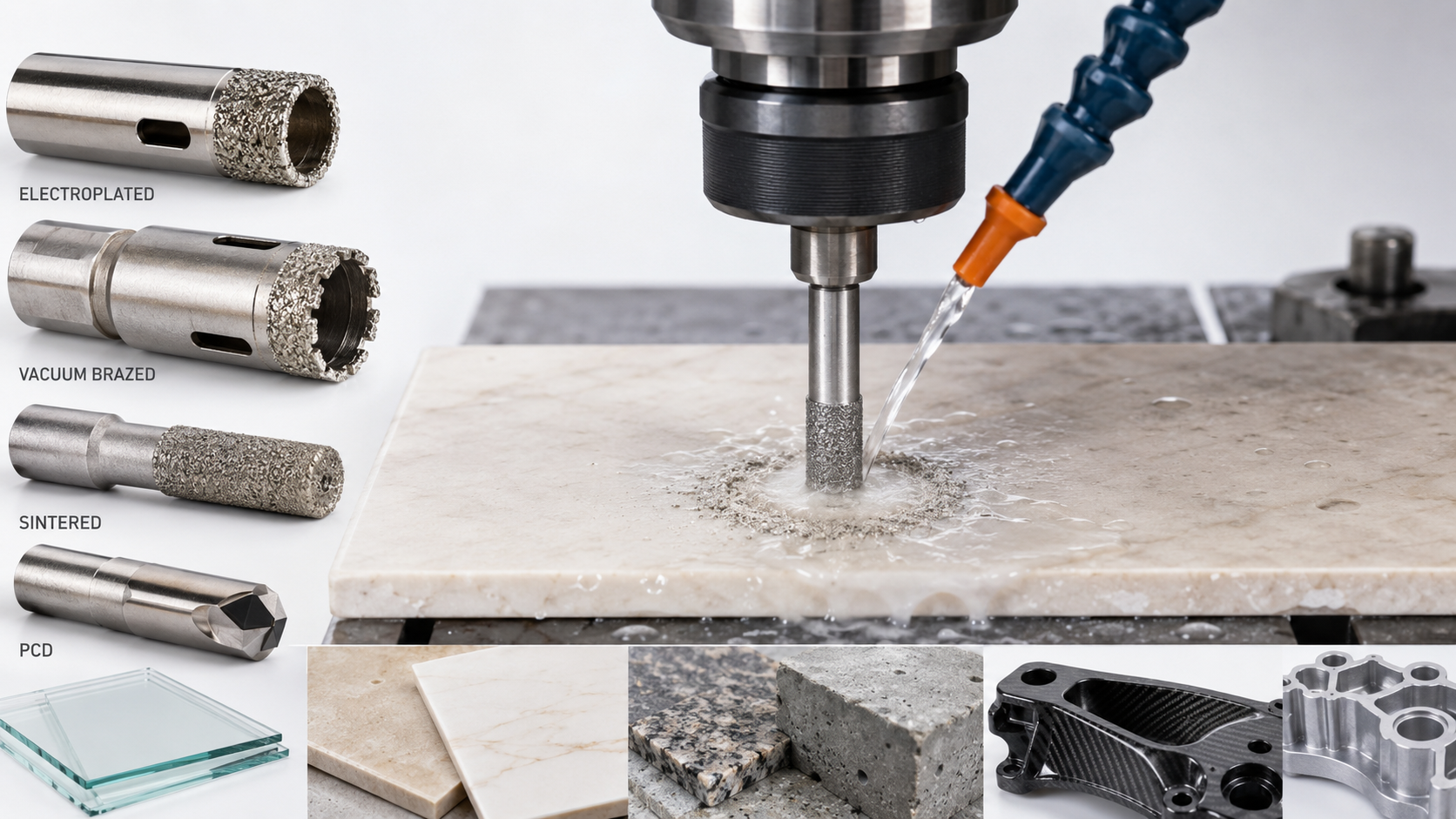
Electroplated diamond drill bits have a thin layer of visible diamond grains. They give a fast first cut and are suited for small drilling quantities. The tool usually comes to the end of its life when this layer is worn out.
The vacuum brazed diamond drill bits hold the diamond grains more firmly and expose a bigger portion of the grain. They are typically used for tile, stone and other hard materials, with wet- and dry-drilling versions available on the market.
Sintered diamond drill bits have diamonds bound in metal through a deeper working layer. As the bond wears, new diamond grains are revealed, making this architecture better suited for repeated drilling.
PCD drill bits have cutting edges of polycrystalline diamond. They are mainly used for precision, large volume machining of carbon fibre, glass fibre, graphite, high silicon aluminium and other abrasive non-ferrous materials.
V. Carbide vs Diamond Drill Bits for Different Materials
1. Steel and Stainless Steel
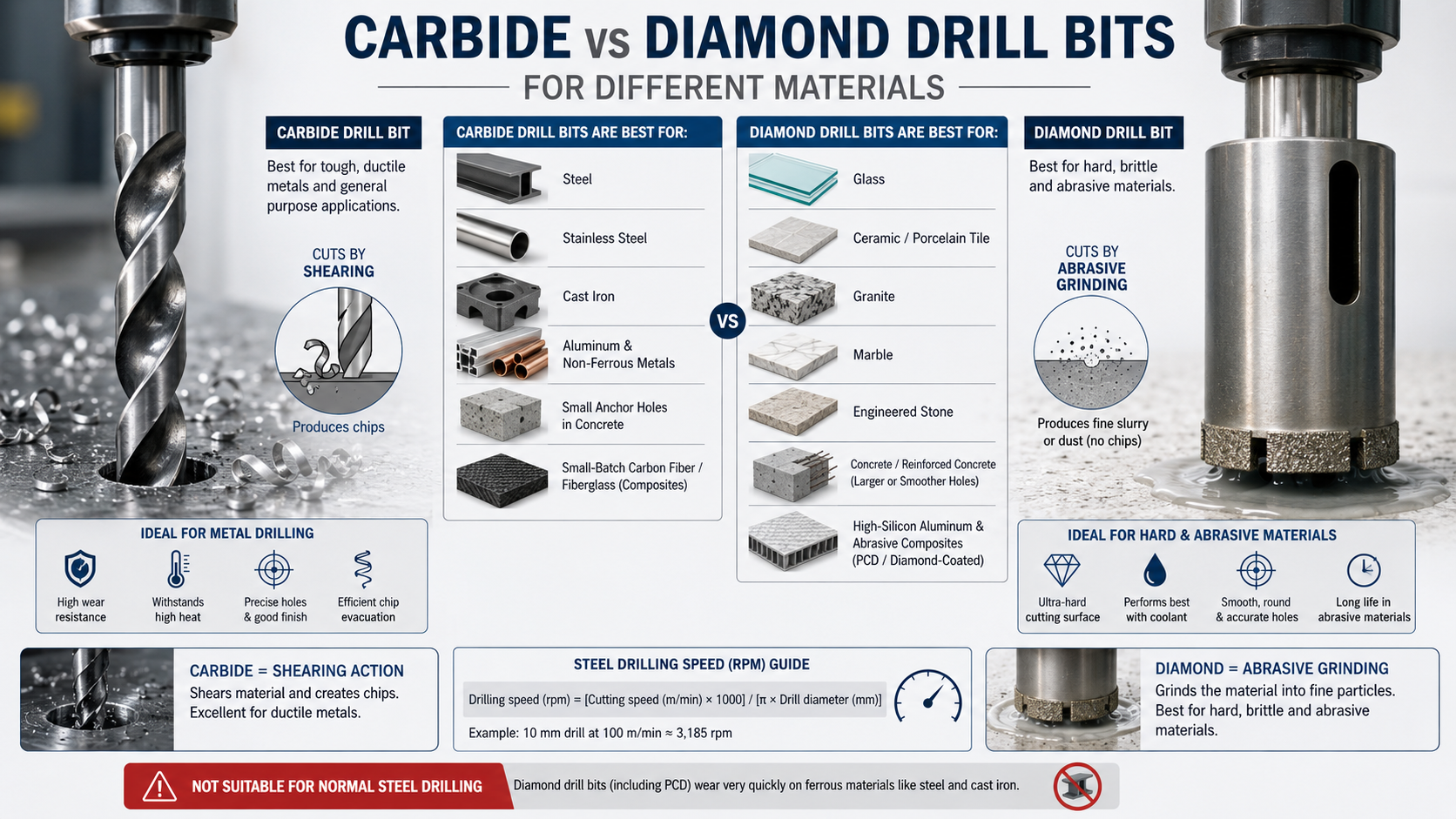
For carbon steel, alloy steel and stainless steel, carbide drill bits are usually the preferable choice. They cut efficiently, produce chips that are easy to handle and retain their edges at higher metal cutting temperatures.
For carbon steel, the initial range for many solid carbide drills can be as wide as around 60 to 150 m/min. In the final configuration, adjustments still have to be made according to steel grade, drill coating, coolant supply, hole depth and machine stability.
The formula can be used to compute the spindle speed:
Drilling speed (rpm) = [Cutting speed (m/min) x 1,000] / [π x Drill diameter (mm)]
For example, a 10 mm drill running at 100 m/min needs around 3,185 rpm.
High speed steel drilling is typically not suited to conventional diamond drill bits. At high temperatures diamond is tougher than carbide, but carbon in the diamond reacts with iron and promotes diamond wear.
2. Cast Iron
Carbide drill bits often offer longer tool life, higher drilling speeds and greater dimensional control in cast iron. However, grey cast iron, ductile iron and castings with sand or hard surface layers may require other grades of carbide.
Interrupted surfaces and strong inclusions might cause repeated impact on the cutting edge. Consequently, a somewhat more rigid grade of carbide might have a longer practical life than the hardest grade at hand.
3. Aluminium and Non-Ferrous Metals
Carbide drill bits are used for aluminium, brass and all other non-ferrous metals. Finished flutes, adequate chip space and keen cutting edges all assist keep the aluminium from sticking to the drill.
Diamond tipped or PCD drills are more useful when machining high silicon aluminium. High volume production requires hard silicon particles which are abrasive and can quickly dull standard carbide blades.
4. Glass and Ceramic
Diamond drill bits are usually better for glass and ceramic as they take the material away slowly. This reduces the likelihood of cracks and huge chips at the entry to the hole.
Water cooling removes heat and small grinding particles Light feed pressure and steady positioning with backing support should also be employed, especially when clean edges are to be obtained on both sides of the hole.
5. Porcelain Tile
Porcelain is denser and harder than the average ceramic tile. A carbide-tipped masonry drill may operate on soft tile, but it will drill slowly or go dull on hard porcelain.
Vacuum brazed or sintered diamond hole saws usually drill quicker and leave cleaner edges. If you’re drilling without a guide , you can start the bit at a small slant to make an initial groove , then bring the drill upright .
6. Granite, Marble and Engineered Stone
Granite is quite abrasive and its mineral grains can require a diamond drill bit. Marble is not as abrasive, but can chip around polished surfaces with excessive drilling pressure.
Engineered stone may have a high amount of quartz which might enhance diamond wear. This means that a drill bit that works well on marble may give a substantially lower life on granite or quartz based stone.
7. Concrete and Reinforced Concrete
For small anchor holes carbide-tipped masonry drills are fine, if you are happy to percussion drill. Diamond core bits are preferred for larger diameters, frequent drilling and holes that require smoother edges or less vibration.
In the case of reinforced concrete, the diamond segment has to cut concrete aggregate as well as steel reinforcement. When a core bit designed for non-reinforced concrete encounters the rebar, it may slow down or damage the segments.
8. Carbon Fibre and Fiberglass
Carbide drills are a cost effective solution for small quantities of CFRP or GFRP products. But abrasive fibres can cause wear to the cutting edges and in the long term induce delamination, frayed fibres or oversize holes.
Diamond coated and PCD drills preserve cutting geometry longer in repeated production. In one industrial application, a solid carbide drill completed around 2,500 pieces, whereas the PCD version completed 15,000 parts, approximately six times the tool life.
VI. Cutting Performance and Hole Quality
1. Drilling Speed
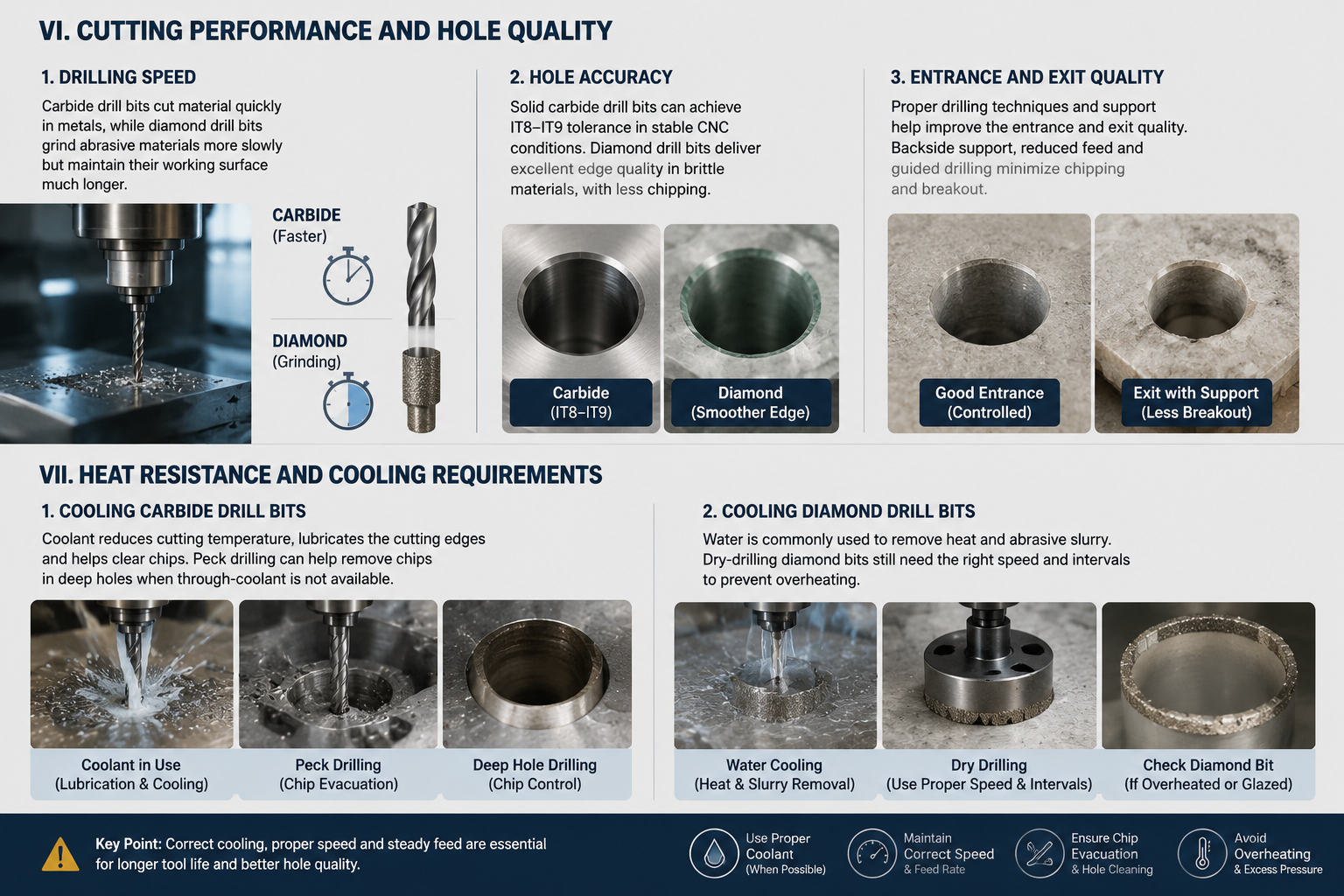
Carbide drill bits are usually faster when drilling steel, cast iron and aluminium since they cut the material and expel chips thanks to their defined edges. The drill can operate at higher cutting speeds and feed rates with stable equipment and effective coolant.
The key operation in diamond drilling is grinding. This can be slower than metal cutting, but diamond holds its working surface on glass, ceramic, stone and abrasive composites where carbide can rapidly lose its edge.
The total production cycle should include drilling time, cooling interruptions, core removal, tool changes, machine resets and rejected workpieces. Just comparing the time spent within one hole does not reveal the actual drilling efficiency.
2. Hole Accuracy
And solid carbide drill bits will create holes about IT8 to IT9 tolerance if the CNC circumstances are stable. Tighter tolerances may require reaming, boring or some other finishing operation.
Drill bits made from diamonds usually produce a superior edge quality in brittle materials. Grinding action can reduce ceramic chipping, glass cracking and composite delamination but the effect depends on feed pressure, cooling and runout.
3. Entrance and Exit Quality
If the drill is not steady or is pushed too fast into the material, the leading edge can become damaged. Positioning can be improved while drilling tile and stone by using a guide, pilot system or angled beginning method.
The exit side is often more difficult to control since the remaining material gets thinner as the drill breaks through. Backside support, a reduced final feed rate or drilling from both sides can decrease breakout damage.
VII. Heat Resistance and Cooling Requirements
1. Cooling Carbide Drill Bits
The coolant decreases the cutting temperature, lubricates the carbide blades and helps clear the chips from the hole. Poor chip evacuation is especially critical in deep holes and with small diameter drills.
Peck drilling can help to clean the chips that build up if there is no internal cooling accessible. But unnecessary re-entry can cause impact on the carbide edge, so the drilling cycle should be suited to the material and hole depth.
2. Cooling Diamond Drill Bits
Water is utilised often when drilling glass, ceramic, porcelain and stone. It removes heat and abrasive slurry from the working diamond surface.
Some vacuum-brazed and segmented diamond bits are intended for dry drilling. These tools still require the recommended speed and drilling intervals to prevent the diamond bond from overheating.
If a diamond drill becomes stuck, adding more pressure is seldom the right answer. The working surface may be glazed, clogged or overheated and should be checked before continuing to drill.
VIII. Hole Diameter and Drilling Depth
1. Typical Carbide Drill Diameter Range
In the field of precision metalworking, carbide drills are often used for drilling diameters from roughly 0.3 mm to 50 mm. This is a common solid-drill range, not an absolute limit, there are other larger carbide tipped and indexable systems.
Small solid carbide drills are especially sensitive to runout and side load. As the diameter gets smaller the same spindle error is a bigger percentage of the drill diameter.
2. Typical Diamond Drill Diameter Range
The size of diamond drills depends on the type of product, whether it is a micro drill, a precision drill, a hole saw or a construction core bit.
| Diamond drill construction | Typical diameter reference |
| Micro diamond drill | Approximately 0.05–0.75 mm |
| Precision diamond drill | Approximately 0.5–25 mm |
| Tile and stone hole saw | Approximately 3–150 mm |
| Concrete diamond core bit | Approximately 16–500 mm |
| Customized large core bit | Can exceed 1,000 mm |
The commonly used 1–25 mm range is for certain precision diamond drills only. It does not include huge tile hole-saws or building core-drilling devices.
3. Deep-Hole Drilling
You can’t select a drill bit based on diameter alone. The ratio of depth to diameter, sometimes expressed as L/D or ×D, impacts cooling, chip evacuation and stability of the tool.
If the hole is deeper than about 5×D, more care is needed to clear the chips. Internal coolant and adequate flute shape can be created for carbide drills for holes above 10×D, and deep diamond drilling will need continual cooling and a dependable technique for core removal.
IX. Machine Stability and Runout
1. Runout Requirements for Carbide Drilling
For conventional carbide drilling, the total suggested runout should normally be kept to below about 0.02 mm. The better goal in the use of small solid carbide drills or in the manufacture of near tolerance holes is to keep TIR under 0.01 mm.
Excessive runout leads one cutting edge to remove more material than the other. This causes large holes, uneven wear, vibration and premature carbide chipping.
2. Runout Requirements for Diamond Drilling
For general precision diamond drilling run out should generally be limited to approximately 0.025 mm or less. For demanding applications such as sapphire or micro-hole drilling, TIR may need to be below ~0.013 mm.
| Drilling condition | Suggested TIR |
| General carbide drilling | ≤0.02 mm |
| Small or precision carbide drilling | ≤0.01 mm |
| General precision diamond drilling | ≤0.025 mm |
| Sapphire or demanding micro drilling | ≤0.013 mm |
The allowable runout must decrease as the drill diameter decreases and as the required hole tolerance decreases.
X. Tool Life and Maintenance
1. Carbide Drill Wear
Carbide drill bits will often suffer flank wear, corner wear or small chips along the cutting edge. If the wear is progressive and uniform, it generally means that the cutting parameters are quite well balanced.
Large edge chips frequently indicate too much runout, unsteady entrance, interrupted cutting or side loading . Complete fracture is usually the result of chips becoming trapped, too much feed, or movement of the drill inside the hole.
2. Diamond Drill Wear
Wear of diamond grains, loss of grains, glazing or damage to the metal bond causes a loss of performance in diamond drill bits. Instead of grinding, a glazed working surface becomes smooth and friction develops.
If the binding is too soft the substance useable diamond grains can be released to early. If the bond is too firm, worn grains catch and do not allow new diamond to be revealed.
3. Resharpening and Reconditioning
Solid carbide drills can be re-sharpened multiple times if the damage has not gone too far back behind the cutting edge. Correct resharpening must restore the point angle, edge symmetry, web geometry and the coating status.
Electroplated and vacuum brazed diamond drill bits are not generally resharpened in the same way. Some sintered tools can be dressed, exposing fresh diamond, while higher-value PCD tools may be reconditioned or fitted with replacement PCD edges.
XI. Carbide vs Diamond Drill Bit Cost
1. Initial Purchase Price
For the same diameter and an industrial application, diamond-coated or PCD drills can be on the order of 2 to 10 times the cost of solid carbide drills. Some very specialised PCD tools can have a price above this range while little electroplated diamond bits may have less differential in price.
| Drill construction | Approximate initial cost |
| Standard carbide drill | Baseline |
| Electroplated diamond drill | About 1.5–3× carbide |
| Brazed or sintered diamond drill | About 2–8× carbide |
| Customized PCD drill | About 5–10× carbide or higher |
These figures are indicative, not quotations. Final price depends on diameter, diamond concentration, bond type, tolerance and order quantity.
2. Cost per Acceptable Hole
Reduced unit price does not necessarily mean reduced drilling cost. Tool changes, rejected items, rework, and machine down time must also be accounted for.
Use this formula:
Cost per acceptable hole = (Tool cost + Maintenance cost + Tool-change cost + Scrap cost) ÷ Number of acceptable holes
| Cost factor | Carbide drill | Diamond drill |
| Purchase price | $40 | $180 |
| Acceptable holes | 250 | 1,500 |
| Tool-change cost | $8 | $8 |
| Scrap cost | $10 | $5 |
| Total measured cost | $58 | $193 |
| Cost per acceptable hole | $0.232 | $0.129 |
In this case, the diamond drill is 4.5 times more expensive upfront, but reduces the predicted cost per acceptable hole by around 44%.
If you’re only going to drill 50 holes, the extra life of the diamond tool may not be worth the increased purchase price. Hence expected drilling amount has to be considered in the selecting process.
XII. Final Recommendation
Carbide drill bits are generally the better choice for fast, accurate drilling in steel, cast iron, aluminium, and other chip-forming materials, while diamond drill bits provide better wear resistance and edge control in glass, ceramic, stone, concrete, and abrasive composites. Your final choice should balance the workpiece material, hole size and depth, equipment accuracy, cooling conditions, and cost per acceptable hole. Send us your material specifications, drilling requirements, equipment details, and expected hole quantity, and we will help you select the right drill bit for your application.
XIII. FAQs About Carbide vs Diamond Drill Bits
1. Is a Diamond Drill Bit Harder Than a Carbide Drill Bit?
Yes, diamond is much tougher and more wear resistant than tungsten carbide. However, its enhanced hardness means that it is not suited for all materials, particularly steel and other ferrous metals.
2. Can Diamond Drill Bits Drill Steel?
Heat speeds up chemical wear between diamond and iron, therefore conventional diamond drill bits aren’t suitable for drilling high-speed steel. For ferrous materials carbide, ceramic or PCBN tools are generally better.
3. Can Carbide Drill Bits Drill Porcelain Tile?
A specialised carbide-tipped drill can punch a few holes in some tile, but it may wear out quickly on dense porcelain. Brazed or sintered diamond hole saws are generally faster in drilling and cleaner in edges.
4. Do Diamond Drill Bits Always Need Water?
No, certain vacuum brazed and segmented diamond bits are made for dry drilling. Generally, wet drilling provides greater cooling and particle removal hence a wet-only bit should not be run dry.
5. Why Does a Diamond Drill Bit Stop Cutting?
Grinding debris can clog the diamond surface, and it can become glazed or damaged by high heat. Before you add extra drilling pressure, check the coolant, speed and working surface.
6. Can Carbide Drill Bits Be Resharpened?
The solid carbide drills and the carbide tipped drills with normal edge wear are regrindable multiple times. Point geometry, edge symmetry, web thickness and coating condition need to be properly repaired.
7. Which Drill Bit Is Better for Carbon Fibre?
Carbide can be inexpensive for low volumes of drilling, however diamond coated or PCD drills tend to last longer for big volume carbon-fibre manufacture. Delamination, hole tolerance and exit-edge quality should also be considered in the final selection.
8. What Runout Is Acceptable for a Carbide Drill Bit?
A useful rule of thumb is to keep the total specified runout for carbide drilling to less than about 0.02 mm. Small diameter or close tolerance drilling may require runout sub 0.01 mm.
9. How Much More Does a Diamond Drill Bit Cost?
Solid carbide drills are 2 to 10 times cheaper than comparable diamond-coated or PCD drills. The real difference relies on diameter, diamond structure, tolerance and order amount.
10. How Long Does a Diamond Drill Bit Last?
Tool life can vary from a few holes when an electroplated bit is misused, to thousands of holes for an application specific PCD tool. The result is dependent on the abrasiveness of the workpiece, cooling, pressure, runout and diamond bond.
11. What Is the Difference Between Electroplated and Sintered Diamond Drill Bits?
Electro-plated drill bits feature a relatively thin diamond layer and are generally ideal for lesser volumes of drilling. Sintered bits have a deeper working layer of diamond that exposes new grains as the tool wears.
12. What Information Is Needed When Ordering Drill Bits?
Please specify the workpiece material, hole diameter, depth, tolerance, type of equipment, cooling technique, and estimated quantity. For difficult applications, an actual material sample helps test drilling speed, hole quality and tool life prior to bulk production.