I. Introduction
You can’t merely look at a size chart when you’re tapping a fine 10-32 thread. Drill bits may seem like simple instruments, but a broken tap in an expensive machined part is a tragedy and can cost a lot. Rejected batches and wasted effort can be the result of incorrect coating, improper size, or bad tolerances. It will tell you the exact standard drill size you need, how to match finishes to different materials, and what quality features to look for so you can buy more in bulk and save money.
II. Quick Answer: What Drill Bit Size for a 10-32 Tap?
The short answer is a #21 drill bit. This is about the proper size tap drill for a 10-24 tap in general. It is exactly 0.1590 inches long, 4.04 mm broad.
Why that size? #21 drill bit will give you roughly 75% thread engagement as far as machining goes. The “sweet spot,” as they term it in the corporate world. It offers you the best hold possible, yet still leaves enough area for the tap to not get trapped or broken.
Tip: If tapping is hard on the shop floor and tools are constantly snapping, don’t jump to a larger drill bit right away. A wider hole makes the thread way weaker. The drill you use should be checked for material, coating, sharpness, and cutting fluid.
III. What 10-32 Means Before Choosing the Drill Bit
If you don’t want to make simple mistakes in your catalogue, you need to know what these numbers mean.
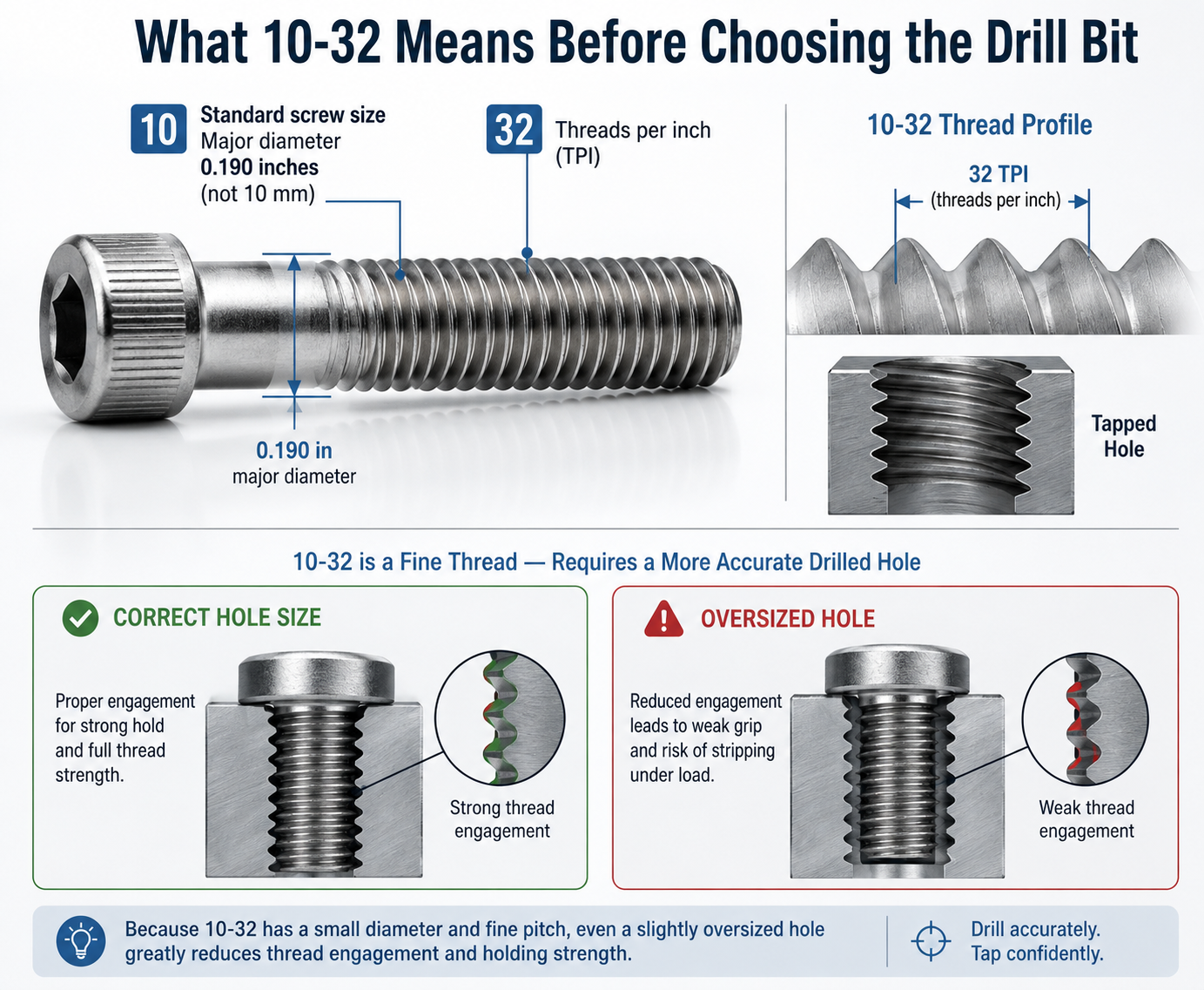
- The 10 refers to the standard screw size (a major diameter of 0.190 inches). It does not mean 10 mm.
- The 32 means there are exactly 32 threads per inch.
The holes are not as deep in 10-32 threads because it is a “fine” thread. This means that the accuracy of your holes is much more important. You can’t have the fine threads grip if the hole you drilled is even slightly too big. The screw will strip as soon as it’s put under load.
IV. Workpiece Material and Drill Bit Selection
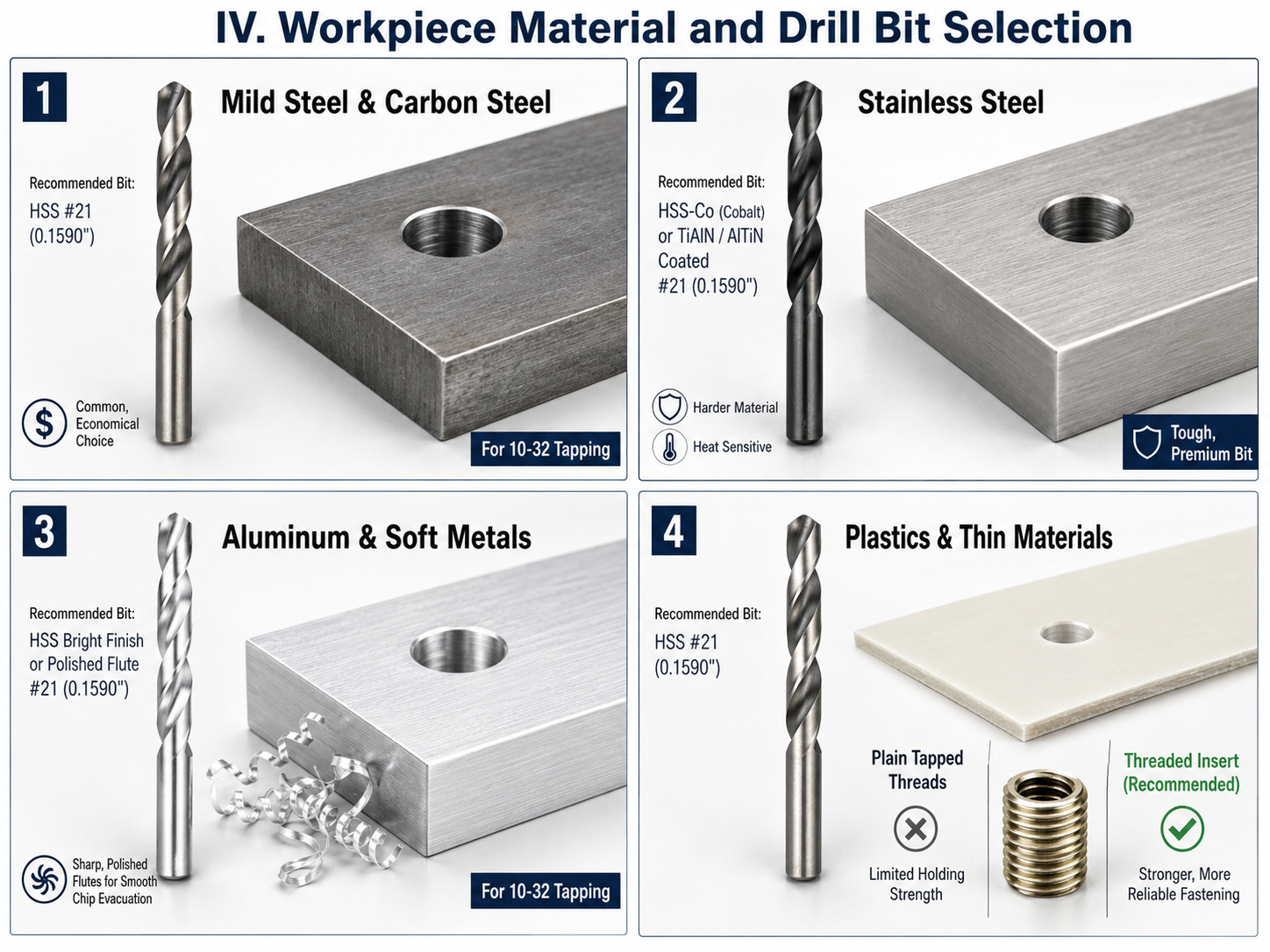
1. Mild Steel and Carbon Steel
Most 10-32 tapping projects are successfully completed with a standard HSS (#21) drill bit. Mild steel is easy to work with, which makes it very useful and economical for repair work, general hardware needs, and everyday use in the workshop.
2. Stainless Steel
Stainless steel is called “work-hardening.” Drilling with a cheap or dull bit can harden the steel as you drill it and make it nearly impossible to tap afterwards. It is the only material that will cut through with cobalt (HSS-Co), TiAlN or AlTiN-coated drill bits without hardening the walls.
3. Aluminum and Soft Metals
Aluminium is easy to drill but it is soft and tends to galle, which means it melts and sticks to the drill bit. Chips cling to the bit, and the hole is scraped and too huge. If you want drill bits with a bright finish or a polished flute, the soft chips won’t stay to the tool as they fall out.
4. Plastics and Thin Materials
The correct drill size is still necessary when drilling into thin materials or polymers but the inherent staying strength of the material is minimal. A regular tapped thread could go loose easily. If your consumers only want a bare tapped hole, you may need to tell them to use threaded inserts or altogether rethink how they attach things.
V. Drill Bit Material and Coating Options
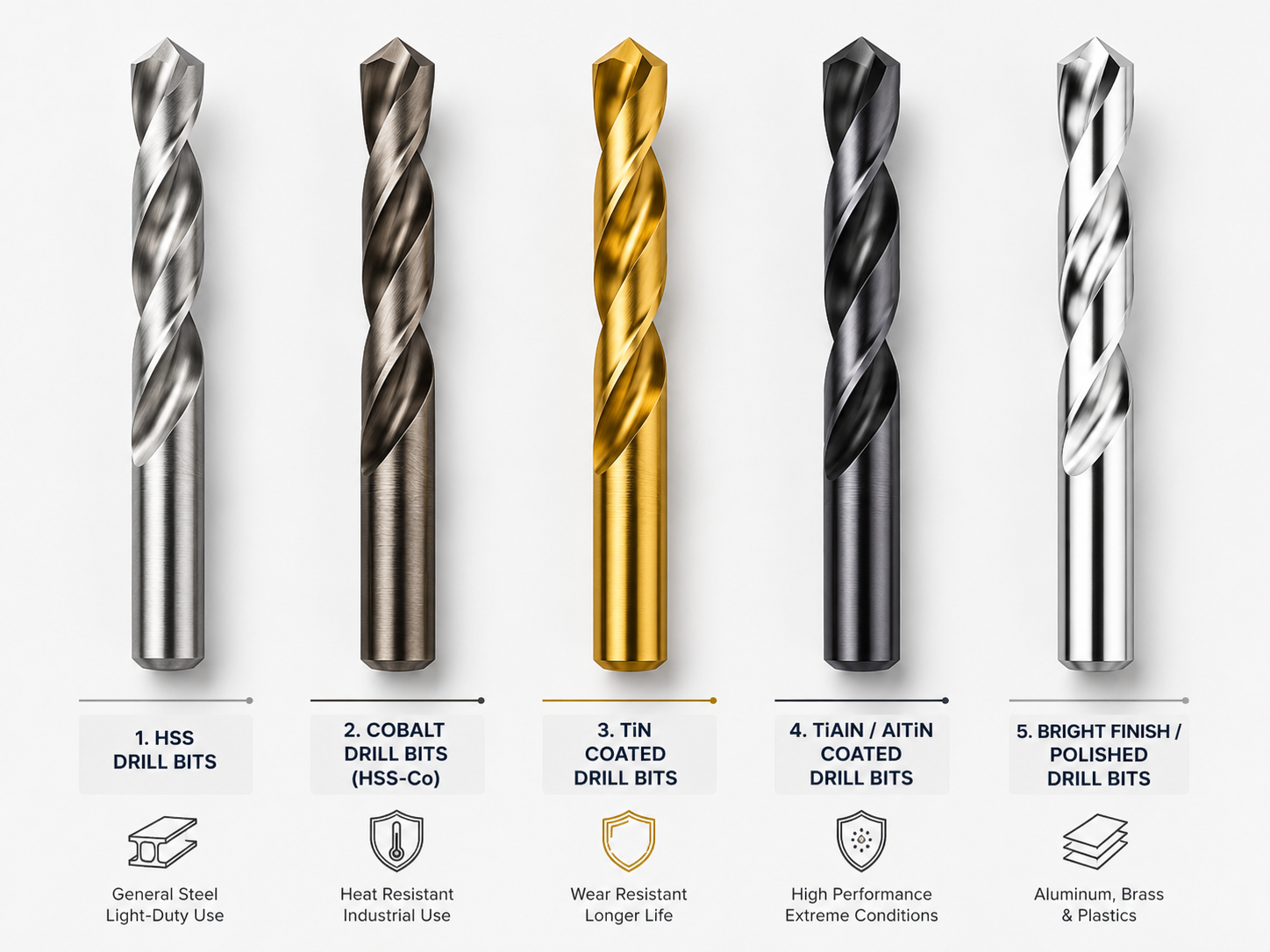
1. HSS Drill Bits
HSS is good for general steel, light duty drills, and price sensitive sectors. Keep these in stock when you require a typical line of products that consumers buy every day, and will sell quickly.
2. Cobalt Drill Bits (HSS-Co)
Cobalt is added to steel so that it can run at considerably greater temperatures without losing its edge. They are a must have for your factory clients, industrial users and professional tool lines with larger margins.
3. TiN Coated Drill Bits
The well-known gold TiN (Titanium Nitride) coating is very resistant to wear and makes things less likely to stick together. It works great for mid-range products and general metalworking needs, and it looks great on store shelves.
4. TiAlN or AlTiN Coated Drill Bits
Great for high heat and harder materials jobs these high tech black coatings. It’s amazing that they need high temperatures to work since they lubricate themselves naturally. That makes them ideal for professional CNC machining users, not for the guy with a hand drill.
5. Bright Finish or Polished Drill Bits
Bits that are brightly polished and not coated have the best surface. They are great for aluminium, brass, and plastics because they cut down on friction and leave a very clean hole finish that is ready for fine threads.
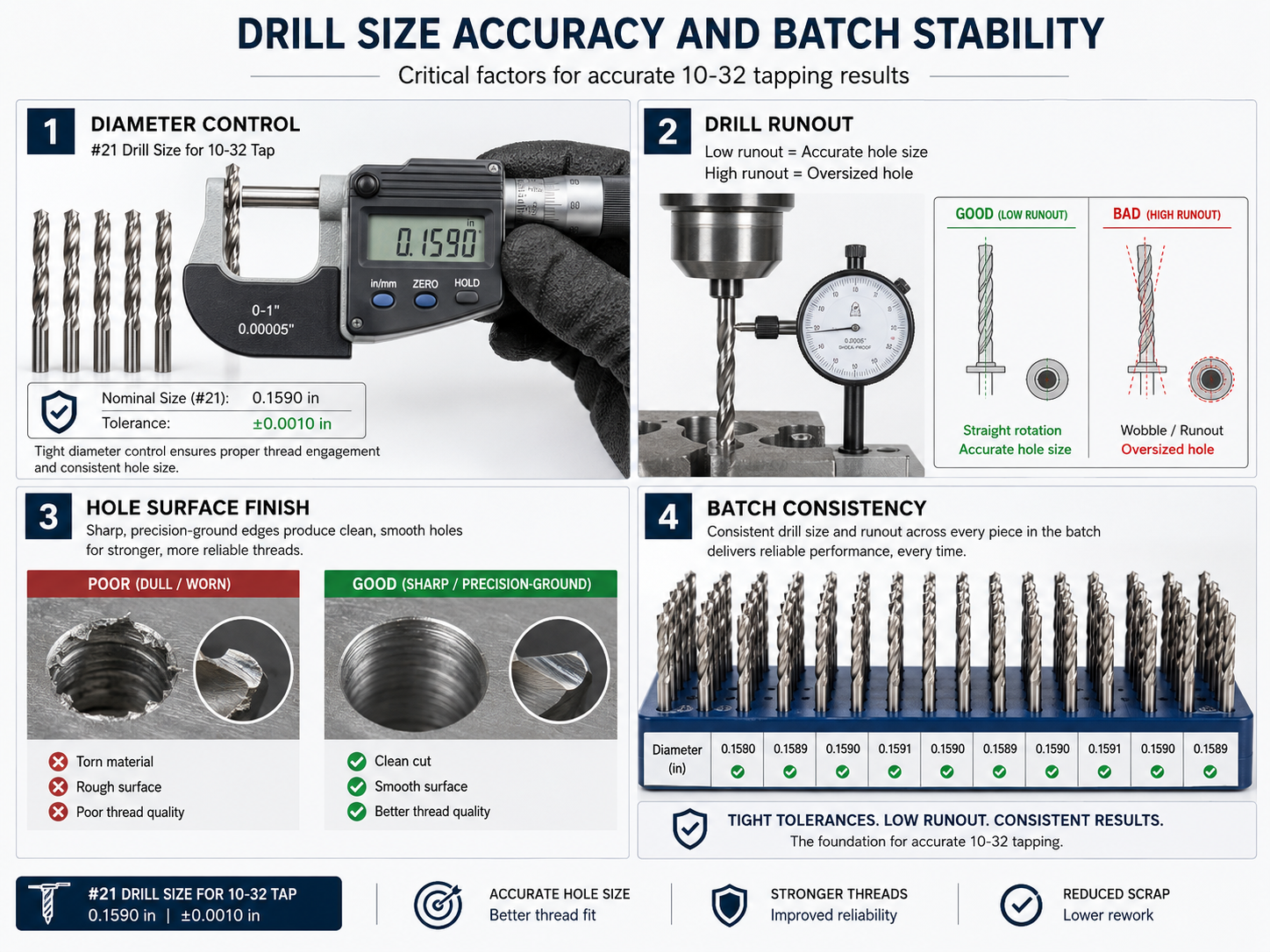
VI. Drill Size Accuracy and Batch Stability
1. Diameter Control
While being made, the thickness of every drill bit, even ones that are stamped “#21,” has to be closely monitored. If your tolerances are too small, your tapped threads will fail quality control checks. This will cause batches to be rejected and end users to be unhappy.
2. Drill Runout
Runout is the amount by which the drill bit shakes slightly as it turns. This makes it work like a boring bar, making the hole bigger than the bit itself. For a fine thread like 10-32, a drill bit that wobbles is a fatal flaw that will cause the threads to come loose.
3. Hole Surface Finish
A hole that is rough and torn makes it harder for the tap to work, which damages the thread finish. Cutting edges that are precisely ground and very sharp make the clean, smooth walls that are needed for professional assembly.
4. Batch Consistency
One good sample doesn’t mean the whole batch is good. When you import or order in bulk, the best way to protect your business’s reputation and lower the number of returns is to make sure that all of your thousands of bits work the same way.
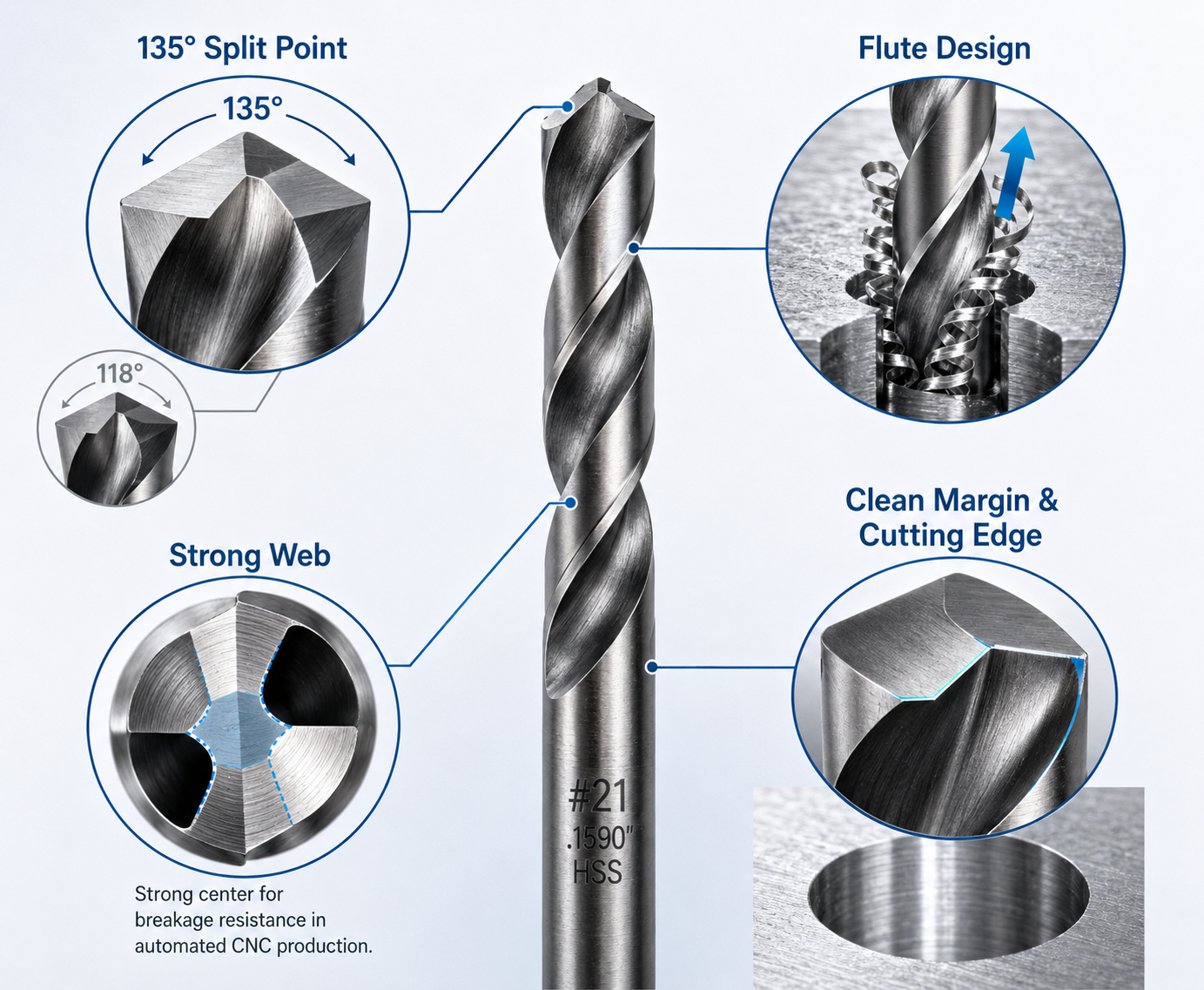
VII. Drill Geometry for More Stable 10-32 Tap Holes
1. Point Angle
A standard point of 118° is common and works for many things. For business use, though, a 135° split point is much better. It keeps the bit from ‘walking’ on the metal and gets rid of the need to center punch by hand, which saves a lot of time on the production line.
2. Flute Design
If you choose the right flute shape, the metal chips will slide out of the hole like an escalator. For small 10-32 holes, this is very important. If the chips are crowded at the bottom, the tap will hit them and break them right away.
3. Web Strength
“Web” refers to the drill bit’s solid center. A web that is bigger and stronger is less likely to break. This is very important for CNC production that is done automatically, since a broken bit can stop a machine and damage a valuable piece of work.
4. Margin and Cutting Edge Quality
The margins are the thin rails on the side of the bit. Clean margins help guide the drill perfectly straight, while precision-ground cutting edges reduce heat buildup and prevent rough hole walls.
VIII. Choosing for Different Buying and Use Scenarios
1. Repair and Workshop Use
Most of the time, standard HSS #21 drill bits are enough. For this market, it makes sense to offer sets of matched 10-32 tap and drill bits. The user doesn’t have to guess the wrong size, which makes the job easier for them.
2. Factory or Batch Production
Buyers in factories want as little downtime as possible. Give them strict size limits, harder drill bits (like Cobalt), and split points at 135°. Selling these higher-level tools keeps broken taps from happening, keeps parts from being rejected, and builds long-term relationships with industrial buyers.
3. Wholesale and Retail Supply
Clear size marking, durable packaging, and well-organized product lines stop customers from buying the wrong tool and returning it. A smartly packaged, logical product line is always easier for distributors to sell and reorder.
IX. Common Mistakes When Choosing a Drill Bit for a 10-32 Tap
Help your customers avoid these frequent and costly errors:
- Confusing the fine 10-32 thread with the coarse 10-24 thread, which requires a completely different hole size (#25).
- Grabbing a random 4.0 mm or 4.1 mm metric drill bit without realizing it alters the thread engagement percentage.
- Making the hole larger just to stop cheap taps from breaking, which ruins the structural integrity of the fastener.
- Choosing plain HSS for stainless steel results in immediate tool burnout.
- Buying low-cost, poorly ground drill bits that suffer from high runout and destroy batch consistency.
X. Conclusion
To summarize, the #21 drill bit is the standard and correct size for a 10-32 tap. But getting a perfect, reliable thread on the shop floor rests a lot on picking the right material for the workpiece, coating it, making sure the tools are the right shape, and being very careful during the manufacturing process.
Get in touch with Hanöki if you want to make sure that your supply chain always has solid quality and consistent performance. We have professional-grade 10-32 taps, matched tap-drill sets, and bulk drill bits. We can also make OEM packaging choices that are specific to your market needs.
- FAQ
- What size clearance hole do you need for a 10-32 screw?
Do not use a #21 drill bit if you want the 10-32 screw to be able to go through a part without having to thread into it. You need a hole for that. The right drill bit for a standard close-fit clearance hole is #9 (0.1960″), and the right drill bit for a free-fit clearance hole is #7 (0.2010″).
- Can you use a roll tap (forming tap) with a #21 drill bit for a 10-32 thread?
Not at all. A #21 drill bit can only be used to make taps. You need to use a bigger #16 drill bit (0.1770″) if your production line has roll taps, which press metal to make threads instead of cutting them. If you use a #21 bit with a roll tap, the tool will break right away.
- Is there an exact metric drill bit equivalent for a #21 drill bit?
To be exact, there is no perfect metric counterpart. It’s 4.04 mm wide for a #21 bit. A 4.0 mm metric bit is just a bit too small, which makes it more likely that the tap will break in hard metals. A 4.1 mm bit is a little too big, which makes the thread hold less well. Stay true to the exact #21 wire gauge size when tapping a 10-32 hole like a pro.
- What does “75% thread engagement” actually mean for a 10-32 tapped hole?
It means that the internal threads you cut will go 75% of the way to the screw’s possible deepest point. The industry aims for 75% because it gives almost 100% of the holding strength while still leaving enough room for the tap to not get stuck and break during production.
- How deep should you drill a blind hole for a 10-32 tap?
For most screws, you should drill the hole at least 1.5 times its diameter, which is about 0.285 inches for a #10 screw. You should also add extra depth to allow for the chamfered tip of the tap and any chips that get pushed to the bottom.
- Do you need a different drill size for Class 2B vs. Class 3B 10-32 threads?
Not at all. For both, you still start with a standard #21 drill bit. The H-limit of the tap you buy, not the size of the drill bit, tells you the thread class, or how tightly the screw fits.
- Can a 10-32 tap fix a stripped 10-24 hole?
Not at all. The #25 bit is used to drill the hole for the 10-24 thread, and the threads per inch are very different. If you put a 10-32 tap into a 10-24 hole that has been cleaned, you will cross-thread it and damage what is left.
- Should you chamfer or countersink a #21 hole before tapping 10-32?
Yes. Before tapping, giving the #21 hole a small 90-degree countersink helps guide the tap completely straight and keeps the top thread from lifting or making a burr when the screw is put in.
- Why do my 10-32 taps snap when reversing out of the hole?
This generally happens in blind holes where metal chips get squished into the flutes of the tap. As you go backwards, those chips stick to the newly cut threads. That is easy to fix: just use a spiral flute tap, which pulls chips up out of the hole.
- What is the minor diameter of a 10-32 tapped hole?
Standard thread charts show that the small width of an internal 10-32 thread is between 0.1562 and 0.1643 inches. At 0.1590 inches, the #21 drill bit is right in this range.
- Is spot drilling necessary before using a #21 drill bit?
Spot drilling is the best way to go if you are drilling into hard materials, curved surfaces, or a CNC machine that isn’t set up in a strict way. It keeps the #21 drill bit from moving, which makes sure the hole is exactly where it needs to be and is the right size for the tap.
- Can you tap a 10-32 thread directly into a laser-cut hole?
Laser cutting leaves a hardened, brittle edge (heat-affected zone) around the hole. Tapping directly into this will quickly dull or break a standard tap. It is best to laser cut the hole slightly undersized and ream or drill it out with a #21 bit before tapping.
- What is the recommended CNC drilling speed for a #21 bit in mild steel?
For a normal HSS #21 drill bit in mild steel, 2,000 to 2,500 RPM and 0.003 to 0.004 inches of feed per revolution is a good place to start. The speeds should be changed based on how the covering and coolant are set up.
- Does the drill bit length affect the 10-32 tapping process?
Yes. When you use a standard jobber-length drill bit, it can bend and run out, leaving the hole a little too big at the top. When CNC machining with great accuracy, a shorter drill bit called a “stub-length” gives the hole the most rigidity and makes it perfectly straight.
- How do you inspect a finished 10-32 tapped hole in production?
A 10-32 Go/No-Go plug gauge is the most reliable way to do things on the factory floor. To make sure the pitch diameter is right, the “Go” side should thread in smoothly. The “No-Go” side, on the other hand, should stop after one or two turns to make sure the hole is not too big.
- What cutting fluid is best for drilling and tapping 10-32 in aluminum?
Aluminium needs a fluid that keeps it from galling, which is when the metal melts and sticks to the tool. For keeping a #21 bit and 10-32 tap clean, heavy cutting oils are not as good as specific aluminium tapping fluids or even WD-40.
- Why does my 10-32 screw feel loose even after I used a #21 drill bit?
It’s most often because of drill runout. The #21 bit will wobble as it spins if the chuck that holds it is worn out. This will make a hole that is about #20 or #19 in size. Always make sure that your gear is centred.
- Can you use a #21 drill bit in a hand drill for 10-32 tapping?
Yes, but hand tools always have mistakes, wobble, and angles that aren’t straight. If you have to use a hand drill, a 135-degree split point drill bit is the best because it cuts right into the metal and doesn’t move around.
- What is a spiral point tap, and when should you use it after drilling?
People sometimes call this type of tap a “gun tap.” It moves the metal chips forward of the tool. For a “through-hole” (a hole that goes all the way through the material), you should use this type of tap after drilling your #21 hole.
- Does drilling a larger hole make tapping a 10-32 thread faster?
To be exact, yes, because the tap has to remove less material. When you move up to a #20 drill bit, however, your ability to hold the thread in place drops by a lot. When used in production settings, giving up thread integrity for speed causes the product to fail.
- Can you use a #21 masonry bit to drill a hole for a 10-32 tap?
Not at all. Masonry bits are made to break up stone and concrete, not metal. They will make a hole that is rough and not straight, which means you can’t use it to tap a fine machine thread.
- How do you remove a 10-32 tap if it snaps inside the #21 hole?
It is hard to get a broken tap out of a #21 hole because it is so small (0.1590″). A special tool with fine prongs is usually needed to remove a broken tap. In CNC manufacturing, the broken tap needs to be burnt out using an EDM (Electrical Discharge Machining) process.
- Is it cheaper to buy individual #21 drill bits or combined tap-drill sets?
Matching tap-drill sets are usually more profitable for wholesalers and retailers, and they also cut down on the number of returns from customers. It is much cheaper to buy #21 drill bits and 10-32 taps in separate bulk amounts for factories that make a lot of things.
- What is the difference between a #21 drill bit and a 5/32″ drill bit?
The 5/32″ drill bit is 0.1562 inches long, which is a little shorter than the #21 drill bit, which is 0.1590-inches long. But, in very soft materials, 5/32″ can sometimes be used instead of a 10-32 tap. This makes pressing much harder and increases tool wear by a lot.
- Why do some 10-32 taps have 2 flutes and others have 3 or 4?
How chip-free and strong a tool is depends on how many flutes it has. A two-flute tap lets the most chips escape, which makes it great for aluminium and other soft, gooey materials. It is better to use a 3- or 4-flute tap on harder steels because the chips are smaller and the tap is stronger.