I. Introduction
The angles of the center drill effect the accuracy of the hole entry, the manner of supporting the workpiece by the center seat, and the life of the cutting profile of the tool. Then choosing the proper angle is not just a matter of looking at the drill diameter. This tutorial discusses the standard center drill angles, their differing performance and how to choose the optimal one for various materials and machining processes.
II. What Is a Center Drill?
1. Definition and Purpose
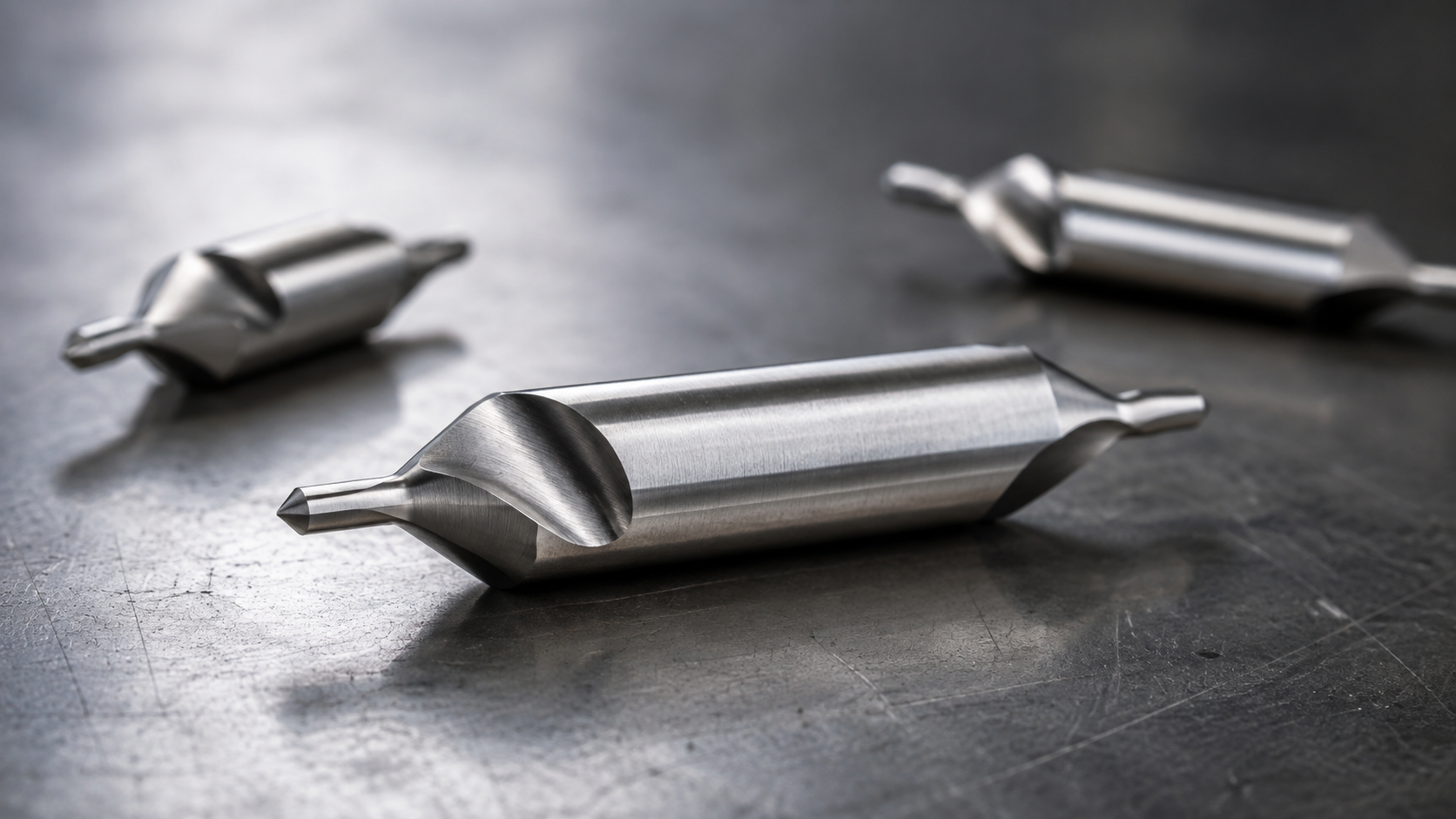
Center drill A short, stiff cutting tool with a small pilot drill and a bigger countersinking part. It can make the pilot hole and conical center seat in one operation. It can make it appropriate for accurate center-hole preparation.
2. Main Applications
Center drills are used mainly to drill center holes for turning between centers, cylindrical grinding, CNC lathe work and precision location. The combined drill and countersink designs also create pilot holes and countersunk holes for mating fasteners.
III. Understanding Center Drill Angles
1. Pilot Point Angle
The pilot point angle is the angle of the drill point that is formed at the small tip of the center drill. Typical designs are 118° or 120° and the angle influences cutting force, chip formation, pilot strength and tool wear.
2. Countersink Angle
The countersink angle is the included angle of the bigger conical portion behind the pilot. It is the seat or countersink of the center and determines its depth, diameter of opening, area of contact and distribution of load.
3. Which Angle Does “60° Center Drill” Mean?
The 60° of a common 60° center drill actually usually refers to the angle of the countersink or center hole, not the angle of the pilot point. The pilot point may still be 118° or 120° depending upon the center drill configuration.
IV. Center Drill Standards and Hole Forms
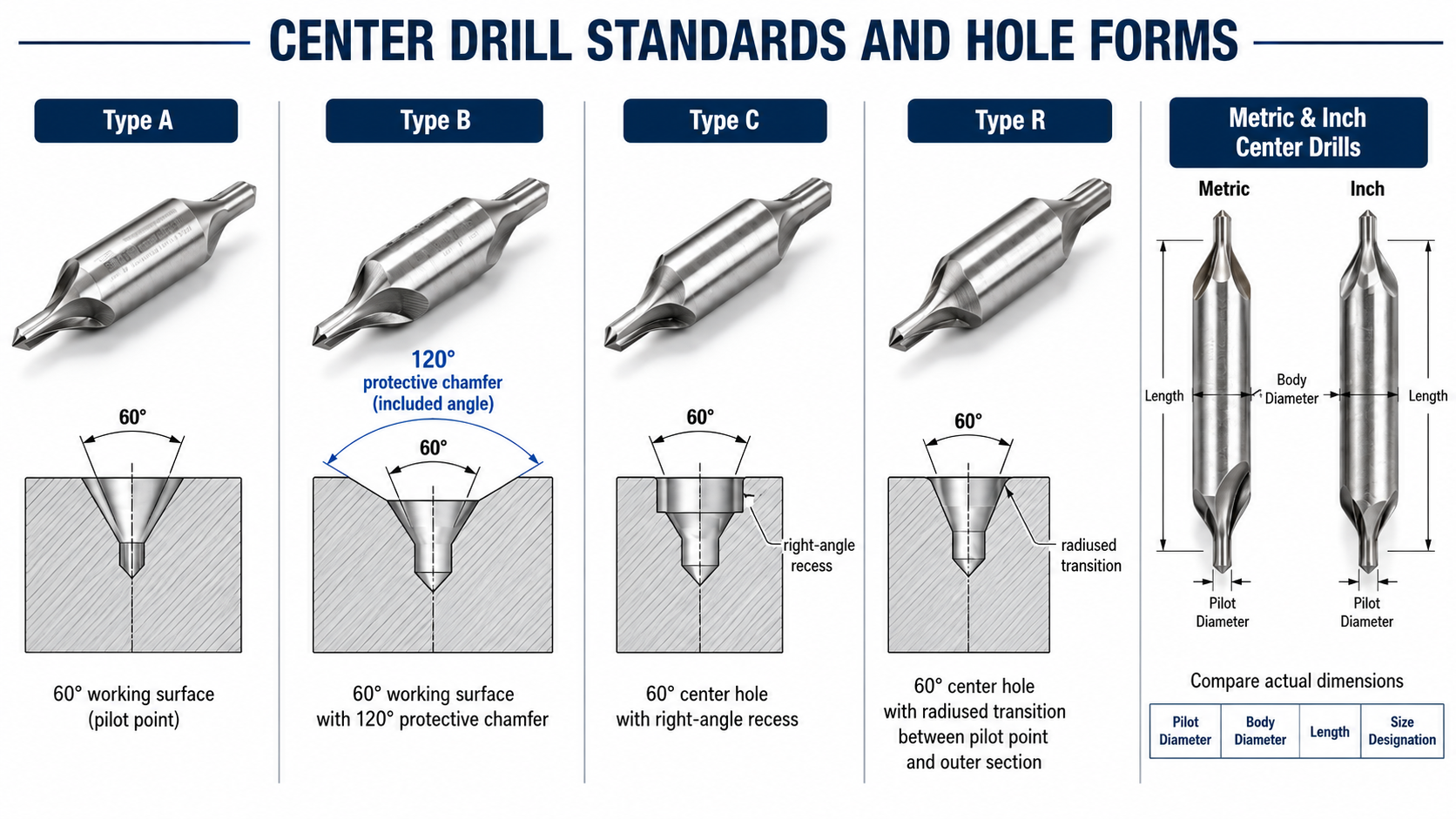
1. Type A Center Drill
Type A has a pilot, followed by a typical 60° center hole portion. It provides a regular center hole without an additional protective recess around the working surface.
2. Type B Center Drill
Type B has a 60° working surface, then a 120° protecting chamfer. The outer chamfer protects the edge of the middle seat from scratches and small impact during handling or repeated setups.
3. Type C Center Drill
Type C has a 60° centre hole and a further right angle recess for protection. The defined recess indicates the amount of material removed around the middle seat for more complete edge protection.
4. Type R Center Drill
Type R uses a radiused transition between the pilot and the outer section instead of a straight conical transition. The curved contour modifies the contact between hole and center and allows the hole to adapt to the prescribed center location.
5. Metric and Inch Center Drills
The metric and inch center drill may have the same nominal angle, but their pilot diameters, body diameters, lengths, and size designations are different. Don’t assume tools with similar size numbers are interchangeable. Compare the actual measurements.
V. Common Center Drill Angles
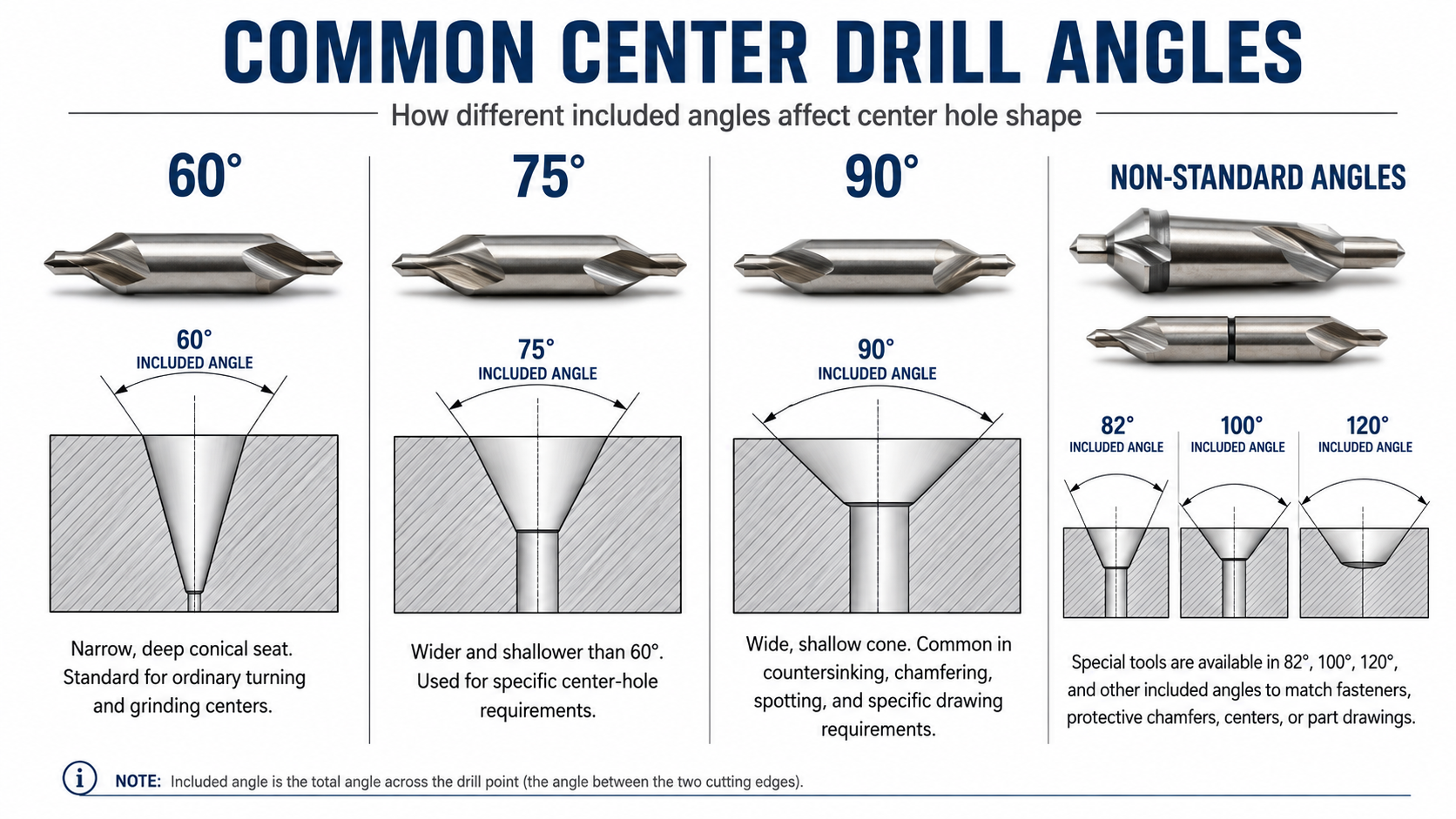
1. The 60° Center Drill Angle
The 60° centre drill gives a rather narrow and deep conical seat. This angle gives a high working surface area in a controlled opening diameter and is the most popular center-hole geometry for ordinary turning and grinding centers.
2. The 75° Center Drill Angle
A 75° center drill will provide a wider and shallower seat than a 60° tool for equal size of pilot and major diameters. It’s a particular center-hole angle, not a universal replacement for the regular 60° design.
3. The 90° Center Drill Angle
A 90° center drill provides a wider, shallower cone. This geometry is common in countersinking, chamfering, spotting and particular center-hole drawing applications.
4. Non-Standard Center Drill Angles
Center drills and combined drill-countersink tools are available with included angles of 82°, 100°, 120° and others. These designs are generally utilised to match certain fasteners, protective chamfers, centers or component drawings.
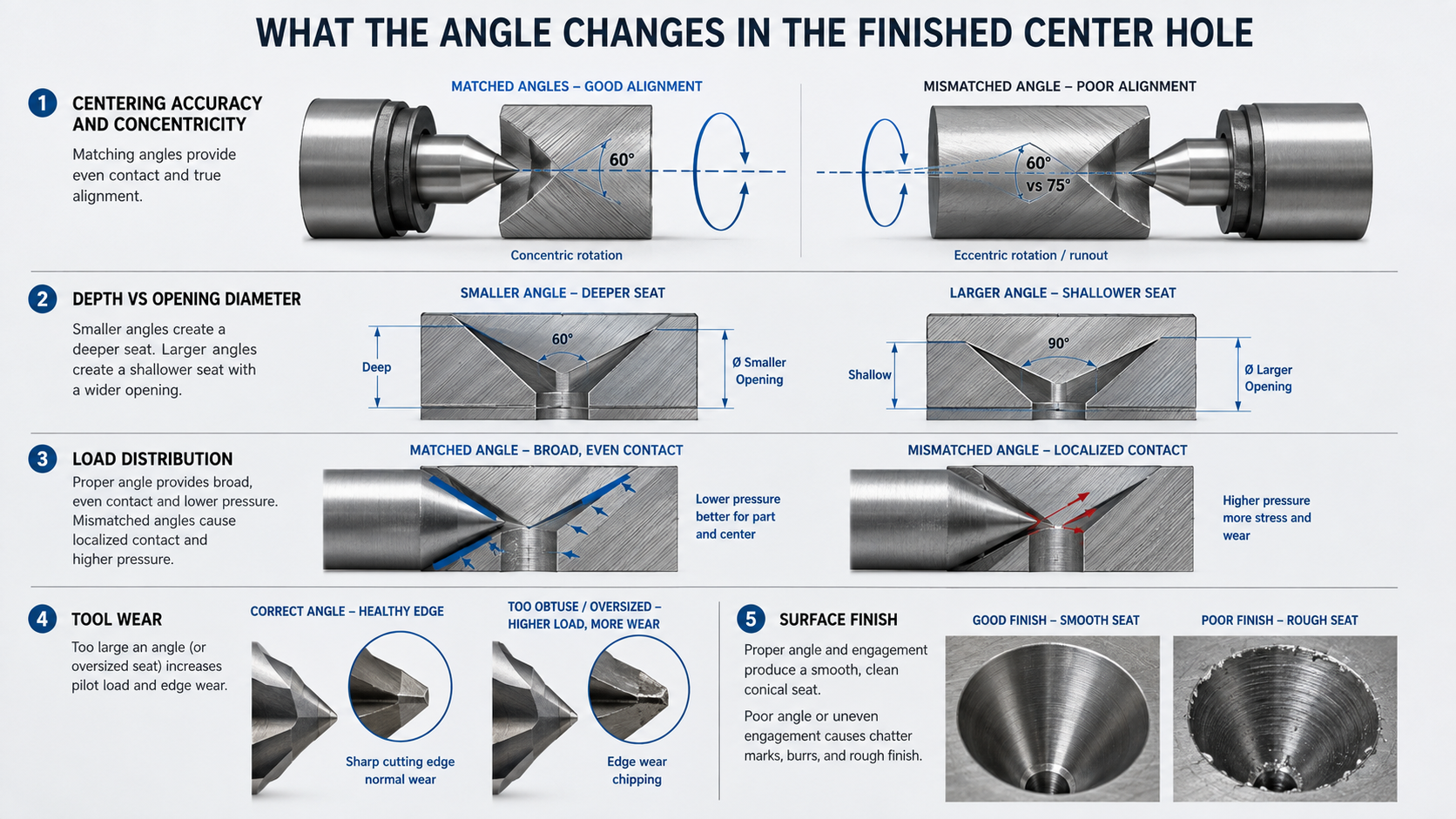
VI. What the Angle Changes in the Finished Center Hole
1. Centering Accuracy and Concentricity
The angle of the center hole dictates how it interfaces with the live or dead center supporting the workpiece. When the angles match, there is more even contact which helps keep the workpiece in alignment when turning, grinding and setting up repeatedly.
2. Center-Hole Depth and Opening Diameter
For the same pilot and major diameters, the smaller the included angle the deeper the conical seat, and the larger the included angle the shallower the seat. This relationship influences the quantity of material taken from the end of the workpiece and the quantity of working surface accessible.
3. Load Distribution
A center and center hole properly matched distribute the supporting load over the desired conical surface. If the contact is in a tiny region, then the local contact pressure increases and the center seat will wear or deform faster.
4. Tool Life and Tool Wear
It alters the amount of material removed by the conical cutting blades and the load distribution in the cutting process. Too great a center seat or too obtuse of an angle increases pilot load, edge wear, and the possibility of chipping.
5. Surface Finish
A constant center drill angle helps both cutting edges enter the workpiece uniformly and generate a consistent conical surface. Uneven engagement can leave chatter marks, burrs, or an unfinished center seat that requires more work.
VII. How to Select the Right Center Drill Angle
1. Based on Workpiece Material
Carbon Steel and Alloy Steel
60° center drills are normally used for a standard center hole when using a 60° lathe center and for carbon and alloy steel. HSS is suitable for general applications. HSS-Co or coated HSS can offer higher wear resistance for repeated production.
Stainless Steel
Stainless steel does not necessarily need a bigger center-hole angle. If the hole must be a 60° center, keep the 60° angle and utilise HSS-Co or carbide to manage the higher cutting resistance and heat.
Aluminum and Other Non-Ferrous Metals
Aluminium can be used with a 60° center hole when the workpiece is against a conventional 60° center. The angle of the centre-hole is less important than having sharp cutting edges and bright or polished surfaces which help to reduce aluminium adhesion.
Hardened and Abrasive Materials
Carbide center drills provide better profile retention when cutting hardened steel, cast iron, or abrasive materials. The tool material changes to improve wear resistance, while the center-hole angle should still match the center or drawing.
2. Based on Machining Operation
Turning between Centers
Use a 60° center drill when the workpiece will be supported by a standard 60° live or dead center. Type A will create a simple center hole Type B will put protection around the same 60° working surface
Grinding between Centers
In addition to the grinding between centers, the center hole must be matched to the machine center. A consistent center-hole shape allows the workpiece to re-axis itself when changing from turning to grinding or is remounted for another operation.
CNC Lathe Centering
A 60° center drill is used, if the CNC lathe wants to make a finished center seat for later support. If the tool is just providing a starting point for another drill, use a spot drill with the same point angle as the next drill.
Countersunk Fastener Holes
Select the counter-sink angle to match the fastening head. Some inch flat-head screws use 82 degrees, many metric countersunk screws use 90 degrees, and other fastener standards may require 100 degrees or another angle.
Special Center-Hole Requirements
Select 75°, Type C, Type R, or other custom profile as defined by machine, mating center or component drawing. Do not substitute it with the nearest standard angle, since drilling deeper alters the hole diameter, not the conical shape.
VIII. Angle Tolerances and Precision Control
1. Angle Tolerance
The allowed angle tolerance relies on the center-hole standard, the accuracy of the final item, and the mating center. Any general work may be done after the tolerance of the specified standard, but precision or custom center holes must reflect the needed angle tolerance on the drawing.
2. Angle and Diameter Control
The included angle cannot be evaluated independently of the pilot and major diameters. Even if the nominal angle is achieved, a center drill can nonetheless generate an oversized or undersized working seat due to improper dimensions or drilling depth.
3. Batch Consistency
For repeated manufacturing, the pilot diameter, countersink angle and primary cutting diameter should be the same from tool to tool. A stable geometry assists you to get the same shape of the center hole when you replace a worn tool.
IX. Common Problems Caused by Incorrect Center Drill Angles
1. Poor Centering
The central contact may only touch the opening or a small inside portion of the hole if the angle is improper. This results in the need for a less stable conical support to keep the workpiece axis.
2. Excessive Vibration
Partial contact means that the work piece responds more strongly to the cutting forces. After remounting the part, you can see vibration, noise, or inconsistent positioning as a consequence.
3. Incorrect Center Holes
A wider angle can result in an aperture that is too broad before the depth of the center seat is achieved. A smaller angle can generate a hole deeper than the component drawing allows.
4. Rapid Tool Wear
If the angle is incorrect, the center drill may have to take out more material or go deeper than it should. This increases pilot and conical edge load causing uneven wear, pilot chipping or premature breakage.
X. Center Drill vs. Spot Drill vs. Regular Drill
1. Center Drill
A center drill is a pilot with a bigger conical section that produces a center hole or a combination pilot and countersink. Its angle is chosen based on the specified center seat, fastener or part drawing.
2. Spot Drill
A spot drill makes a starting impression to guide a subsequent drill. Under typical circumstances, its point angle should be equivalent or slightly bigger than the point angle of the next drill so the center of the drill hits first.
For example, when a 60° center drill is used before a 135° carbide drill, the outer cutting blades of the carbide drill may be the first to contact. That corner shock is reduced with a proper 135° or larger spot drill.
3. Regular Drill
A standard drill takes away material to make the main hole. The 118° and 135° figures are common and are for the point angle between its major cutting lips, not the angle of a load bearing centre seat.
XI. Final Recommendation
First, figure out if you need a center hole for turning or grinding, a locating point for another drill, or a countersink for a fastening. Set the angle to the centre as per drill, fastener or drawing and select HSS, HSS-Co or carbide as per the material and manufacturing requirements. Hanöki will help you to check the correct center drill specification. Please send Hanöki the material of your workpiece, the center-hole form, the pilot diameter, the main diameter, the length of the tool, kind of machine and quantity necessary.
XII. FAQs About Center Drill Angles
1. How Deep Should a Center Drill Go?
The center drill must go deep enough to create the major diameter needed for the finished center seat. If you use the whole length of the cutting as your depth goal, the hole might get bigger than what the drawing shows.
2. What Does a Center Drill Size Number Mean?
The product system is characterised by a size number indicating a certain set of pilot diameter, body diameter and length. It does not define the finished centre seat diameter or the whole tool geometry.
3. Can Type B Replace Type A?
Type B can provide the same working seat of 60° with the addition of a protective chamfer of 120°. It may replace Type A only if the additional recess is acceptable on the part drawing.
4. Can Type R Replace Type B?
Type R and Type B provide distinct center-hole profiles. Type R features a rounded transition and Type B has distinct 60° and 120° conical surfaces.
5. When Is Type C Required?
Type C is used when the fixed protective recess is specified on the standard or drawing of the center hole. It should not be picked just because the work item is large and substantial machining load is required.
6. Are Metric and Inch Center Drills Interchangeable?
Not essential, even if both instruments employ a 60° angle. The pilot diameters, body diameters, cutting lengths and size designations may vary.
7. Will Regrinding Change the Center Drill Angle?
Improper regrinding may alter the angle, pilot diameter, pilot length and transition profile. Before using a reground center drill for controlled center holes, check it against the original specification.
8. Why Does a Center Drill Pilot Break Easily?
The pilot may be too small for the required center hole, may run too deep, or may have excessive runout. An slanted or otherwise uneven surface on the workpiece may load one pilot edge ahead of the other.
9. Can a Center Drill Start on an Angled Surface?
A normal center drill can be deflected as the initial point of contact with the cutting edge is the surface. Before making the final center hole, a firm starting surface or proper spotting method should be prepared.
10. Can Different Center Drill Angles Be Used at Opposite Ends of One Part?
Yes , if two ends are separate functions or matching various centre criteria. Both hole shapes must still conform to the component drawing and the equipment utilised in later procedures.
11. Do Micro Center Holes Need Tighter Angle Control?
Small differences in dimension and angles become more significant with smaller pilot and center-seat diameters. Micro center holes hence demand more tightly controlled angle, pilot size, runout and inspection.
12. Are Center Drill Angles the Same across Different Manufacturers?
Although the nominal angle may be the same, the pilot size, body size, edge preparation and manufacturing tolerance may differ. Swap out one manufacturer’s tool for another and compare the whole set of dimensions drawings.
13. Can a 60° Center Drill Be Used before a 135° Drill?
This can cause the 135° drill to hit around its outer cutting edges first rather than in the center. Use a spot drill with the same or slightly larger point angle if the aim is to guide the subsequent drill.
14. How Can You Tell If a Center Hole Is Too Shallow?
The center tip may bottom in the pilot before the conical surfaces are fully engaged. Check the pilot clearance and finished major diameter against the center hole drawing.
15. What Happens If the Center Hole Is Too Deep?
The aperture diameter is enlarged and additional material is removed from the end of the workpiece. The larger seat may no longer match the sketch or give the desired contact position.
16. Can the Same 60° Center Drill Be Used for Aluminum and Steel?
The same center-hole angle can be used when both workpieces are to fit a 60° center. The proper tool material, coating, surface finish and cutting conditions may still differ.
17. Is HSS or Carbide Better for Center Drilling?
HSS is more forgiving to vibration and appropriate for general or smaller volume applications. Carbide provides more rigidity and wearability for steady machinery and repeatable manufacturing.
18. Does a Coating Change the Center Drill Angle?
A coating does not purposefully alter the nominal angle . Excessive coating thickness or inadequate edge preparation can impact a very small cutting edge . Thus, the full coated tool must be able to achieve the desired completed shape.
19. Can an Incorrect Center-Hole Angle Be Corrected?
If a bigger finishing diameter is appropriate and there is enough material left the hole might be recut. Where correction exceeds the drawing limit, the part will be subject to engineering approval.
20. What Information Is Needed for a Custom Center Drill?
Give the pilot point angle, center-hole angle, pilot diameter, major diameter, cutting length, overall length, tool material, workpiece material and number. Provide a finished-hole or tool design when the desired profile is not a standard shape.