I. Introduction
If your drill slips on hardened steel, becomes too hot, or becomes dull after only a few holes, the problem may be the drill, not the cutting parameters. You must fit it to the steel hardness and hole condition in terms of substance, point shape, coating and length. This guide discusses which drill bit to use, why it works, and what happens if you choose the wrong one.
II. What Counts as Hardened Steel?
1. What Hardened Steel Means
Hardened steel is steel that has been heat treated to make it harder and more wear-resistant. It can be quenched, tempered, case hardened or induction hardened. The most useful information when choosing a drill is the hardness at the place where you will make the hole.
2. Why the Final HRC Matters
The HRC evaluates how resistant the steel is to the cutting edge. The HRC increases and the drill needs more edge hardness and wear resistance to cut through the surface and make chips. A drill that can work in 35 HRC steel may just rub and overheat in 60 HRC steel.
3. Case-Hardened and Through-Hardened Steel
Case-hardened steel is steel which has a hard outer shell and a soft core. Initially, the drill has to penetrate the hard surface and then be steady when the cutting load reduces inside the part.
The cutting edge is under a high stress during the whole operation and often requires higher wear resistance.
4. Why the Steel Grade Is Not Enough
D2, H13, 4140 and 4340 can be provided in annealed, prehardened or completely hardened form. You may need a different drill bit for each situation. Before choosing the tool, be sure of the quality of steel and its hardness after heat treatment.
III. Why Hardened Steel Needs a Different Drill Bit
1. The Cutting Edge Must Penetrate the Surface
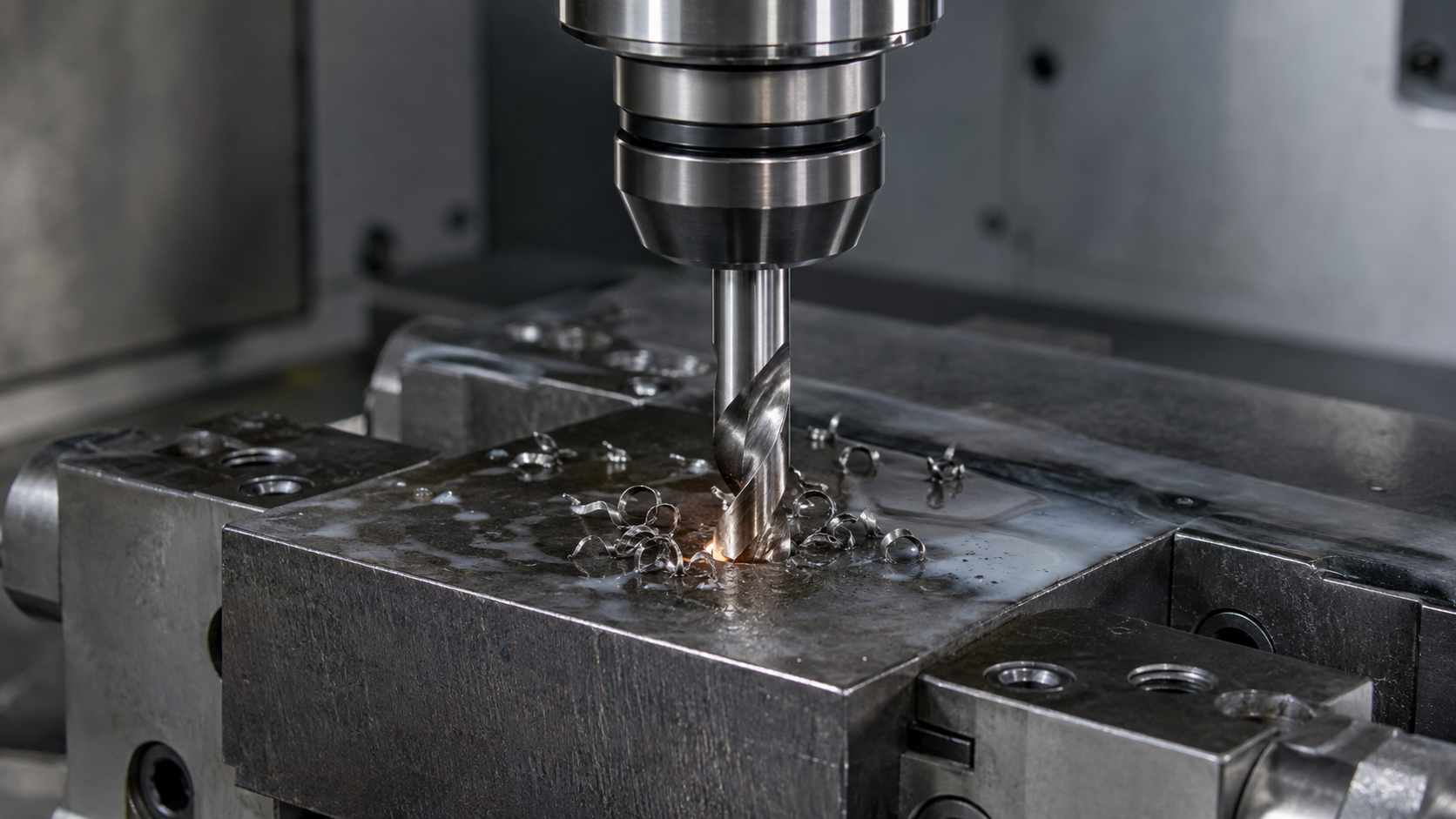
A good drill eliminates hard steel by cutting it into chips. If the edge is not firm and sharp enough, it glides on the surface. This produces heat without beneficial penetration and rapidly destroys the drill point.
2. Hardened Steel Wears the Edge Quickly
Hardened steel is abrasive to the cutting corners and flank surfaces of the drill. When these sections are used the edge becomes rounded and it takes more energy to keep cutting. The outcome is slower penetration, greater temperatures and shifting hole diameters.
3. Cutting Heat Stays around the Drill Tip
The strong steel is highly resistant to cutting and hence generates heat at the site of the drill. The edge is kept hard at this temperature with the use of a suitable substrate and coating. If they are not there, even if it hasn’t fractured or chipped, the drill gets dull.
4. High Loads Increase Chipping Risk
Solid carbide has the hardness required for high-HRC steel, but is impact sensitive and side-load sensitive. An unstable holder, a tool that is excessively long, an angled entry or cross hole might put most of the strain on one cutting corner and damage it.
IV. Which Drill Bit Material Should You Choose?
1. Standard HSS for Drilling before Hardening
Standard HSS is fine for normal steel and for holes drilled before heat treatment. It is suitable for lower cost and good toughness when the workpiece has not reached final hardness yet.
Usually not suited for highly hardened steel. The cutting edge wears quickly and loses its capacity to create chips. Just a generic “heavy-duty HSS” description doesn’t indicate the drill can cut high-HRC material.
2. M35 Cobalt for Prehardened Steel
M35 is a cobalt HSS alloy, with around 5% cobalt. It holds an edge better than normal HSS at elevated temperatures, while being more tolerant of vibration than solid carbide.
Select M35 for prehardened steel, low-HRC workpieces, occasional holes and machines with limited stiffness. If it simply polishes the surface and does not make chips, the workpiece is generally outside the practical range of the drill.
3. M42 Cobalt for More Demanding Prehardened Steel
M42 usually includes around 8% cobalt, and is more heat resistant than M35. Good for when M35 wears out too rapidly but you still need the robustness of an HSS based drill.
M42, for prehardened or moderately hard steel, where the equipment is not stable enough for solid carbide. Increasing the cobalt grade is generally not as reliable as using a hardened-steel-specific carbide drill when the material reaches the 55–65 HRC range.
4. Cobalt or Carbide for Steel around 35–45 HRC
Cobalt and carbide can both work in this range. Select M42 when you want additional toughness, utilise softer equipment, or simply generate a limited number of holes.
If your CNC machine is stable and you need longer tool life or more consistent hole size, select solid carbide. Carbide is more expensive initially, but can reduce tool replacements with repeated manufacture.
5. Solid Carbide for Steel around 45–55 HRC
If the steel is over about 45 HRC then solid carbide is often better suited. The increased hardness lets the cutting edge to penetrate the material and resist abrasive wear for a longer time than cobalt HSS.
Drill using a carbide drill with a sharp point, reinforced cutting blades and heat resistant coating in this series. You could drill the first few holes with a common purpose carbide drill but it will lose precision or chip before long run is over.
6. Hardened-Steel Carbide for 55–65 HRC
Steel with hardness of 55-65 HRC generally needs a solid-carbide hardened steel drill. The drills are made of a wear resistant carbide grade, reinforced cutting edges, a robust core and a coating that remains stable even at high cutting temperatures.
This range does not automatically allow for the use of ordinary carbide drills. Even if the drill itself is constructed of carbide, if the shape and coating are designed for ordinary steel, the cutting corners may wear or chip quickly.
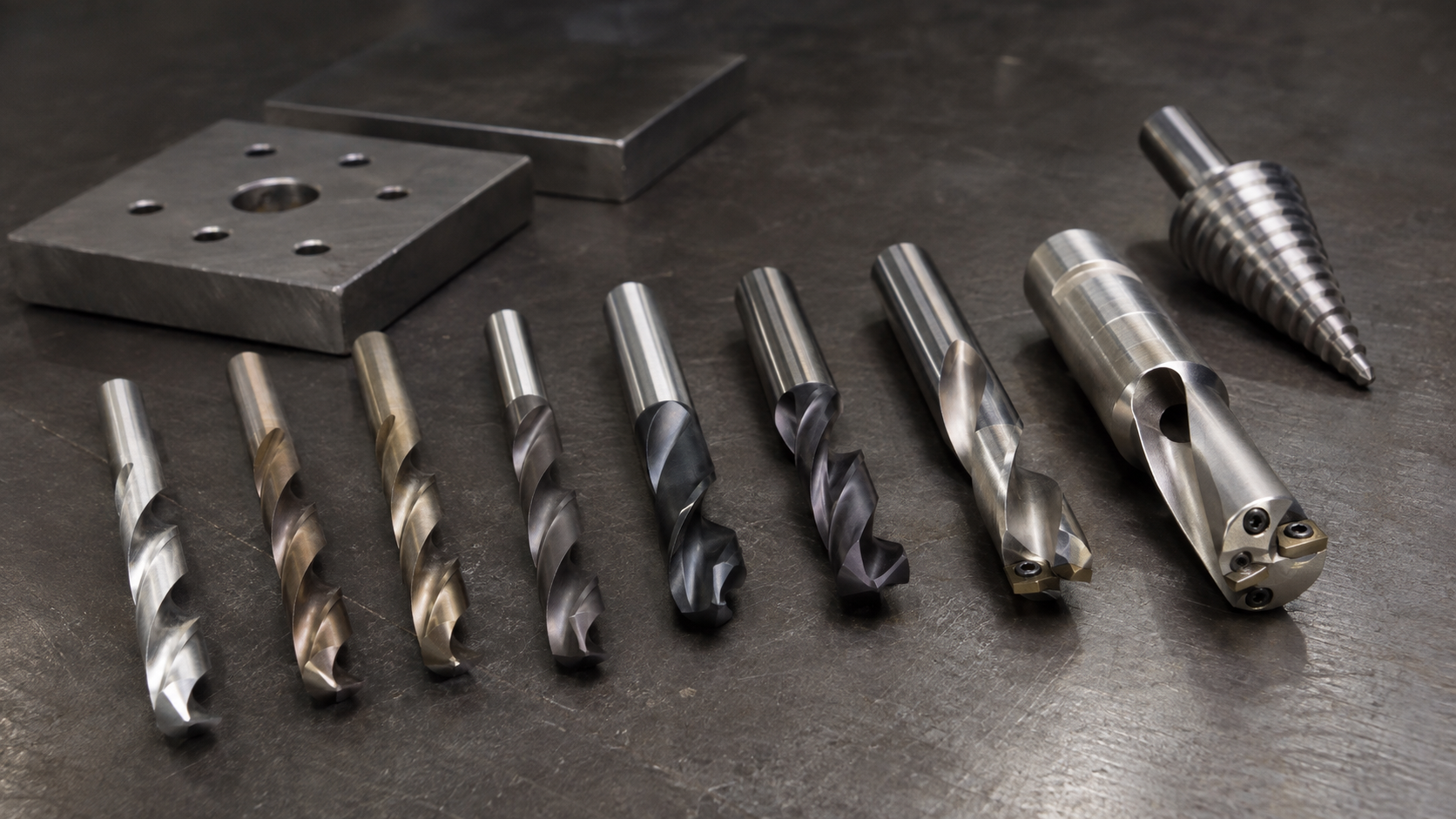
7. Carbide-Tipped Drills for Larger Diameters
Carbide-tipped drills have carbide cutting edges attached to a steel body. It uses less carbide than a solid-carbide drill, which can reduce tool cost at larger diameters.
Choose it when you need a moderately large hole and the tolerance required does not warrant a full solid carbide construction. For small or close tolerance holes, solid carbide often provides higher stiffness and dimensional consistency.
8. Indexable Drills for Repeated Large Holes
Indexable drills employ changeable cutting inserts so that the drill body can still be used even when the cutting edges are worn out. They can reduce long term tooling expenses when you are producing larger holes regularly in mild hard or hardened steel.
Select an insert grade suitable for the actual HRC and check that the drill will reach the required depth and hole tolerance. Generally, solid carbide gives better stiffness and dimensional control for small holes or holes requiring close tolerances.
9. Step Drills for Limited Hardened-Steel Applications
Most general purpose step drills are made for sheet metal and not for fully hardened steel. The several cutting blades can wear unevenly , causing unequal step diameters .
The substrate, coating and hardness range of a step drill must fit the workpiece. Choose accordingly. Carbide drills or a bespoke step tool is usually safer for thick or fully hardened steel.
10. Special Carbide or Another Process above 65 HRC
Some specialised carbide drills can cut steel above 65 HRC, although it is contingent upon the total drill design and regulated machining circumstances. At this hardness a drill may make a hole but will have an uneconomically short service life.
Compare the projected number of suitable holes with the alternative of drilling pre-heat treating or EDM. The right answer is the process which makes the desired hole without many tool adjustments or risk of breakage.
V. Which Drill Geometry Works in Hardened Steel?
1. A 118° Point for Lower-Hardness Steel
The point angle is the angle generated between the major cutting edges at the point of the drill. The 118° point is used on general purpose HSS and cobalt drills and has quite sharp cutting blades.
Suitable for low HRC and pre-heat treated steel, if the drill material is strong enough. In fully hardened steel, the longer cutting edges and narrower outer corners may wear or chip more quickly.
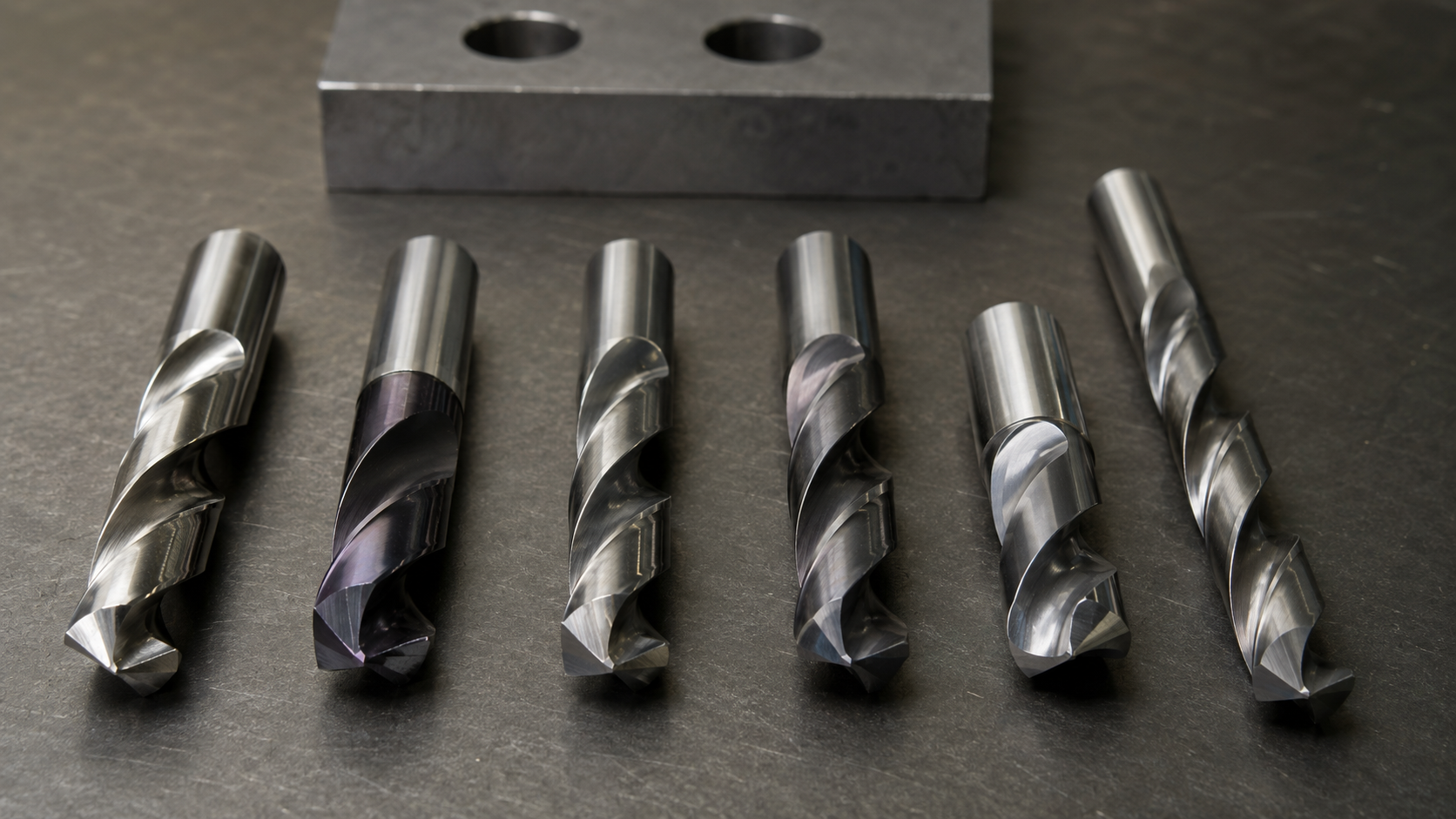
2. A 135–140° Point for a Stronger Drill Tip
A 135-140° point is flatter and creates shorter, stronger cutting edges. This helps the tip resist the increased cutting load of hardened steel.
This spread of points is usual on carbide drills with hardened-steel shanks. But the angle is only one piece of the design. The substrate, edge preparation, coating and drill core must also be adapted to the desired HRC.
3. A Split Point for Better Hole Starting
The split point minimises the chisel edge in the center of the drill. This means less thrust is needed to pierce the hardened surface and there is less wandering until both cutting blades are operational.
Select a split point when the hole position is important or when a conventional point slides before entering the steel. The starting performance is better, but the drill material has to be firm enough to cut the work piece.
4. Reinforced Edges for Chipping Resistance
A modest edge hone, corner chamfer or curved cutting edge reinforces the regions most susceptible to chip away. This is particularly beneficial in high HRC steel, angled entry, cross holes and other situations where the loads are unequal.
The strengthening should still permit the edge to cut. excessively much honing will cause the drill to push instead of shear. An edge that is excessively sharp may chip under the first severe load.
5. A Stronger Core for Higher Cutting Loads
A thicker core of drill makes it more resistant to tension and bending. This helps to keep the drill steady when heavy load is applied to the cutting edges by the hardened steel.
The core cannot be considered independent from the flutes. Deep holes still require adequate flute space to carry chips out, thus the drill must balance body strength and chip capacity.
6. The Shortest Drill That Reaches the Hole
Short drills are stiffer and less sensitive to runout than extended drills. If your hole is deeper than 3×D, a short drill is typically more stable than an over-sized 5×D or 8×D tool .
Consider the usable cutting depth, not only the entire length of the tool. For a blind hole, take the drill-point length into account in the calculation of the depth the tool must penetrate.
VI. Which Coating Is Suitable for Hardened Steel?
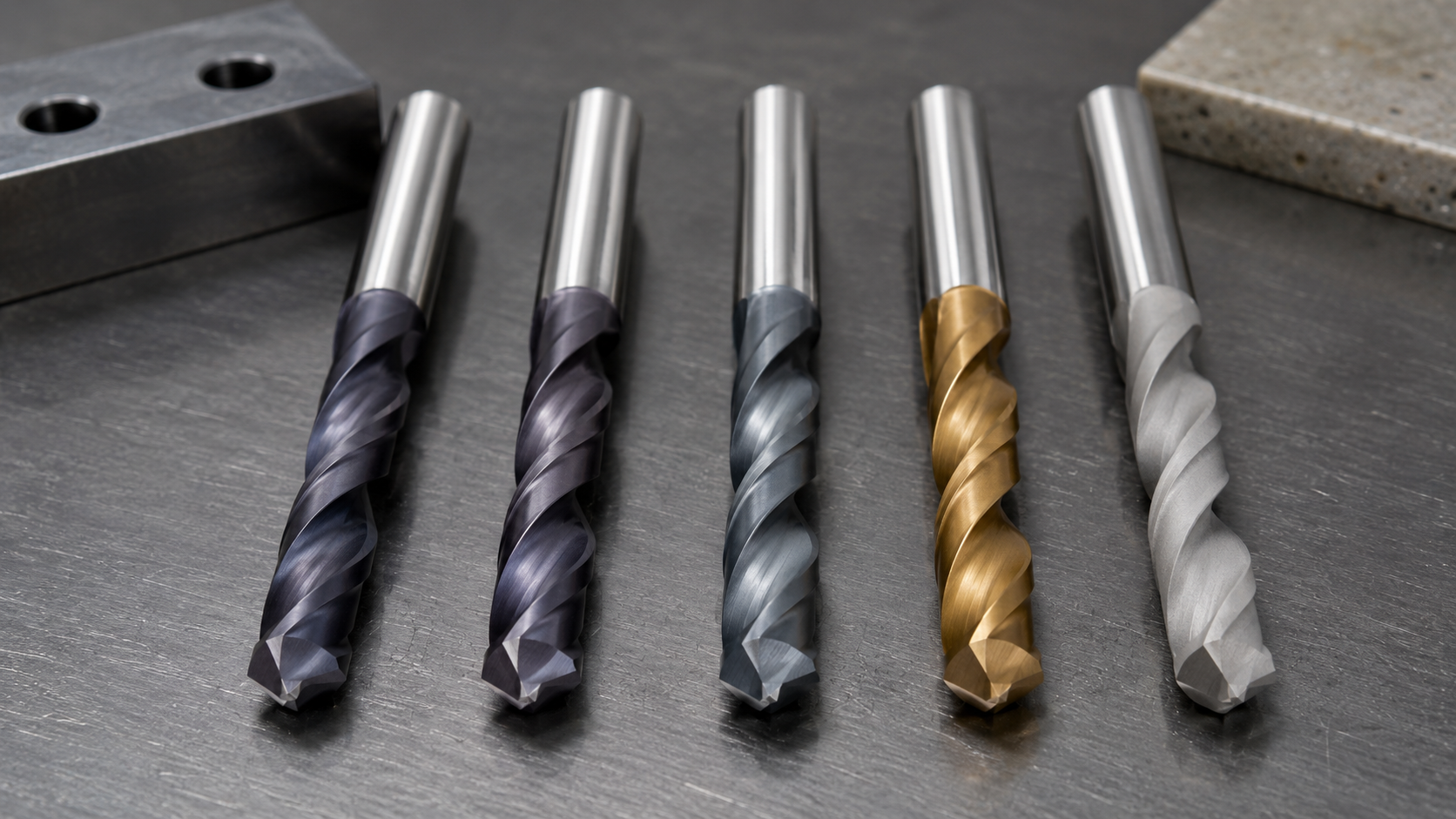
1. AlTiN or TiAlN for High-Hardness Steel
AlTiN and TiAlN retain usable hardness at the high temperatures generated in hardened steel drilling. The wear they help reduce is abrasive wear and it allows the carbide edge to retain its cutting geometry longer.
These coatings are best effective on solid carbide drills for ~ 45 – 65 HRC steel. They cannot give a conventional HSS drill the same cutting capacity as a hardened steel carbide drill.
2. TiCN for Moderately Hard Steel
TiCN has good wear resistance and is accessible on cobalt and carbide drills. This is a sensible choice for prehardened and moderately hard steel when you don’t need a full high-HRC carbide drill.
The real depth depends on the drill used under the coating. Don’t just choose TiCN because of the coating name, look at the substrate and the application range.
3. TiN for General-Purpose Work
TiN enhances wear resistance in general and is frequently used on HSS and cobalt drills. It can be suitable if the drill is to be used in ordinary and fairly hard steels.
It is not the first choice for fully hardened tool steels. A drill labelled “TiN-coated” doesn’t tell you enough to know that it will cut 55–65 HRC material.
4. Why Diamond Coating Is Not the First Choice
Diamond coating is very durable but is not usually chosen for ferrous hardened steel. At high cutting temperatures the carbon might react with the workpiece iron and diminish the coating life.
Diamond coatings are more suitable for abrasive non-ferrous materials, graphite, ceramics and composites. Cutting ISO H at high temperatures is what a coating designated for cutting ISO H steel is for.
5. Why the Substrate and Coating Must Match
The substrate defines the base hardness, rigidity and resistance to fracture of the drill. It protects the cutting surface from heat, oxidation and wear.
So you have to assess the whole instrument. The same coating on two drills can produce drastically different results if they have different carbide grades, tip designs, or edge preparations.
VII. Conditions Required for the Selected Drill to Work
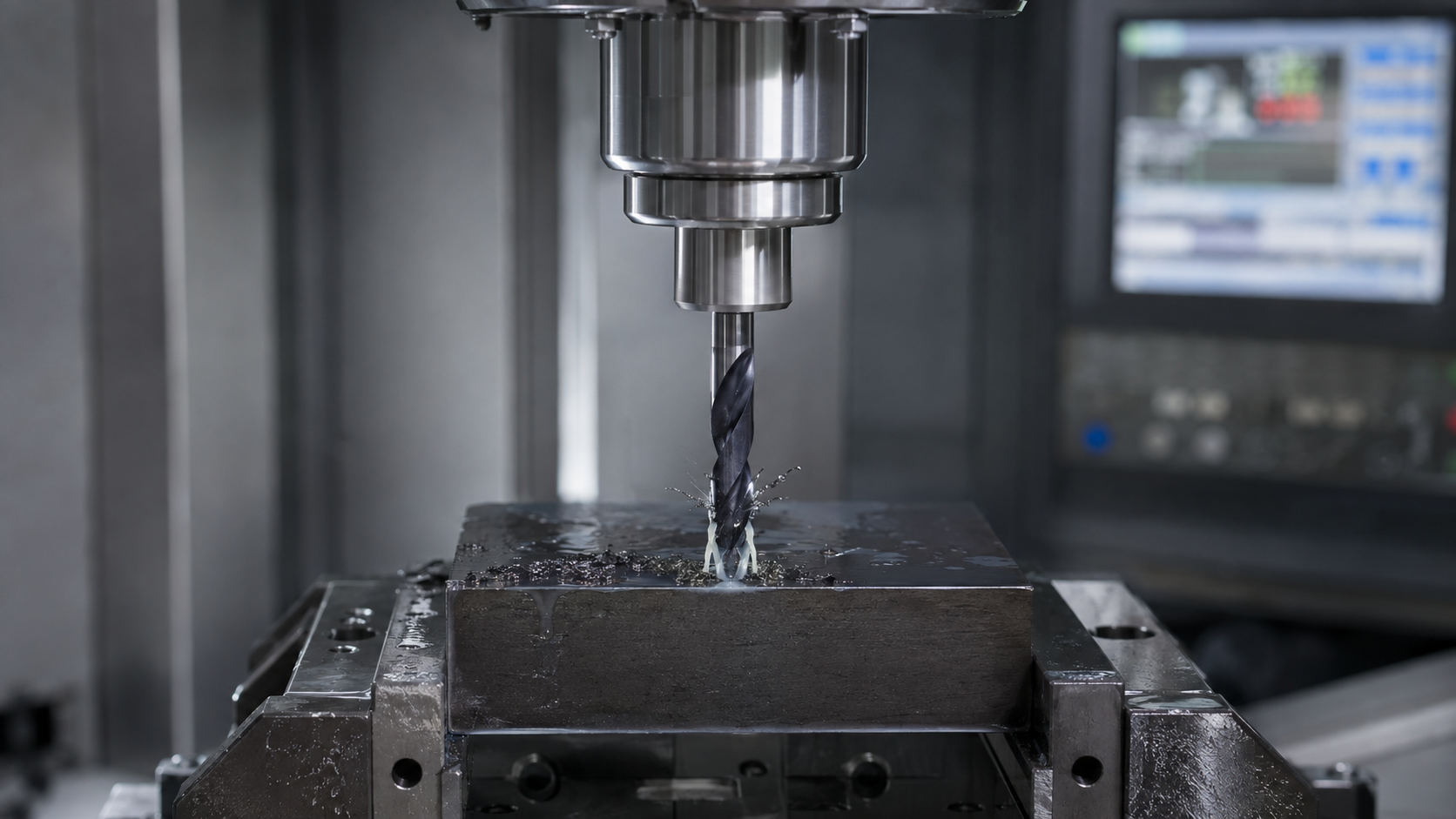
1. Use Cutting Data for the Exact Drill
The cutting speed and feed are affected by the substrate, coating, diameter of the drill, HRC of the workpiece, hole depth and cooling process. Values for one carbide drill may not be applicable to another drill with differing point or edge preparation.
Use cutting data for the total application and not a general hardened steel speed. You don’t get the same settings automatically on a 5 mm coated carbide drill in 60 HRC tool steel as you do on a 12 mm carbide drill in 40 HRC prehardened steel.
2. Use Enough Feed to Keep the Drill Cutting
The feed must be adequate to enable the cutting edges to enter the steel and make chips. If the feed is too low, the drill grinds against the hardened surface. This increases the heat and flank wear.
The feed should not exceed the drill load capability. A appropriate feed rate gives stable chips and a consistent rate of penetration. An excessive feed rate causes rapid spikes in load, chipping or drill breakage.
3. Match the Cooling Method to the Hole Depth
External coolant may suffice since shorter holes are easier for coolant to reach the drill point. The deeper the hole the more difficult it is for external coolant to reach the cutting edges and flush the chips.
For deeper hardened-steel holes, a through-coolant drill sends fluid to the drill tip and back pushes chips through the flutes. If the depth and chip load make external cooling ineffective, then choose internal coolant.
4. Use Peck Drilling for Chip Removal, Not as a Default Cycle
Peck drilling occasionally pulls the drill out to break or remove chips. It is useful when a drill which is cooled from outside produces chips which are not able to constantly leave a deeper hole.
It is not necessary for each hardened-steel hole. Through-coolant drills generally allow chip evacuation without frequent withdrawal. Unnecessary pecking re-loads the carbide edge, and may lead to chipping.
5. Keep Runout Low Enough for Both Edges to Cut Evenly
Runout causes one cutting edge to remove more material than the other cutting edge. The overloaded edge is the first to wear or chip, and the other edge contributes less to the hole.
If failures occur frequently on the same cutting edge, check the spindle, holder, collet, tool overhang and workpiece clamping. Even loading will not be corrected by changing the drill to a harsher grade.
VIII. What the Failure Pattern Tells You
1. The Drill Slides or Wanders
A drill that slides over the surface may have a wrong tip, a dull edge, or not enough hardness for the work. See whether it can make chips at the two edges where they touch the steel.
If it is still polishing the surface, stop and check the HRC of the workpiece and the drill application range. More pressure does not generate heat as a rule, but better penetration.
2. The Drill Overheats without Penetrating
Thus the cutting edge is rubbing, not cutting . Overheating without beneficial penetration. The drill may be too soft, already dull, or not getting enough feed to get into the material.
Check the cutting edge and check the drill’s working range with the hardness of the workpiece. The same failure will be accelerated by extra heat . Fix the mismatch before restarting .
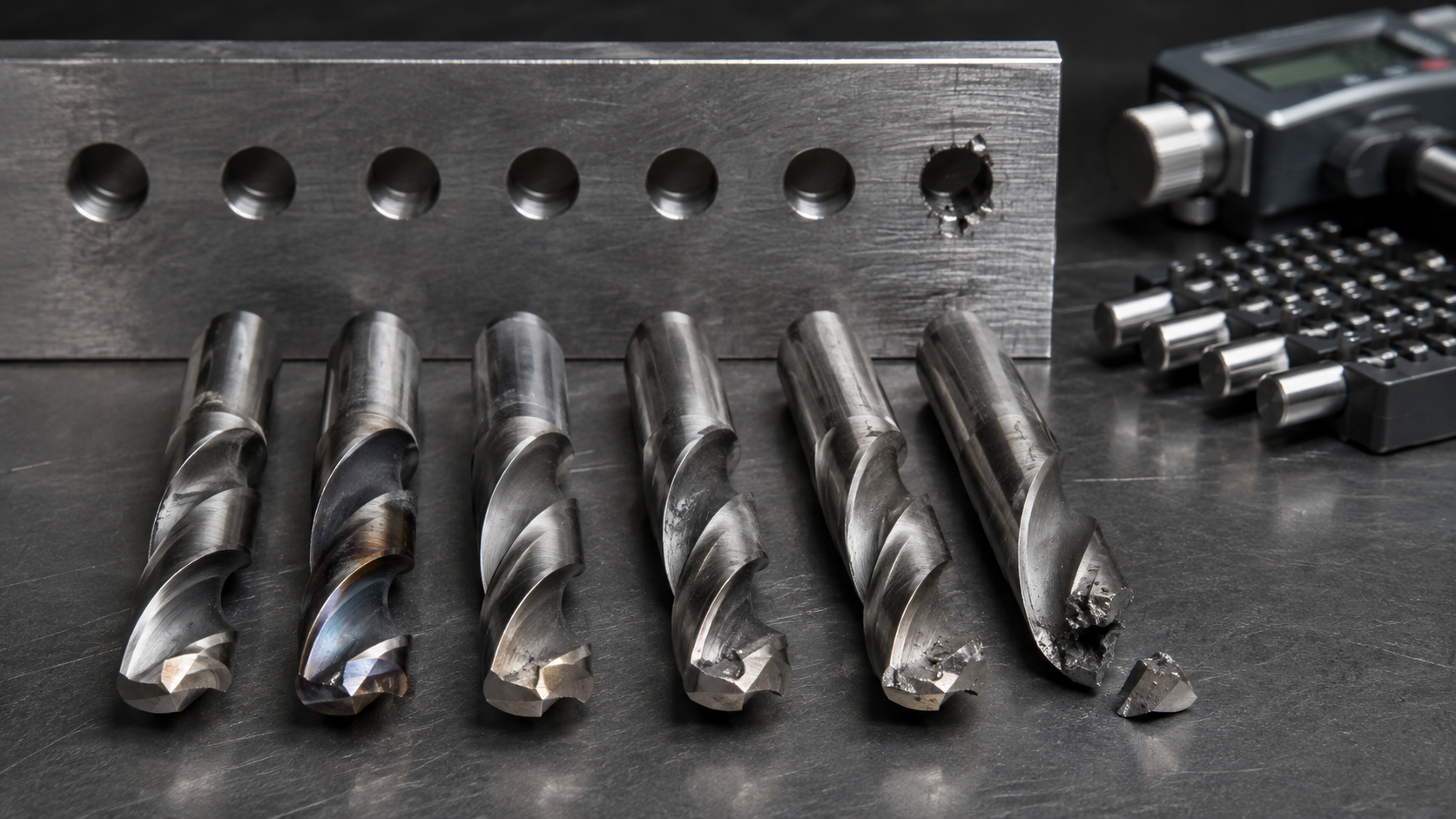
3. The Drill Becomes Dull after a Few Holes
Rapid dulling often signifies that the substrate or coating is not resistant to the abrasive wear of the material. This can also be caused by not enough feed causing too much rubbing time of the drill.
Check that both cutting edges are worn down evenly and gradually. Wear can also signal to an application or cutting-condition problem. Heavy wear on only one edge is an indication of runout or misalignment.
4. The Cutting Edge Chips
Chipping is when a brittle cutting edge is exposed to more strain or force than it can withstand. Too much runout, a tool that is too lengthy, entry angles, cross holes or an edge preparation that is too sharp are common reasons.
Depending on the exact cause, choose a shorter drill bit, a stronger edge design, or geometry designed for interrupted cutting. Impact chipping can be made worse by simply going to a tougher carbide grade.
5. The Drill Breaks inside the Hole
Chips can clog the flutes and increase torque, or side loading can bend the tool, and a drill can snap. It may also be that the corner chipping was there first and that is what caused the drill to cut unevenly.
Check flutes for packed chips; check both cutting corners. If chip evacuation is the primary concern, utilise a drill with the proper flute length and internal coolant for deep holes.
6. The Hole Size Changes during Production
Progressive corner wear is normally marked by a gradual change in hole diameter. A quick change is more likely to be caused by chipping, movement of the drill or material on the cutting edge.
Check the monitor hole size regularly, rather than waiting for the drill to fail. This means you can replace it when it fails to make decent holes, rather than when it is utterly useless.
7. The Tool Cost per Hole Is Too High
It is not economical just to have a drill that can cut the steel. Take the tool cost and divide it by the number of good holes. Then add tool changes, rejected parts, regrinding, and machine downtime.
A more costly carbide drill may be less expensive per hole if it gets through more than one batch. You don’t use enough of its extra life for only a few holes to make up the greater expense.
IX. Final Recommendation
Start with the final workpiece HRC. M35 or M42 can be suitable for prehardened and moderately hard steel, while applications above approximately 45 HRC increasingly require solid carbide. For steel around 55–65 HRC, choose a drill specifically designed for hardened materials and match its point, coating, length, and coolant structure to the hole.
Send Hanöki your steel grade, final HRC, hole diameter, depth, tolerance, entry condition, machine type, coolant method, and expected hole quantity. Hanöki can help you select a cobalt, solid-carbide, carbide-tipped, indexable, or custom drill for the application.
X. FAQs About Drill Bits for Hardened Steel
1. Should You Drill Steel before or after Heat Treatment?
Drilling before heat treating makes cutting easier and cheaper, however the hole can alter slightly during hardening. Drill following heat treatment, final hole must be regulated in the final hardened condition.
2. Can an M42 Cobalt Drill Cut 50 HRC Steel?
There are some speciality M42 drills that will cut steel close to 50 HRC, although this is not a general property of all M42 products. For holes to be repeated at this hardness, a solid-carbide drill made of hardened steel is generally more dependable.
3. Can One Drill Handle Both 4140 Prehard and 60 HRC D2?
A sufficiently hardened steel carbide drill could cut both, but it may not be the lowest cost in the softer material. If you use both applications on a regular basis, separate drills will give you better tool life and cost control.
4. Can You Drill through a Case-Hardened Surface?
Yes if the drill can punch through the surface HRC and manage the load change inside the part. When you choose the tool, consider the surface hardness and the approximate case depth.
5. How Can You Confirm the Depth of a Hardened Layer?
Verify heat treatment specification or perform hardness traverse across component portion. Surface HRC alone does not tell us the depth of hardened layer.
6. Does a Solid-Carbide Drill Need a Pilot Hole?
Most short 3×D or 5×D drills can be started directly on a level surface if the solid-carbide drill has a self-centring tip. Deep-hole drills, angled entry surfaces and very small diameters may necessitate a corresponding pilot hole to prevent movement during entry.
7. What Spot Angle Should You Use before a 140° Carbide Drill?
Use a spot angle equal to or greater than the point angle of the following drill (140°). A narrower spot angle can cause the outer corners of the carbide drill to contact first and can increase the chance of chipping.
8. Can You Enlarge an Existing Hole in Hardened Steel?
When the centre is no longer supported by material, a typical twist drill might become unstable. Use a straight twist drill, circular interpolator or drill for hole expansion.
9. Can a Flat-Bottom Drill Start on a Hardened Curved Surface?
Some carbide flat bottom drills are made with curved or angled entry. The acceptable angle of entry and HRC range can vary. Make sure that both situations are part of the intended use of the drill.
10. Can Carbide-Tipped Drills Replace Solid-Carbide Drills?
Carbide tipped drills can minimise tool cost at bigger diameters and give a harder steel body. Solid carbide is often superior for smaller diameters, more stiffness and tighter hole control.
11. Can Coated Carbide Drills Be Resharpened?
Many solid-carbide drills can be resharpened and recoated if enough material is left. Sharpening the cutting lips is only part of the process. The point, edge preparation, web thinning and diameter relationship must be re-established.
12. Will Regrinding Change the Drill Diameter?
Yes, regrinding can change the cutting diameter, and change the relationship between the point and margins. Before returning the reground tool to precise production, check it against the hole tolerance.
13. Why Do Two Drills Rated for 60 HRC Have Different Tool Life?
The HRC value makes no allowance for variations in carbide grade, coating, edge prep, flute strength and manufacturing precision. These variances impact the way each drill handles heat, wear, runout and interrupted cutting.
14. How Should You Test a Hardened-Steel Drill?
Test in actual workpiece condition with planned hole depth, holder, machine and coolant technique. Record allowable hole quantity, diameter change, edge wear and reason for tool replacement.
15. What Should You Do If the Workpiece HRC Is Unknown?
Check the heat-treatment record or hardness test before selecting the drill. If not accessible, a controlled experiment on an uncritical region can be used, stopping if the edge rubs without forming chips.
16. When Should You Use EDM Instead of Drilling?
Consider EDM when the steel is too thick for the drill, when the hole involves severe interrupted cutting, or when the tool cost and breakage from traditional drilling is unacceptable. Compare the total process time, hole tolerance, surface condition and cost before deciding.