I. Introduction
End mills and drill bits seem identical but using the wrong tool can result in broken tools, plugged flutes, inaccurate holes, rough surfaces and longer machining cycles. This guide compares their cutting directions, geometries, chip removal, machine requirements, accuracy and wear. It also tells you which tool to use for round holes, deep drilling, slots, pockets, flat bottom features and combined drilling-and-milling operations.
II. What Are End Mills and Drill Bits?
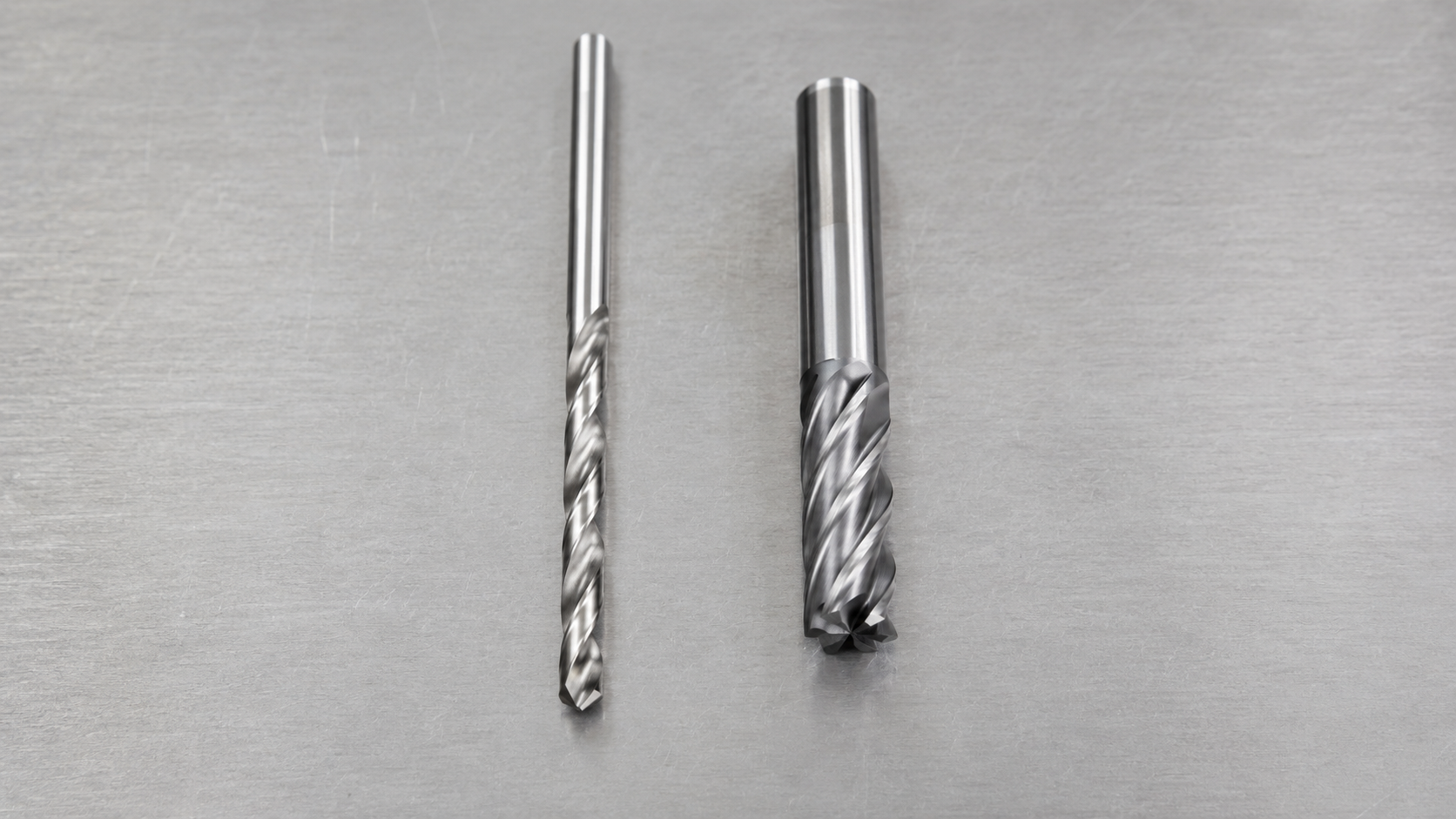
1. What Is a Drill Bit?
A drill bit is a tool for making holes. As it goes into a piece of work, it cuts from its sharp end. It has two cutting lips that remove material, and spiral blades that move the chips out of the hole. Because of how they are made, drill bits are the best choice for making standard round holes, pilot holes, tapping holes, blind holes, and deep holes.
2. What Is an End Mill?
A milling tool with cutting edges on both the sides and the end face is called an end mill. It can move both up and down and across the workpiece, which lets you make slots, pockets, contours, shoulders, sides, and flat-bottom recesses. For different shape features, you can get flat, ball nose, and corner-radius end mills.
III. Key Differences Between End Mills and Drill Bits
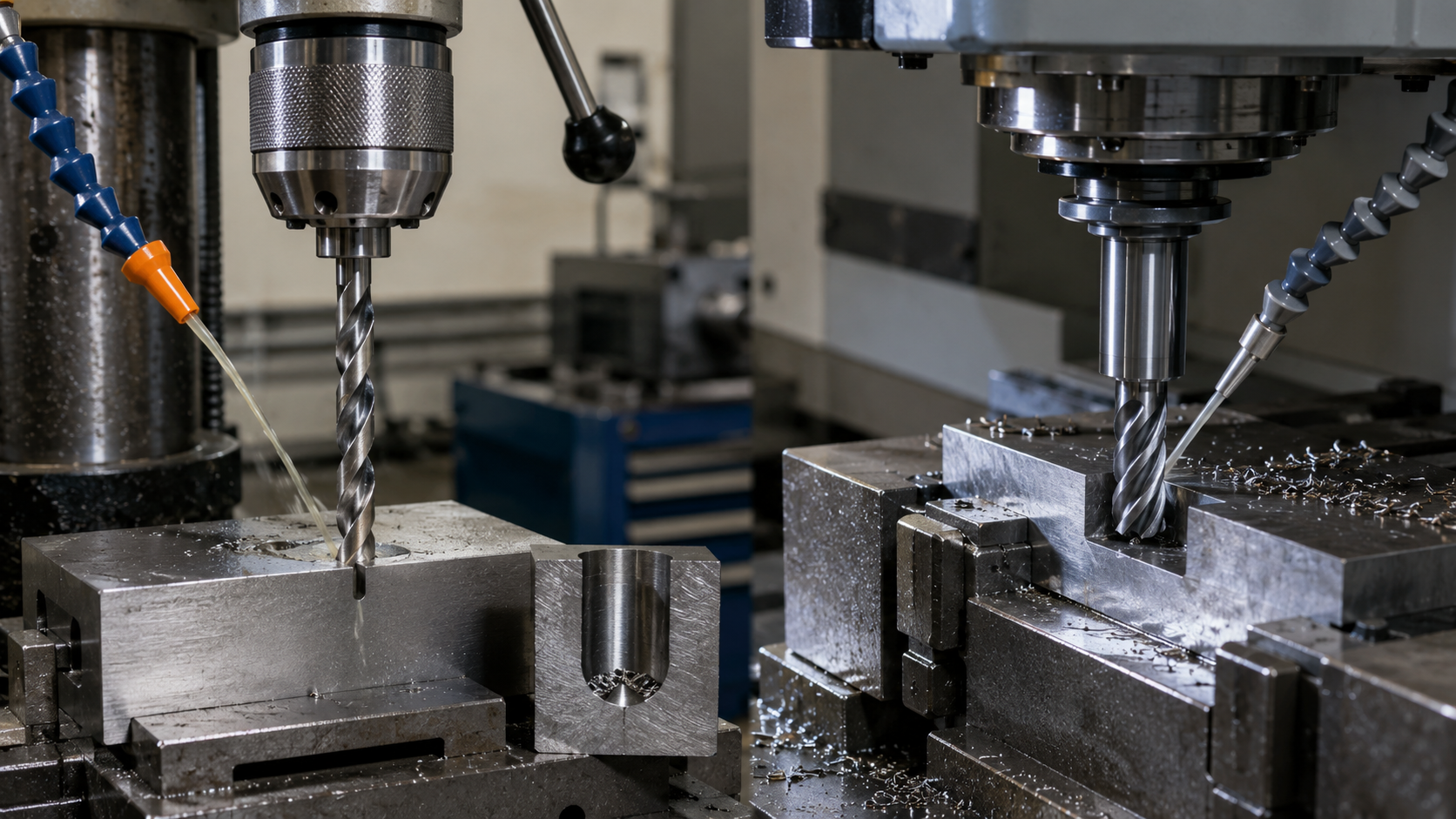
1. Cutting Direction
The drill bit normally feeds straight into the material along the axis of the tool. Their cutting power is downwards which makes them good for making round holes rapidly. You should not push a normal drill bit sideways . The body and cutting edges are not designed to withstand constant pressure from the side .
End mills cut downward and to the side. The side edges can be used to move along the X- and Y-axes to create slots, walls and contours while the end edges can be used to facilitate floor cutting and entering the material. End mills are used when you need to change the direction of your tool path inside the workpiece.
2. Cutting-Edge and Tip Design
Drill bits typically feature two cutting lips on a pointed end. Common point angles are 118° for general purpose drilling and 135° for harder materials or when a better control of the start is required. The centre chisel edge pushes into the material before the cutting lips remove it, and a split-point design lowers this pushing action and helps the drill start with less wandering.
End mills contain many cutting edges on the sides and on the end. A flat end mill will generate straight walls and a near flat floor, a ball nose end mill will follow curved surfaces and a corner radius end mill will offer a stronger cutting corner. Only a center-cutting end mill may plunge into solid material; all other types require a ramp, an open edge, or a predrilled entry hole.
3. Bottom Shape
Drill bits are pointed, so a blind hole will have a conical bottom. A 118° drill has a point depth of around 0.30D additional, and a 135° drill has about 0.21D additional, where D is the drill diameter. So a 10 mm 118° drill will require some 3 mm of extra depth under the full diameter area of the hole.
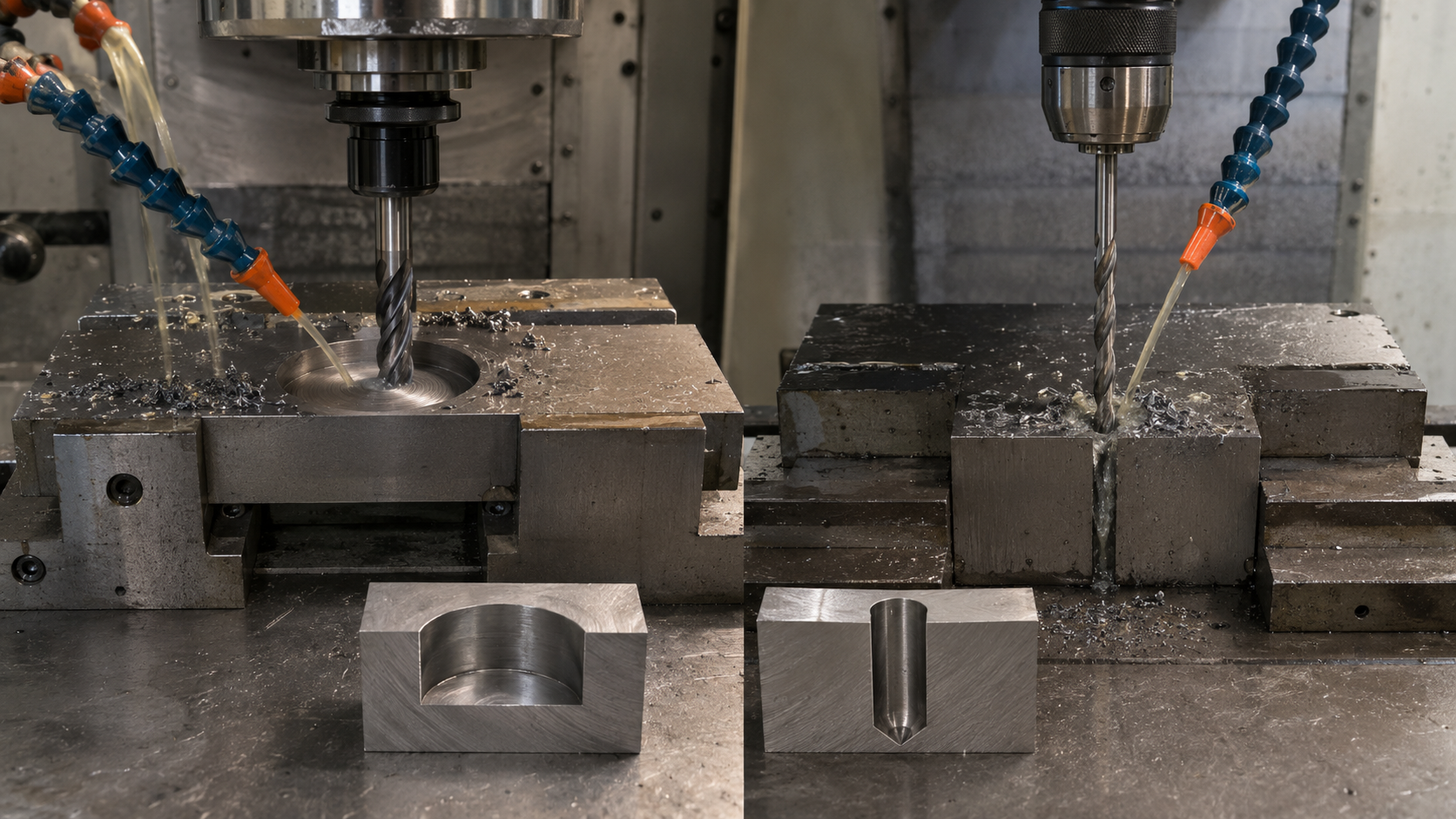
End mills are able to create a considerably smoother bottom because they don’t have a tip like a drill. This makes flat end mills good for counterbores, shallow recesses, pocket flooring and other features where a drill-point shape is not desirable. A specialist flat-bottom drill may nonetheless give a faster cycle for repeated manufacturing of flat-bottom holes.
4. Flute Design and Chip Removal
Drill bits usually contain two deep spiral flutes for carrying chips from the bottom of the hole to the surface. This provides them a distinct edge in deep hole machining since each chip has to travel through the enclosed hole before it can escape. Drills come in 3×D, 5×D, 8×D and deeper varieties to fit the needed hole depth.
End mills can have two, three, four or more flutes. Fewer flutes allow for more chip space and work well in aluminium, deep slots and other high-chip-volume applications. The more flutes you have, the more cutting edges you have, and the stronger the core will be, but you can run into clogging problems during full width slotting if you don’t have enough room for the chips. Blow chips from deep slots and enclosed pockets with air or coolant before re-cutting.
5. Cooling Requirements
Drill bits cut at the bottom of an enclosed hole and external coolant may have trouble reaching the cutting point as the hole becomes deeper. Through-coolant drills get coolant to the cutting lips directly, then drive chips back through the flutes to overcome this difficulty. Through-coolant offers more dependable cooling and chip removal for repeated holes at 5×D or deeper.
End mills are easier to cool during open side milling because the cutting area is exposed. Deep pockets and full-width slots are more difficult because chips and heat can collect around the cutter. Correctly directed coolant or air blast keeps the flutes clear and protects the finished surface.
6. Tool Path and Machine Type
The tool path of the drill bit is usually very basic – down into the material and back out again . They are appropriate for hand drills, drill presses, lathes, magnetic drills and CNC drilling cycles. The machine needs to have sufficient torque and axial feed force for the chosen hole diameter and material.
End mills follow more complex routes in X, Y and Z directions. They need a milling machine or CNC machining centre that can control lateral movement and can resist radial cutting forces. Side milling is not possible on a normal drill press as the spindle, bearings and table are intended to accept downward drilling stresses.
7. Toolholding
Adjustable jaws on drill chucks can grip drill bits of varied shank sizes, therefore they are typically used to hold them. If the application demands a smaller runout and more constant hole size, precision collets or hydraulic holders may be employed.
End mills should be clamped in milling collets, hydraulic holders, shrink-fit holders or specialist end mill holders. A drill chuck may not grip the cutter tightly enough to resist side forces, and may enable too much runout or tool pullout. If you are using a mill, employ a milling load holder.
8. Accuracy and Surface Finish
Drill bits cut accurate holes , and do it fast . The drill should be short , pointed , and centred properly . However the large or off centre hole can be caused by point wandering, unequal cutting lips, runout, and trapped chips. If the desired diameter or wall finish is closer than the drill can hold, drill a little undersize and finish using a reamer or boring tool.
And end mills offer additional control over sidewalls, level floors, curves and nonstandard hole diameters. You can change the tool offset on a cnc machine to correct an interpolated hole instead of changing the cutter. End mill deflection and spindle runout still have an effect on the output, therefore use a short, stiff setup for finishing work.
9. Tool Life and Wear
Drill bits usually wear along the cutting lips, outside corners, chisel edge and margins. A dull drill requires greater feed pressure, creates more heat and may make larger or rougher holes. Replace or resharpen when the hole size, burr level, or cutting load start to vary.
End mills generally wear on the side cutting edges and the corners. Side wear affects the machining dimension and corner chipping creates marks on the wall or floor. Keep tool extension short, remove chips properly and prevent unstable entrance for constant edge life.
IV. When Should You Use a Drill Bit or an End Mill?
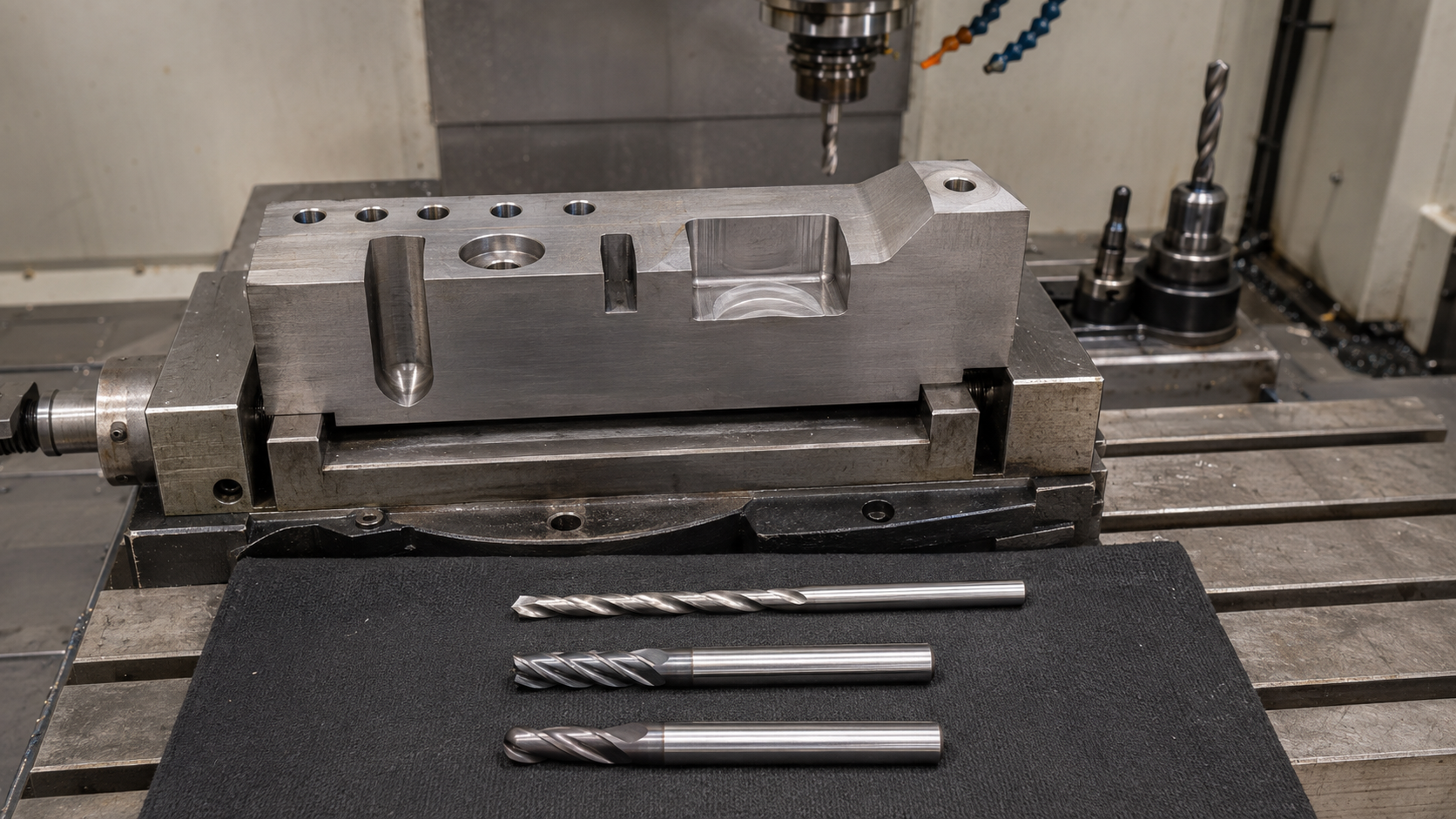
1. Standard Round Holes
When you need a standard round through hole, blind hole, pilot hole, or tapping hole, use a drill bit. It cuts out the whole hole width in one downward motion, so it works faster than circular milling.
2. Deep Holes
Use a drill for the actual depth, such as a 3x D or 5x D model. The drill point and flutes are designed for straight penetration and axial chip removal, while an end mill is more likely to deflect or trap chips in a deep cylindrical feature.
3. Flat-Bottom Holes and Counterbores
Use a center-cutting flat end mill for flat-bottom holes and counterbores in low to medium volumes. For a large or deep feature, drill most of the material away first and use the end mill to complete the bottom and wall. To save cycle time, use a specialised flat-bottom drill for repetitive manufacturing.
4. Slots and Keyways
Slots and keyways should be machined with an end mill because its side edges can remove material as the cutter passes over the workpiece. If the slot starts inside a solid surface, use a ramp or a helical entry, then proceed along the needed path.
5. Pockets, Profiles, and 3D Surfaces
Flat end mill for pockets and straight walls, corner-radius end mill for when you want a stronger cutting corner, and ball nose end mill for curved 3D surfaces. Choose the largest cutter that can reach the shortest internal radius. This will increase stiffness and minimise machining time.
6. Nonstandard or Multiple Hole Diameters
If you have a low-volume CNC job and need numerous nonstandard hole sizes, use an end mill with circular or helical interpolation. The same cutter can serve for multiple diameters, just modifying the programd path. Dedicated drills are still faster for lots of the same holes.
7. Angled or Curved Entry Surfaces
A regular drill can “walk” if one cutting lip hits an inclined or curved surface before the other one does. Make a small flat starting surface with an end mill and then drill the hole, or use a drill intended for angled entry.
V. Can an End Mill Replace a Drill Bit?
You can use a centre cutting end mill to make a shallow hole but it is not the greatest substitute for a drill in every case. Direct plunge puts the whole end face in the cut and provides little room for chips therefore a ramp or helical entry is usually smoother. If you need a nonstandard diameter, a flat bottom, or a hole that has to be changed through the CNC programme, use an end mill.
Use a drill bit for conventional round holes and for deep holes. The sharp point enters the material better and the flutes are designed to carry chips along the full depth of the hole. Replcaing it with end mill increases the cycle time. But does not improve the basic hole producing process.
VI. Can a Drill Bit Replace an End Mill?
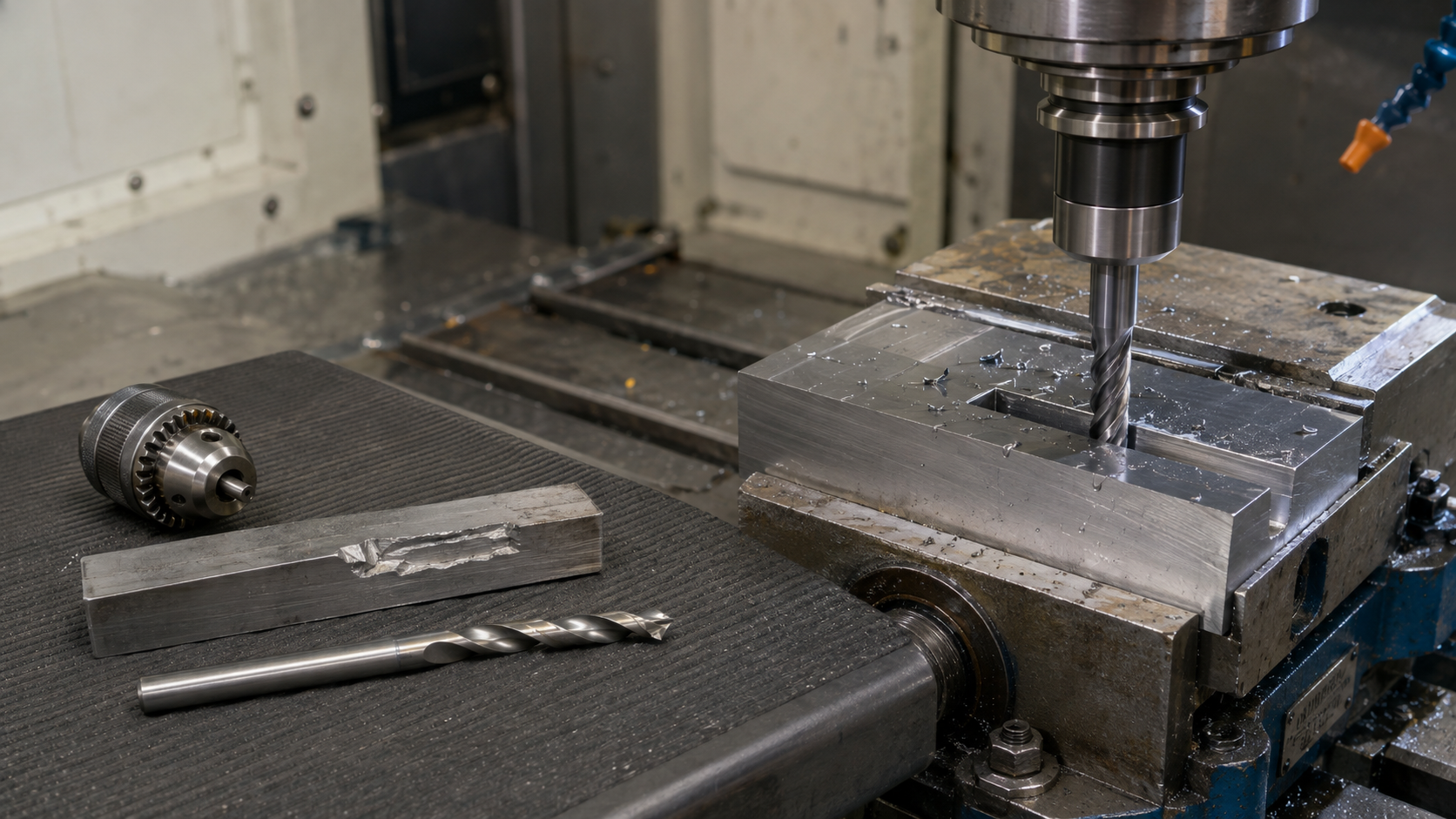
A regular drill bit is not a replacement for an end mill for side cutting. Its margins lead it into a hole, but do not act as milling edges, and its lengthy body offers little resistance to lateral force. Moving it sideways can cause the drill to bend, harm the workpiece, loosen the chuck, or shatter the tool.
Use an end mill or boring tool to increase the size of a hole from the side, fix its location or manufacture a slot. Only a drill-mill intended for the purpose should be used for combination drilling and limited side cutting.
VII. How Drill Bits and End Mills Work Together
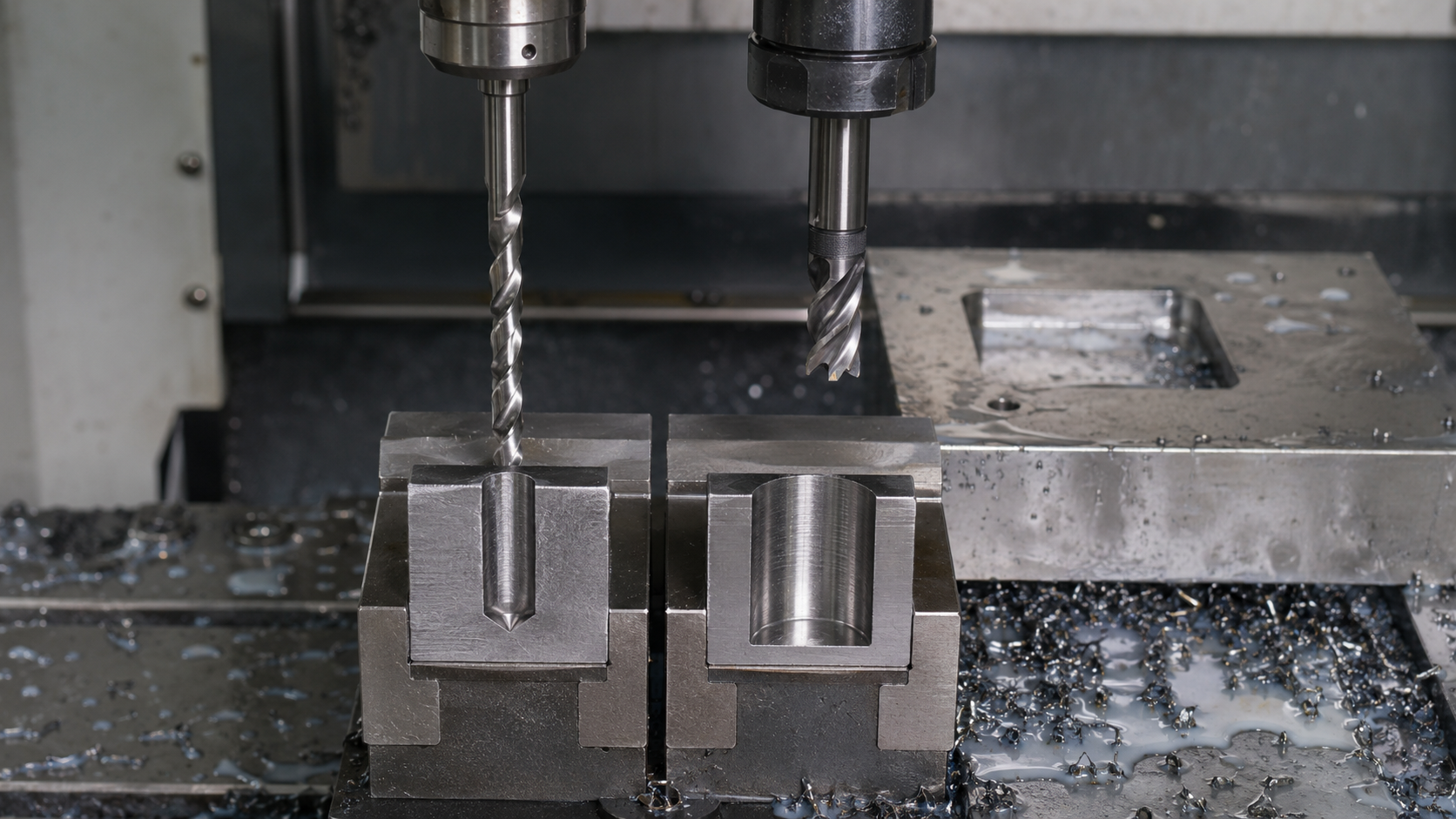
Often the same feature will be finished by separate pieces such as drill bits and end mills. The drill eliminates material swiftly, while the end mill shapes the areas the drill can’t reach.
For a flat bottom hole . Drill a little smaller than the final size , then clean up the wall and remove the cone bottom using a flat end grinder . For a large nonstandard hole, the centre is drilled out and the final diameter is obtained using circular interpolation. A predrilled hole can be used to insert a non-center-cutting end mill into a closed pocket safely.
This combo provides you with the drilling speed of a drill bit and the shape control of an end mill without making either tool perform an inappropriate function.
VIII. Common Selection Mistakes
1. Using a Drill Bit for Side Milling
A drill bit can force material out the sides, but it doesn’t control the wall and it can’t safely take the radial stress. If the tool path passes laterally through the material, use an end mill.
2. Plunging with a Non-Center-Cutting End Mill
A non centre cutting end mill lacks a full cutting edge at its centre, therefore direct plunging results in friction and overheating. Use a centre cutting tool, ramp into the workpiece, or start from a predrilled hole.
3. Using an End Mill for a Deep Standard Hole
When an end mill is used for deep axial cutting, it may deflect and clog. Use a drill rated for the proper depth, then use an end mill only if the wall, diameter or bottom need to be further machined.
4. Choosing Only by Tool Diameter
A 10 mm drill and a 10 mm end mill may have the same nominal size but they cannot do the same jobs. Choose according to necessary cutting direction, hole depth, bottom form, tool path, machine type and production volume.
IX. Conclusion
When you need a normal round hole, a tapping hole, a pilot hole, or a deep hole, you need a drill bit. You use an end mill if you want a slot, pocket, contour, sidewall, flat bottom recess or a nonstandard CNC machined diameter. If a feature requires both fast material removal and controlled finishing, use the drill first, and finish the last wall, floor or shape with the end mill.
X. FAQs About End Mills and Drill Bits
1. Why does a drilled blind hole need extra depth?
A regular drill leaves a pointed bottom below the entire diameter part of the hole. Allow about 0.30D for a 118° point, or 0.21D for a 135° point, where D is the drill diameter.
2. Can a ball nose end mill be used to make a hole?
A ball nose end mill may reach into the material, but it leaves a rounded bottom, and cuts slowly at its centre. Use on curved surfaces, not on normal cylindrical holes.
3. Does a center-cutting end mill need a pilot hole?
A center-cutting end mill can be plunged into a shallow feature without a pilot. If you want to go deeper, employ a ramp or helical path to lower the strain and give the chips more room to escape.
4. Can you use an end mill in a drill press?
While the drill press is capable of spinning an end mill, it is not able to control the radial forces produced when side milling. Slots, pockets and curves are machined using milling machines or CNC machining centres.
5. Can an end mill enlarge an existing drilled hole?
Yes, it can widen a drilled hole with circular interpolation, and can also adjust the final diameter. Leave an even amount of material around the hole so that the cutter runs stable.
6. When is circular interpolation better than drilling?
Use circular interpolation for non-standard diameters, prototypes, low volume products and pieces that need numerous hole sizes. For several similar standard holes, use special drills.
7. Do more flutes make an end mill better for plunging?
No, since with more flutes there is less place for chips. The safer bet is a center-cutting end mill, with enough flute space and a ramp or helical entry.
8. Why is an interpolated hole smaller than the programmed size?
The hole can be undersized by tool deflection, worn edges, wrong correction, spindle runout or movement of the machine. Measure first hole and fix the tool offset before starting the batch.
9. Which tool gives better hole-position accuracy?
The short rigid drill delivers repeatable placements if the starting point and machine alignment are correct. 1. Use an end mill or boring tool from the side to move or repair an existing hole.
10. Can a drill bit be held in a milling collet?
Yes, a straight shank drill can be retained in a collet of the proper size. Make sure that the collet is gripping the entire shank, not touching the flutes.
11. Which tool is better for drilling on an angled surface?
The standard drill can slip because its cutting lips engage the surface unevenly. Mill for angled entry or drill to a little flat first.
12. Should the drill and end mill have the same diameter when used together?
Not necessarily. If it’s a flat bottom hole, use a drill that is slightly smaller than the finished size, so the end mill can clean the wall and floor.
13. Can a drill-mill replace both tools?
A specifically built drill-mill is capable of drilling, chamfering and limited side cutting in light operations. A dedicated drill is still superior for deep holes, although an end mill is more sturdy for heavy slots and pockets.
14. Can a standard end mill produce an internal thread?
No, a typical end mill does not have a cutting profile to make a thread. Utilise a thread mill with a helical route that has the same pitch as the desired thread to be machined.
15. Which tool normally produces fewer burrs?
A sharp drill with the proper point and controlled breakthrough can remove burrs around a round hole. End mills give better control of the burr on slots and profiles, because a separate light pass can be used to polish the final edge.