I. Introduction
Getting the correct size drill bit for a 5/16” tap is easy and can save you a lot of money. When the hole is the wrong size, threads might be weak, taps can break, work can be delayed, and quality problems persist. Here is a guide to help you decide the proper size before you drill, tap, or order a bunch of them.
II. Quick Answer: What Drill Bit Size for a 5/16 Tap?
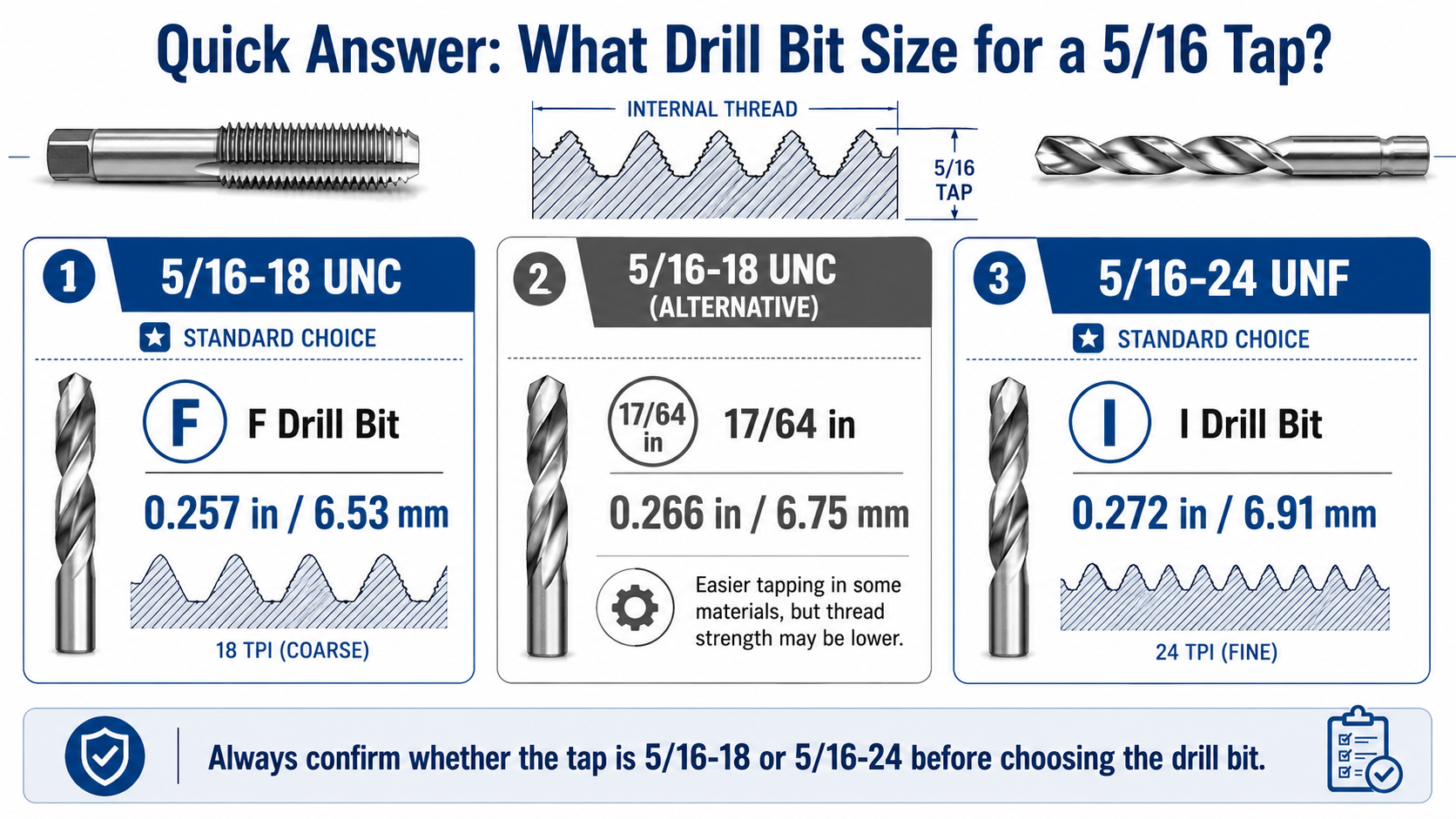
Most of the time, a F drill bit will fit a 5/16-18 UNC tap. It is around 0.257 inches, which is 6.53 mm.
You can also use 17/64 inch to tap 5/16-18. This is roughly 6.75 mm or 0.266 inch in size. Some materials are easy to tap, but the thread may not be as strong.
For a 5/16-24 UNF tap, an I drill bit is usually the best choice. It measures roughly 0.272 inches, or 6.91 mm.
The basic idea is easy to understand. Before you select a drill bit, be sure the tap is 5/16-18 or 5/16-24.
III. First, Understand What a 5/16 Tap Means
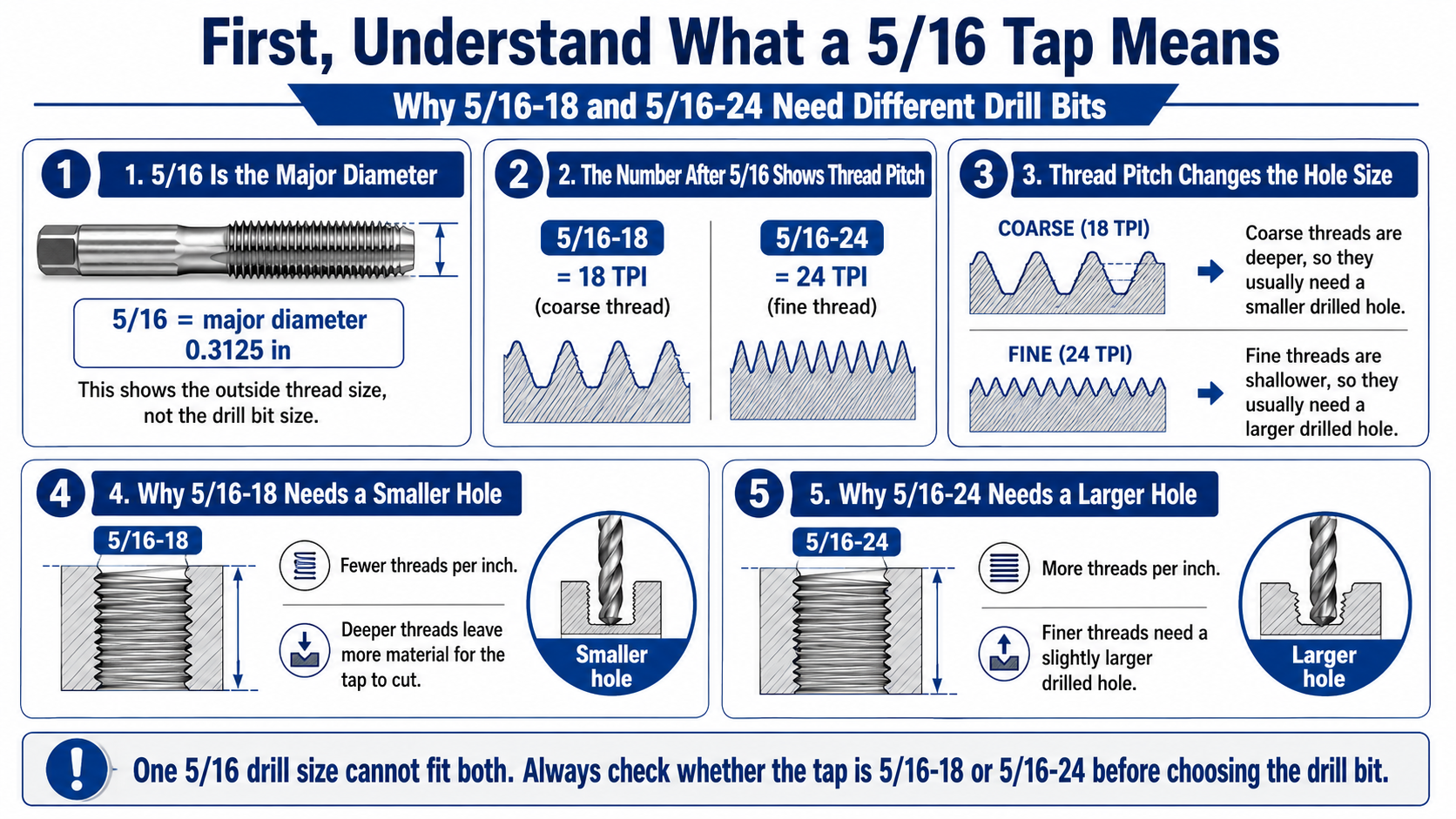
1. 5/16 Is the Major Diameter
The big measurement for the tap in inches is 5/16. In decimal form, it is comparable to 0.3125 inches. This will just tell you the size of the outside thread. It does not tell you yet what size drill bit to use.
2. The Number After 5/16 Shows Thread Pitch
The 18 in 5/16-18 is the number of threads per inch, 18. This thread is savage. 24 in 5/16-24 means 5/16″ diameter, 24 threads per inch. This is a good thread.
3. Thread Pitch Changes the Hole Size
A large thread is preferable for disposing of things than a small thread. That’s why it normally requires a smaller opening. A fine thread has a smaller thread width. So you have to make a bigger hole before you can tap the thing.
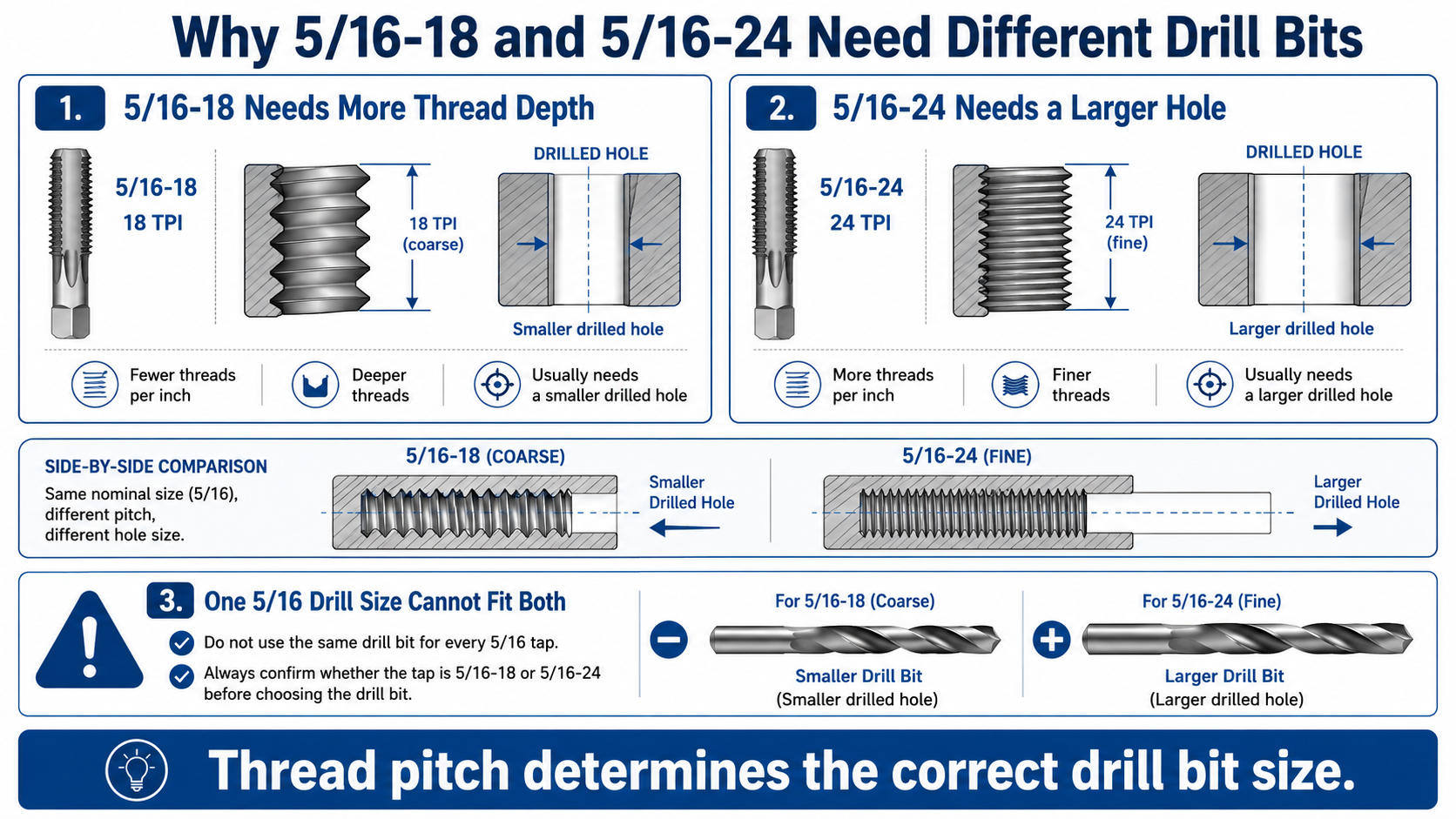
IV. Why 5/16-18 and 5/16-24 Need Different Drill Bits
1. 5/16-18 Needs More Thread Depth
A 5/16-18 tap has fewer threads per inch. Each thread is deeper than a 5/16” – 24 thread. Hence, the hole was drilled smaller. The tap can cut a smaller hole.
2. 5/16-24 Needs a Larger Hole
A 5/16-24 tap has more holes per inch. The threads are thinner, with a greater surface area. The hole is too small to tap. They cannot be tapped. This can cause additional wear and tear in the long run.
3. One 5/16 Drill Size Cannot Fit Both
You can not use the same drill bit for all 5/16 taps. The pitch tells us the size of the drill. This becomes more essential if you have taps of varying sizes. Differences could lead to problems in the stores and with how they are used.
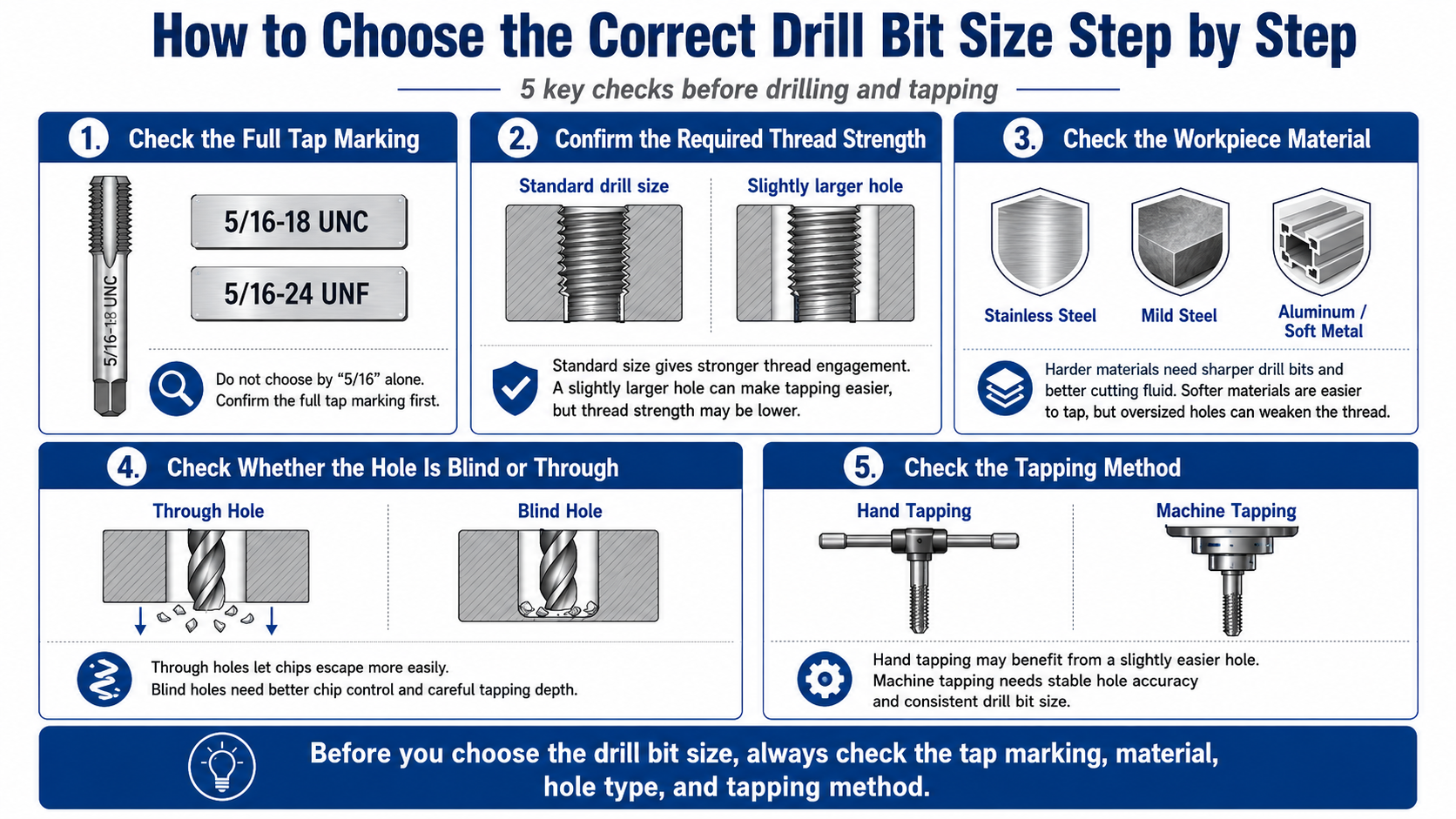
V. How to Choose the Correct Drill Bit Size Step by Step
1. Check the Full Tap Marking
First, make sure that the whole marking on the tap is correct. Choose more than just “5/16.” Check for signs like 5/16-18 UNC or 5/16-24 UNF. This tells you what size drill bit to get ready.
2. Confirm the Required Thread Strength
If you want the threads to engage more deeply, use the standard drill size. Sometimes, that is a F drill bit for 5/16-18. If tapping is a problem, a hole that is a little bigger might help. But it would also make people less likely to join threads.
3. Check the Workpiece Material
The harder the material is, the harder it is to tap. When cutting stainless steel, you generally need sharper tools and better cutting fluid. It is easy to tap into things that are soft. But big holes could still make the thread less strong.
4. Check Whether the Hole Is Blind or Through
A through hole makes it easier for chips to come out. In general, this is a better and more reliable way to tap. Chips at the bottom are caught by the blind hole. You need to be able to handle the chip better and be careful about how deep you tap.
5. Check the Tapping Method
Hand tapping needs more control from the operator. To keep things from breaking, a hole that’s a little bigger might work better. Taping a machine hole needs to be steady and accurate. When working in groups, it’s more important to use drill bits of the same size.
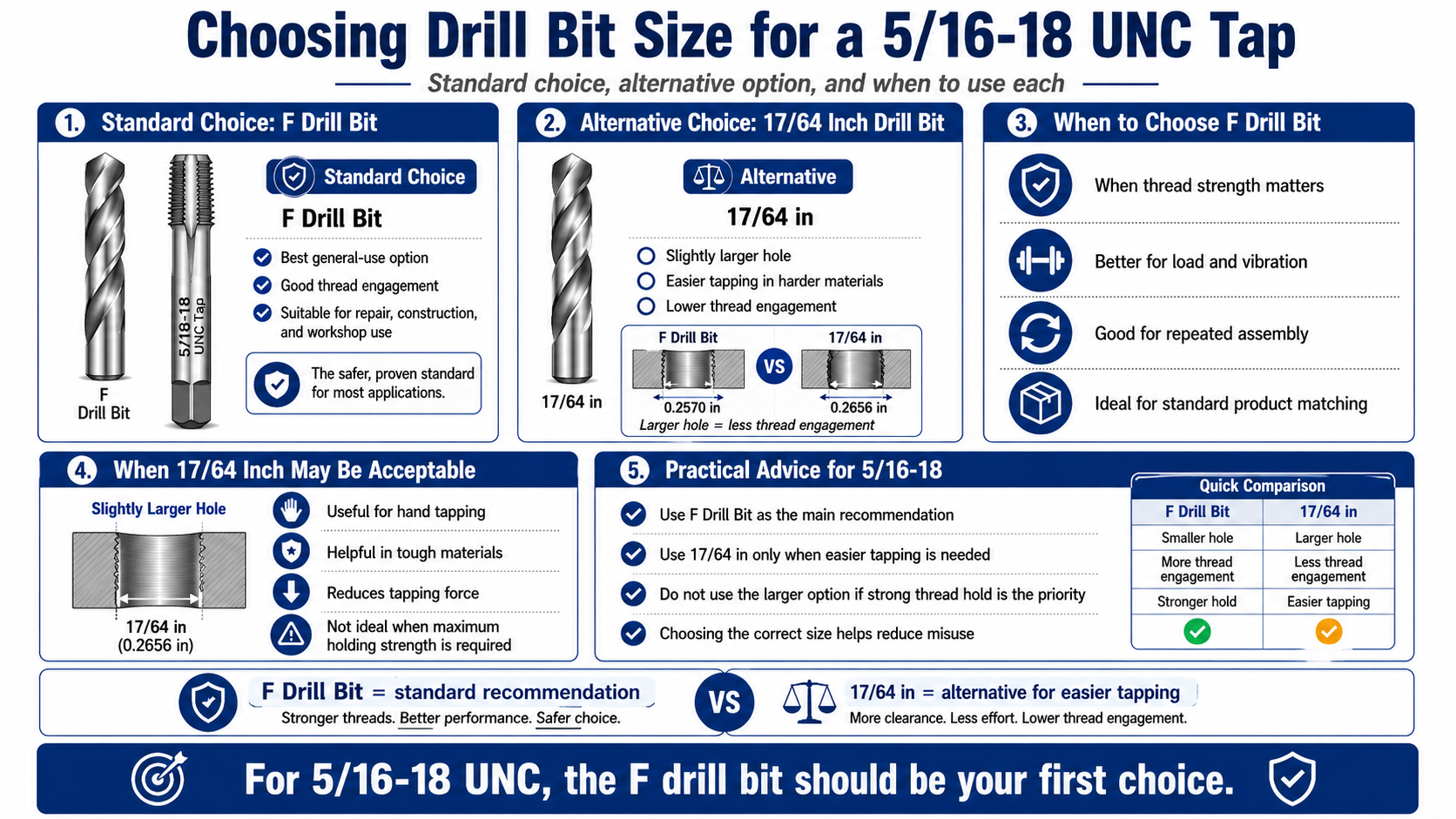
VI. Choosing Drill Bit Size for 5/16-18 UNC Tap
1. Standard Choice: F Drill Bit
F drill bits are what most people use for a 5/16-18 tap. This is a good way to open the thread for general use. Perfect for fixing machines, fastening things together in building, and using in the workshop. Plus, it’s the safest usual choice.
2. Alternative Choice: 17/64 Inch Drill Bit
Some people tap 5/16-18 with 17/64″. It’s a bit bigger than a F drill bit. It can make it easy to get into harder materials. But it often leads to less thread involvement.
3. When to Choose F Drill Bit
An F drill bit is used when thread strength is more important. That’s better for load, vibration, or repeated building. It also helps when you want a normal match for a product. This makes regular supply less confusing.
4. When 17/64 Inch May Be Acceptable
When you need to make the tap less strong, use 17/64”. You can use this to help you tap by hand or with tough materials. Do not use when you need the strongest hold possible. Because the hole is bigger, there is less material to hold the thread in place.
5. Practical Advice for 5/16-18
For general use, the F drill bit should be the main suggestion. You could try 17/64. This helps make it easier to choose the right size. Also helps with using it in the wrong way in real life.
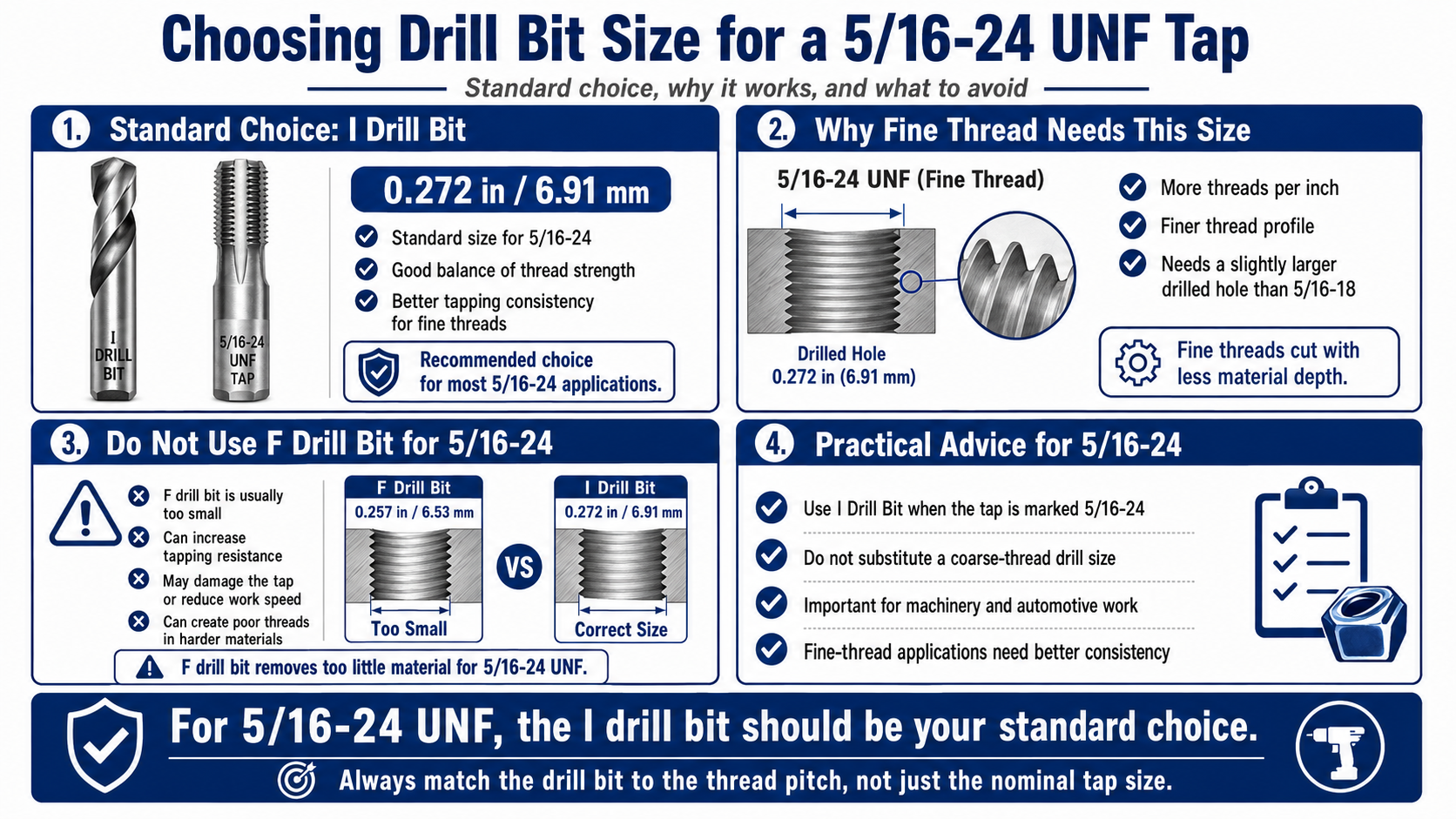
VII. Choosing Drill Bit Size for 5/16-24 UNF Tap
1. Standard Choice: I Drill Bit
An I drill bit is usually the right size for a 5/16-24 tap. It’s about 0.272 inches in length and width. This size will make a hole that is good for fine thread tapping. It gives threads a good mix of strength and resistance to tapping.
2. Why Fine Thread Needs This Size
There are more threads per inch on a 5/16-24. The diameter of the thread is less than 5/16-18. To cut through the thread, there is less material for the tap to go through. Most of the time, the bigger hole is right.
3. Do Not Use F Drill Bit for 5/16-24
A F drill bit isn’t usually big enough for a 5/16-24 hole. Perhaps it will make cutting too hard. This could hurt the tap or slow down the work. It can also make threads that don’t work well in harder materials.
4. Practical Advice for 5/16-24
Use an I drill bit if the tap says 5/16-24 on it. Do not use a drill bit with coarse thread instead. This is especially important for tasks involving tools and cars. Applications that use fine thread often need better consistency.
VIII. How Material Affects the Drill Bit Size Decision
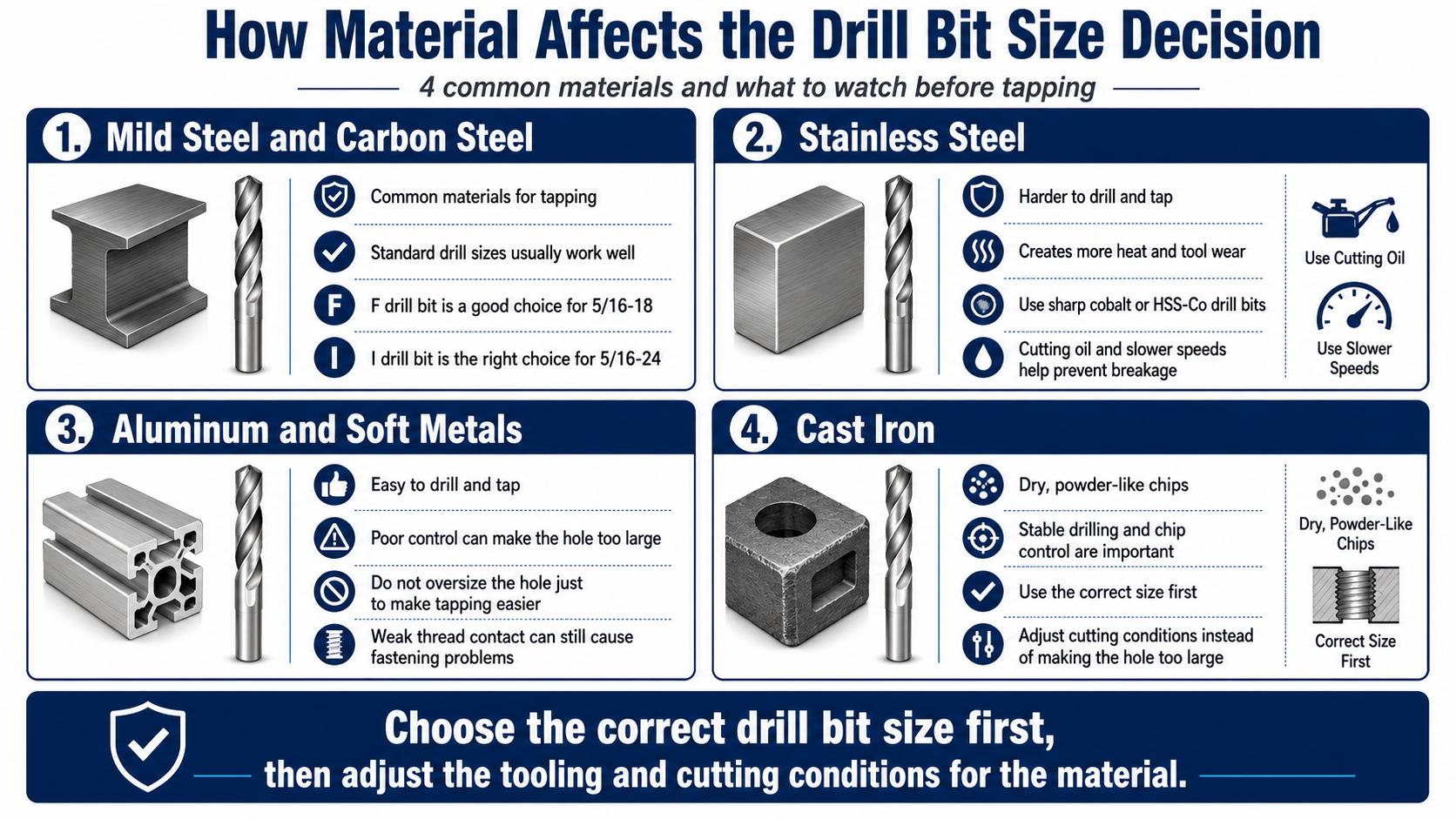
1. Mild Steel and Carbon Steel
Steels like mild steel and carbon steel are often used for tapping. Most of the time, standard drill sizes work well. A F drill bit is a good pick for 5/16-18. An I drill bit is still the right choice for 5/16-24.
2. Stainless Steel
It’s tougher to drill and tap stainless steel. More heat and tool wear are caused by it. Cobalt or HSS-Co drill bits that are sharp should be used. Cutting oil and slower speeds can also help keep things from breaking.
3. Aluminum and Soft Metals
Metal is simple to drill and tap. But if you don’t have good control, the hole might be too big. It won’t help to make the hole bigger. Fastening problems can still happen even if the thread contact is weak.
4. Cast Iron
Chips made from cast iron are dry and white, like powder. It’s important to have stable drills and watch out for chips. First use the right size, then change how it’s cut. If you have chip problems, don’t make the hole too big.
IX. Hole Accuracy Matters More Than Many Buyers Expect
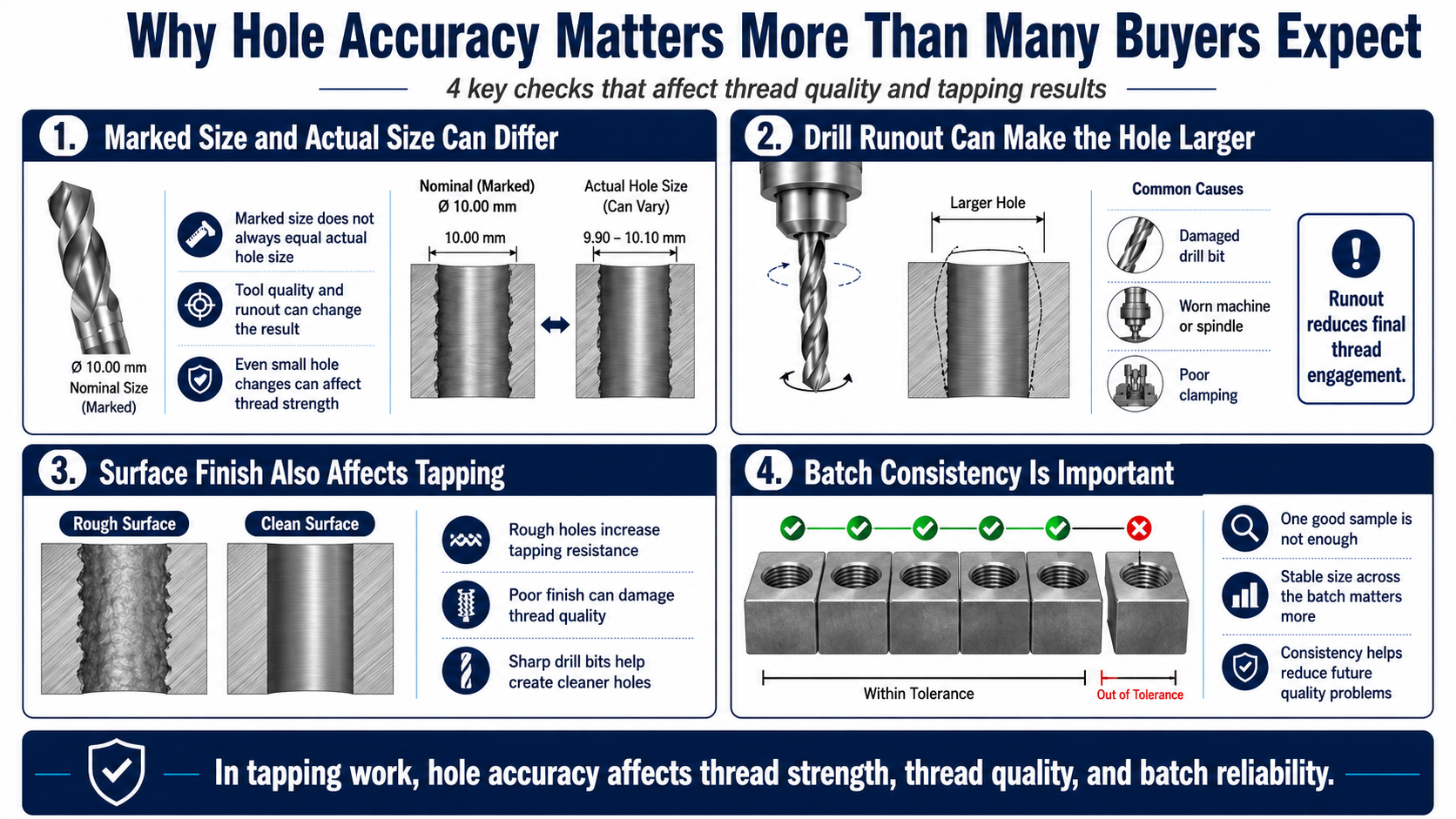
1. Marked Size and Actual Size Can Differ
A drill bit that says it’s a certain size might not always cut that size. The quality of the tool and its runout could affect the hole that is made. In tapping work, this is very important. Changes in even small holes can affect the strength of the thread.
2. Drill Runout Can Make the Hole Larger
The hole you drill gets bigger if the drill bit moves around. This changes how the final thread engages. It’s possible for runout to happen because of broken drill bits, worn-out tools, or not enough clamping. When you test, you should look at all three.
3. Surface Finish Also Affects Tapping
If you drill a hole that isn’t smooth, it will be harder to tap. It can also make the thread finish badly. A hole is better when the drill bit is sharp. This makes it easier for the tap to cut.
4. Batch Consistency Is Important
Just because one sample is good doesn’t mean the whole batch is good. It’s more important that the size stays the same in different parts. This is very important if you buy drill bits often. Quality problems can be avoided in the future by keeping the size the same.
X. Common Mistakes When Choosing Drill Bit Size for 5/16 Tap
1. Choosing by Diameter Only
Some people pick the drill size too quickly when they see 5/16. People often make this mistake. First, you need to make sure of the thread length. There is a difference between 5/16-18 and 5/16-24.
2. Using 17/64 for Every 5/16 Tap
For some 5/16-18 jobs, 17/64 will work. It’s not the only answer, though. Not many people would pick that for 5/16-24. It might also make threads weaker on some jobs.
3. Ignoring Material Hardness
When you tap on hard objects, the resistance goes up. Ignore this, and the tap could break or wear out faster. A bigger hole isn’t always the answer. Most of the time, better results come from using better drills and cutting fluid.
4. Ignoring Hole Depth
It’s harder to control the chip when the hole is larger. This is a lot worse when there is a blind hole. You need enough space for the chips and enough depth to tap. The tap will break if you bottom it out.
5. Buying Drill Bits Without Size Control
Low-cost drill bits might look fine at first glance. But tapping can go wrong if the width isn’t controlled properly. There is no accuracy for the 5/16-inch tapping size. This has a direct effect on the tool life and thread strength.
XI. How to Check the Result After Drilling and Tapping
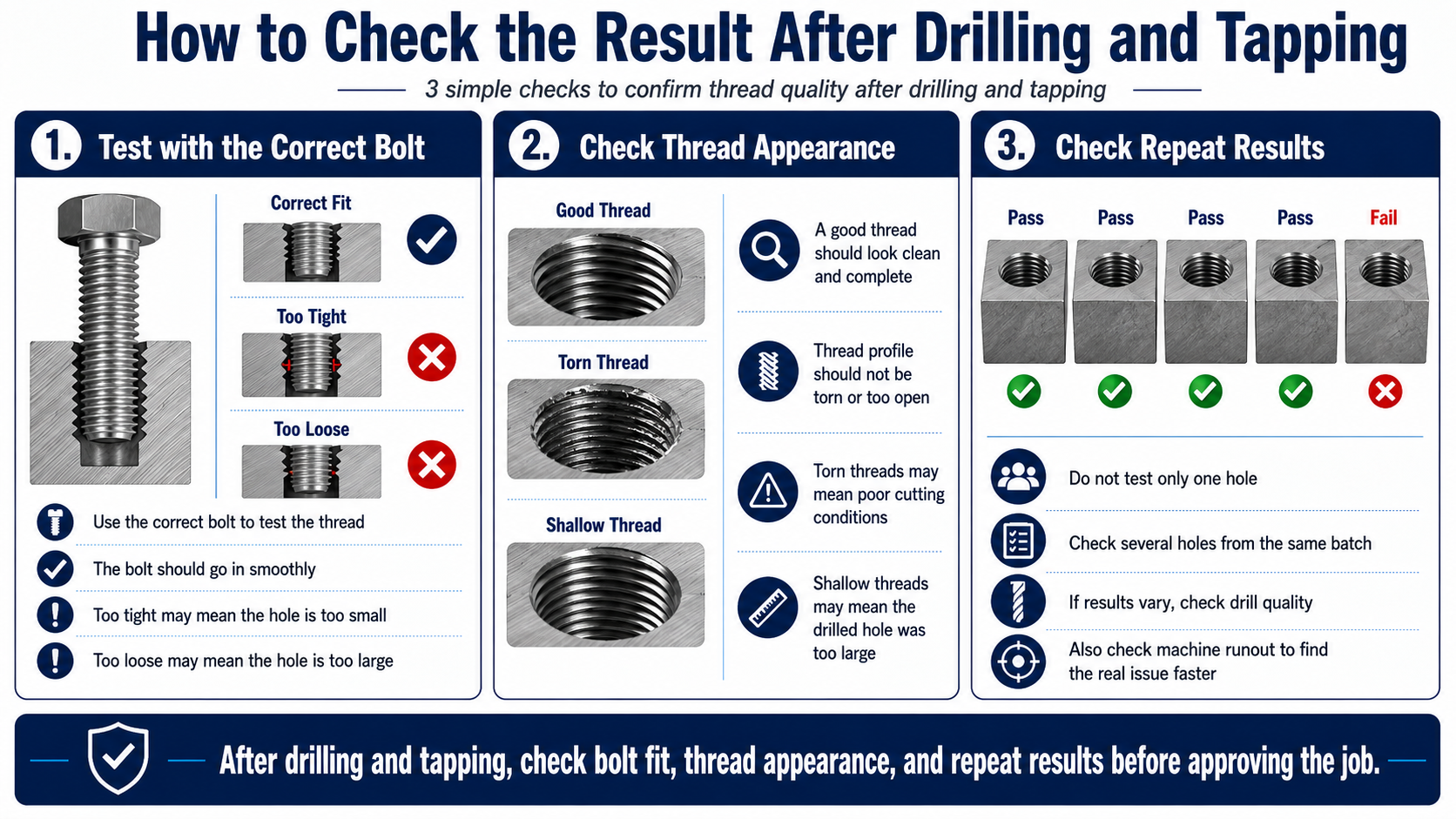
1. Test with the Correct Bolt
Once the thread is tapped, use the right bolt to check it. Too much slack should make it hard to go in. The hole might not be big enough if the bolt is too tight. The hole might be too big if it’s not tight.
2. Check Thread Appearance
A good thread should look whole and neat. The thread’s profile can’t be ripped or too open. Threads that are torn generally mean that the cutting conditions are bad. Thin threads could mean that the hole that was made was too big.
3. Check Repeat Results
It’s not enough to just test one hole. Some holes from the same group need to be checked. If the results are changing a lot, check the quality of the drill and the machine’s runout. This speeds up the process of finding the real issue.
XII. Buying Checklist for 5/16 Tap Drill Applications
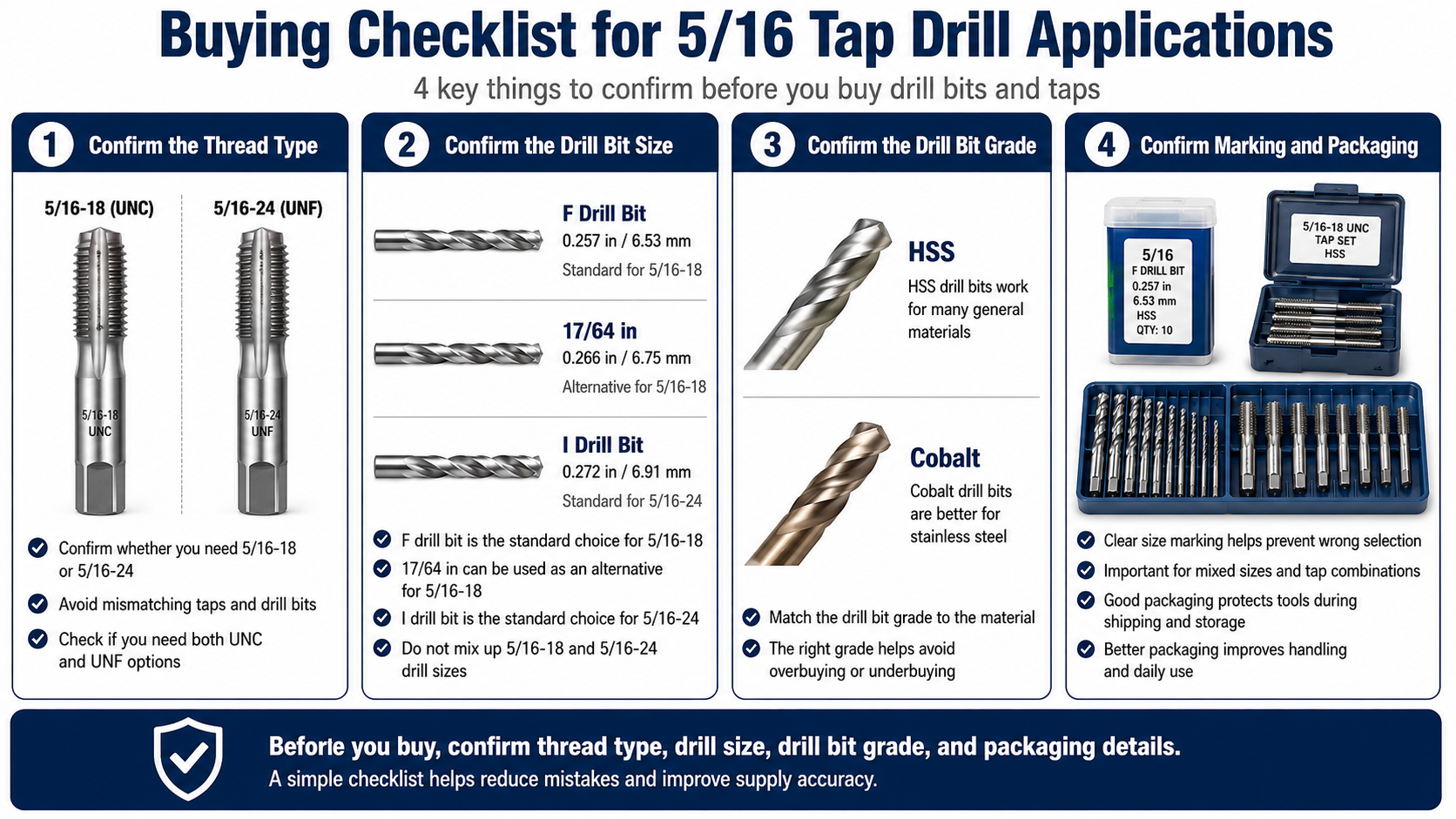
1. Confirm the Thread Type
Before you buy, please make sure you need 5/16-18 or 5/16-24. This keeps drill bits from being paired up wrong. Also, check to see if you need both UNC and UNF sizes. This gives you a bigger choice.
2. Confirm the Drill Bit Size
F drill bits are the most common type for 5/16-18. You could also use 17/64 inch instead. Get out my 5/16-inch to 24-inch drill bits. Don’t use the 5/16-18 drill bit by accident.
3. Confirm the Drill Bit Grade
Good HSS drill bits can be used on a wide range of materials. Cobalt drill bits work better on stainless steel. The grade needs to be right for the material and the market level. This makes sure you don’t buy too much or too little.
4. Confirm Marking and Packaging
Clear size labels to keep people from picking the wrong one. This is especially useful for taps of different sizes and combinations. When instruments are being shipped or stored, good packaging will keep them safe. The item is also simpler to use because of this.
XIII. Conclusion
The thread pitch tells you what size drill bit you need to drill a 5/16 tap. For 5/16-18 UNC, use a F drill bit. For 5/16-24 UNF, use an I drill bit.
If you want to buy a lot of drill bits, taps, or matched tap sets, please contact us to find out what sizes and packaging options are available. We can help you come up with reliable tool choices for your market.
XIV. Frequently Asked Questions
1. What is the closest metric drill bit for a 5/16-18 tap?
For a 5/16-18 tap, the F drill bit is about 6.53 mm long. You can look at 6.6 mm or 6.5 mm if you need a metric option. It depends on what you need to tap.
2. What is the closest metric drill bit for a 5/16-24 tap?
The I drill bit for 5/16-24 is around 6.91 mm. The closest practical size comparison would be a metric drill bit of 6.9 mm.
3. Is a 6.5 mm drill bit suitable for a 5/16-18 tap?
An F drill bit is about the same size as a 6.5mm drill bit. If thread strength is an issue, you should try with the material you plan to use first.
4. Is a 6.8 mm drill bit too large for a 5/16-18 tap?
F drill bits are rather large with a diameter of 6.8 mm. The thread may not bite as well but it may be easy to tap.
5. What is the difference between tap drill size and clearance drill size?
A tap drill size is used to drill the hole before tapping it. A bolt can pass through a clearance hole size that is greater without severing the threads.
6. Do you need a pilot hole before using a 5/16 tap?
You have to have the right tap hole before you use a 5/16 tap. If the beginning hole is not the proper size, the tap will not cut a good thread.
7. What thread percentage is common for 5/16 tapping?
In many ordinary tapping jobs, up to 65% to 75% of the thread is engaged. But stronger threads get more involved, and it takes more energy to tap them.
8. Should you choose a larger drill bit for easier tapping?
If you tap too hard, you can select a slightly larger hole. But don’t make the hole too big if the final thread needs to hold well.
9. Can you use a 5/16 tap in thin sheet metal?
A 5/16 tap will work in thin sheet metal, but the thread may not hold up too well. You may have to use inserts, nuts, or stronger material for better outcomes.
10. What drill bit material works best with 5/16 taps?
Most steel can be drilled with HSS drill bits. Cobalt or HSS-Co drill bits are more suitable for stainless steel and other hard materials.
11. Should you stock both 5/16-18 and 5/16-24 taps?
Yes, you should have both if your market does repair work, mechanical, automotive or building work. There are situations when UNC threads are better than UNF threads.
12. What is the best drill bit set to pair with 5/16 taps?
An excellent set should include F drill bits, I drill bits, and standard fractional sizes. This provides a way to service the needs of those who need to tap 5/16-18 and 5/16-24.
13. How can you reduce broken tap problems in bulk use?
You will require the proper size of drill, steady drill bits, cutting fluid, and tapping speed. The holes are not drilled properly, and that is generally why taps break.
14. Why does drill bit quality matter for 5/16 tap holes?
A poor drill bit might make holes that are too big, too rough, or not solid. This affects the quality of the threads, the smoothness of the tapping, and the repeatability of batch operations.
15. How do you test a 5/16 tap and drill bit combination before ordering?
You can try out the drill bit by tapping it on the actual board. Then take the force required to tap, the look of the thread, the fit of the bolt, and do it again.
16. What information should be printed on 5/16 tap drill packaging?
The package should be simple to understand the size of the tap, thread, drill bit, and material. Writing clearly helps you make the right choice at work every day.
17. What industries commonly use 5/16 taps?
5/16 inch taps are widely used to mend machinery, work on autos, produce metal objects, attach things during building, and for maintenance work. These sites need to be able to consistently match sizes.
18. Can a regular twist drill be used for a 5/16 tap hole?
If it is the proper size and make it is possible to use a standard twist drill. The best are drill bits that are sharp and have good, consistent width control.
19. How do you prevent oversized holes when drilling for 5/16 taps?
Use a steady drill bit. Reduce runout. Clamp the workpiece tightly. Check the condition of the machine. If the tool is shaky or not well controlled, the holes could be overly large.
20. What should you include in a 5/16 tap and drill set?
A helpful set might have a 5/16-18 tap, a 5/16-24 tap, a F drill bit, an I drill bit, and clear size directions. That makes it a simple choice.